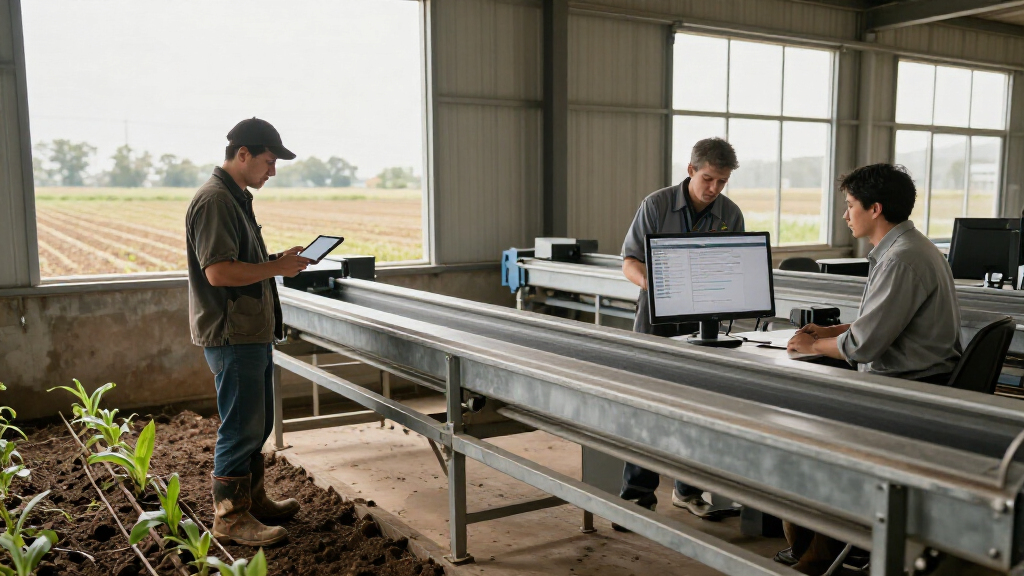

🔍 Read the full analysis: How The Field, Factory, And Office Shape The World Of Work on ThorstenMeyerAI.com

Get business pricing on office and shipping supplies
- Business-only prices and quantity discounts
- Tax-exempt purchasing
- Multiple users, one account, clear invoices
TL;DR
ThorstenMeyerAI.com launched “Work After Work,” a 60-episode series about how economies and work have changed. Its opening episode uses the primary, secondary and tertiary sectors to describe the shift from farming to manufacturing and services, while distinguishing historical estimates from the author’s speculation about automation.
ThorstenMeyerAI.com published the first episode of “Work After Work” on November 2, launching a planned 60-episode series on how employment has moved among farming, manufacturing and services. The installment uses historical and modelled employment estimates to argue that the long-term change in work is not simply a story of jobs disappearing, but of workers moving between sectors.
The episode organizes economic activity into three broad categories: the primary sector, which takes resources from nature; the secondary sector, which makes goods and builds infrastructure; and the tertiary sector, which provides services. Farming, manufacturing and teaching are familiar examples, though the boundaries can vary between statistical systems. Mining, for example, is classified differently in some accounts.
The article reports that, in historian Stanley Lebergott’s estimates, farming accounted for 73.7% of the U.S. labor force in 1800, 40.2% in 1900 and 12.0% in 1950. It cites the International Labour Organization’s modelled estimate that agriculture represented 1.5% of U.S. employment in 2025. These figures describe different historical periods and sources; the article presents them as measures of employment share, not a count of all work or output.
The episode also cites a shift in global employment: according to the ILO modelled estimates discussed by the author, services employed more people worldwide than farming from 2001. It says China’s primary-sector share of employment fell from 83.5% in 1952 to 22.2% in 2024, and Japan’s fell from 53.8% in 1920 to 3.2% in 2020, citing national census figures for Japan. The comparisons show how the sector mix has changed, but do not by themselves explain every cause or the quality of jobs created.
Where Workers Have Moved
The sector model matters because it gives readers a way to track where people earn their living as technology and economies change. A smaller agricultural workforce does not mean less food is produced; it can reflect changes in productivity and the movement of workers into other kinds of work. The same question is central to debates about automation: when machines change the amount or kind of labor needed in one activity, which jobs grow elsewhere?
The article’s historical framing also cautions against treating manufacturing decline as proof that a country has stopped producing goods. It says U.S. factory employment is about 35% below its June 1979 peak, while real manufacturing output in 2025 was about 1.9 times its 1979 level. Those measures have different units—employment and inflation-adjusted output—and together illustrate that output can rise even as factory headcounts fall. The figures are attributed to the source article and are historical comparisons, not a forecast.
For readers, the distinction is relevant to discussions of job displacement and economic change. Sector totals can show broad movement, but they cannot establish whether workers who leave one industry find comparable pay, security or conditions in another. The series sets up that wider question without resolving it in its opening episode.
Products Worth Considering

Canon PIXMA PRO-200S Wireless Professional Inkjet Photo Printer

LG UltraGear 34GX90SA-W 34-inch WQHD Curved OLED Gaming Monitor

FLEXISPOT 60 x 30-Inch Bamboo Electric Standing Desk with White Frame
As an affiliate, we earn on qualifying purchases.
The Three-Sector Model’s Origins
The article traces the model to economic writing in the first half of the 20th century. New Zealand economist Allan G. B. Fisher used the term “tertiary” in work written in 1934 and published in 1935, according to the source. Colin Clark compared employment patterns across countries in his 1940 book, while French economist Jean Fourastié argued in 1949 that services could take in workers displaced as industry became more productive.
The model’s three boxes are deliberately broad. The source uses bread as an example: growing wheat is primary work, processing it is secondary work, and transport, retail and accounting are services. A software engineer working for a manufacturer might be counted differently depending on the statistical rules. The categories therefore help describe long-run patterns, but they are not a precise map of every occupation.
The opening episode is the first part of a planned sequence about how the economy is built, how work has moved and which tasks may remain human as machines take on more. Its automation argument is framed by the author as a question the series will examine, rather than as a conclusion established by the historical figures.
“The three boxes are blunt.”
— Thorsten Meyer, author of the episode
What the Sector Figures Leave Out
The source article provides selected employment-share estimates, but its supplied material does not include the full underlying tables or methodological notes for every figure. The ILO numbers are modelled estimates, while other figures come from historical estimates or censuses, so definitions and coverage may not be identical across countries and time periods. In particular, the source does not establish a single comparable method for all the national examples.
It is also unclear how the author’s proposed automation sector would be defined or measured, or what supports the suggestion that it could do up to 90% of work without a human hand. Meyer labels the idea as a thesis and points to a later episode for scrutiny; it should not be read as a verified forecast. The opening installment does not specify which occupations, countries or time horizon would be included in that estimate.
The Series’ Next Questions
“Work After Work” is planned as a daily series of 60 episodes. According to the article, its later installments will examine how work moved between sectors and how machines are changing tasks. Episode 48 is identified as the point when the author’s claim about automation becoming a sector of its own will be put to trial.
The next useful test for readers will be whether later episodes support their claims with clear definitions, comparable data and evidence about what happens to workers—not only to output or employment shares. The source does not provide a release schedule beyond describing the series as daily, or details about the next episode’s subject.
Key Questions
What is “Work After Work”?
It is a planned 60-episode series published by ThorstenMeyerAI.com about how economies are built, how work has shifted and how automation may affect jobs. The first episode appeared on November 2, 2026.
What are the three economic sectors?
The primary sector takes resources from nature, the secondary sector makes goods and builds, and the tertiary sector provides services. Statistical definitions can differ, including over where mining belongs.
What does the episode say about U.S. farm employment?
It cites Stanley Lebergott’s estimate that farming accounted for 73.7% of the U.S. labor force in 1800 and 12.0% in 1950, alongside an ILO modelled estimate of 1.5% of U.S. employment in 2025. The figures come from different sources and periods.
Does the episode establish that automation will replace 90% of work?
No. Meyer labels the possibility that automation could do up to 90% of work as his thesis, not a fact. The article says a later episode will examine that claim.
When did services become the largest global employment sector?
According to the ILO modelled estimates cited in the episode, services employed more people worldwide than farming from 2001. The source’s claim concerns employment, not output or income.
Source: ThorstenMeyerAI.com