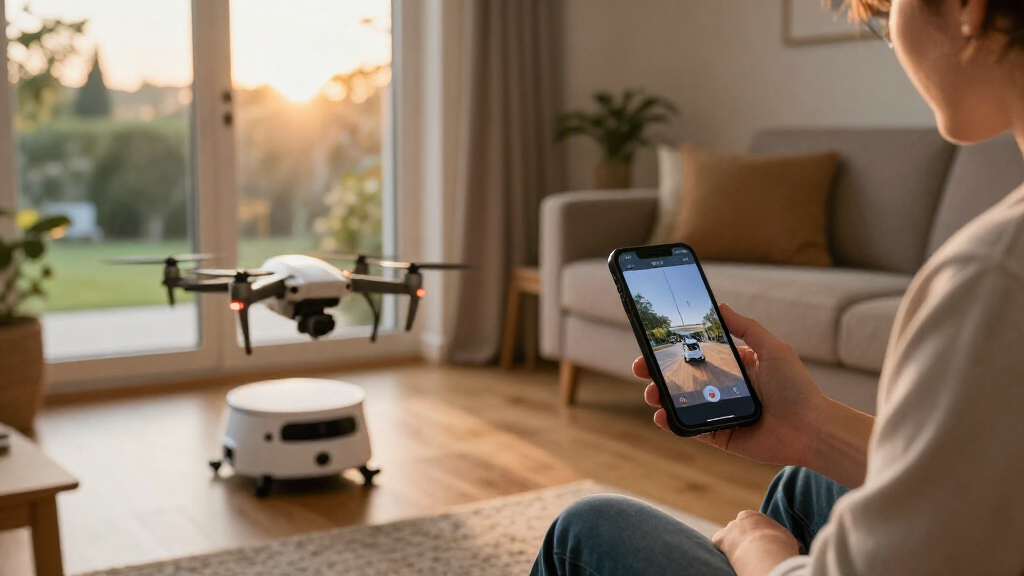

🔍 Read the full analysis: Ring’s Home Drone And Patrol Robot: How The Devices Work And Why Privacy Matters on ThorstenMeyerAI.com

Get business pricing on office and shipping supplies
- Business-only prices and quantity discounts
- Tax-exempt purchasing
- Multiple users, one account, clear invoices
TL;DR
Amazon’s Ring announced two mobile security cameras on Nov. 10, 2026: an indoor drone for homes and a wheeled patrol robot for businesses. The robot is listed at $999.99 and the drone at $249.99, but the drone has not received required FCC authorization, and Ring’s privacy claims have drawn scrutiny over cloud access and its past record.
Amazon’s Ring announced two mobile security cameras on Nov. 10, 2026: the Ring Drone Cam, which flies inside homes, and the Ring Rover Cam, a wheeled patrol robot for businesses. The devices are designed to move toward alerts from other Ring cameras, sensors or alarms, but the drone is not yet authorized by the FCC, and Ring’s privacy assurances face questions about cloud processing and the company’s earlier handling of customer video.
Ring says both products use a system called AI Pilot to map a space, suggest patrol points and avoid obstacles. The devices use cameras, vision models and sensors, with cloud processing, and can travel to investigate when another Ring device detects activity. Scheduled patrols require a compatible Ring Protect plan, according to the company.
The Rover Cam costs $999.99, with U.S. shipping listed to begin Dec. 16, 2026. Ring says it can patrol on a schedule, scan 360 degrees when it reaches a point, and stream and record up to 4K video while moving or patrolling. Its adjustable mast raises a periscope camera above counters or shelves; the device also has a siren, light tower and two-way audio. The Verge reported that it runs for about 30 minutes on battery, covers an estimated 5,000 square feet and operates on one floor.
The Drone Cam is listed at $249.99, with U.S. shipping scheduled for Jan. 27, 2027. Ring says it offers 2K video, a 148-degree field of view, 360-degree rotation and two lights. It can fly on scheduled routes or in response to an alert. Ring says its camera is off while docked. The company’s announcement also says the drone has not received authorization required under FCC rules and may not be sold until it does.
Ring’s mobile cameras move into view
Ring announced a home drone and a business patrol robot. Their mobility may help investigate alerts, while raising questions about recording, cloud access and privacy.
Two devices, different settings
Both are designed to move toward alerts from other Ring devices.
Drone Cam
Flies indoors on routes or in response to an alert. Ring says its camera is off while docked.
Rover Cam
A wheeled patrol robot that can scan and record while moving. Scheduled patrols require a compatible Ring Protect plan.
Release plans have conditions
Ring’s listed U.S. shipment dates are plans, and the drone has an additional approval hurdle.
What mobility changes
A moving camera can investigate beyond a fixed camera’s view, but can also record as it travels through shared spaces.
- Check activity beyond a camera’s usual view.
- Respond to alerts by traveling to investigate.
- Who can access footage, and how long is it retained?
- How do recording indicators work for workers, visitors and household members?
Cloud access remains a question
Ring says its TAKE encryption supports cloud features, with servers temporarily accessing keys; full end-to-end encryption is an optional setting.
Before buying
Key details for consumers and businesses are still pending.
- Drone sale depends on FCC authorization; no decision date is given.
- Scheduled patrols require a compatible Ring Protect plan; plan prices are not specified.
- Independent testing, final specifications and customer controls are not yet available in the supplied information.
Mobile Cameras Change Home Patrols
Unlike a fixed camera, a mobile device can move into areas where a person may not have installed surveillance equipment. That may help a user check an alert beyond the camera’s usual view, but it also means the device can record as it travels, including through spaces used by household members, workers or visitors. Rover’s stated ability to record while moving, and to begin recording after detecting motion even while docked, makes its operation and indicators relevant to people inside a business.
Ring says visible lights and status displays signal recording, while the drone is designed to be audible. Those measures do not settle questions about who can access footage, how cloud features handle it or how long recordings are retained. Consumers and businesses will also need to weigh the products’ prices, subscriptions and operational limits against the benefit of a camera that can respond to an alert.
Products Worth Considering

FlexiSpot E6 Electric Standing Desk, 55 × 28 in, Bamboo Top, White Frame

Apple iPad Air 11-inch (M4), 128GB, Wi-Fi 7, Space Gray

Apple MacBook Air 13.6-inch Laptop with M5 Chip, 16GB Memory, 512GB SSD, Midnight
As an affiliate, we earn on qualifying purchases.
Ring’s Earlier Mobile Camera Plans
The announcement builds on a project Ring has pursued for years. Ring previewed an indoor drone called the Always Home Cam in 2020; The Verge reported that founder Jamie Siminoff said development began in 2016. The new Drone Cam is the latest version of that idea, now presented as part of a broader product line called Ring Robotics.
Rover is aimed at shops and offices and draws on Amazon’s earlier Astro work, according to Ring. The Verge reported that Amazon launched Astro for Business in 2023 and discontinued it about a year later. That history is relevant to prospective business customers evaluating how long the new service and product line may be supported, though it does not establish what Ring will do with Rover.
Privacy scrutiny also predates this launch. In May 2023, the Federal Trade Commission charged Ring with allowing employees or contractors to access customers’ private videos and with failing to provide basic privacy and security protections. Those were allegations in the FTC’s complaint; the source material does not provide the outcome of the case.
“For years, customers told us they wanted eyes in the places a fixed camera couldn’t reach, and peace of mind in the spots they’d never want one.”
— Jamie Siminoff, Ring founder and chief inventor, in the company announcement
FCC Approval and Data Access
The most immediate unresolved issue is whether the Drone Cam will receive FCC authorization in time for its planned January shipment. Ring says it may not be sold before authorization, but the announcement does not give a decision date or explain what part of the rules remains unmet.
Ring says its TAKE encryption, announced in August 2026, is inspired by end-to-end encryption. Under the company’s description, its servers temporarily access keys to run cloud features such as smart alerts and then delete them; full end-to-end encryption, where only customer devices hold the keys, remains an optional setting. The source material does not specify which features on these two devices work with that optional setting, or give detailed retention and access rules for their recordings.
The FTC’s 2023 complaint and the EFF’s criticism inform the privacy debate, but neither establishes how these newly announced products will perform in practice. Independent testing, final product specifications and customer controls are not yet available in the supplied information.
Shipments Await Product Milestones
Ring lists Rover Cam shipments in the United States beginning Dec. 16, 2026, followed by Drone Cam shipments beginning Jan. 27, 2027. The drone date depends on the required FCC authorization, and Ring has not stated when that review will be completed. Prospective buyers can expect the final release details to clarify device performance, subscription requirements and privacy controls. Until then, the announced prices and dates are company-listed plans, not confirmation that both products will be available on schedule.
Key Questions
What are Ring’s new mobile security devices?
Ring announced the Drone Cam, an indoor flying camera for homes, and the Rover Cam, a wheeled patrol robot aimed at businesses. Both are designed to respond to alerts from other Ring devices.
How much do the devices cost, and when are they expected?
Ring lists Rover Cam at $999.99 with U.S. shipments scheduled from Dec. 16, 2026. Drone Cam is listed at $249.99, with U.S. shipments scheduled from Jan. 27, 2027, subject to required FCC authorization.
Can the Drone Cam be sold now?
Ring says the drone has not received authorization required under FCC rules and may not be sold until that approval is granted. The company has not provided a decision date in the supplied material.
What privacy protections does Ring say are included?
Ring says the drone’s camera is off while docked, Rover has a sleep mode that retracts its camera and turns off its microphone, and both devices show recording indicators. The company also says videos use TAKE encryption; its servers may temporarily access keys for cloud functions. Full end-to-end encryption is described as an optional setting.
Do scheduled patrols require a subscription?
Ring says scheduled patrols require a compatible Ring Protect plan. The supplied announcement does not specify plan prices or all the features available under each plan.
Source: ThorstenMeyerAI.com