
📊 Full opportunity report: Best Quiet Case Fans + the Airflow Setup That Actually Works on ThorstenMeyerAI.com — validation score, market gap, and execution plan.
TL;DR
This article identifies the best quiet case fans for 2026, emphasizing large, slow-moving fans for optimal silence and cooling. It also explains the airflow setup that ensures effective, quiet cooling for high-power AI workstations.
In 2026, the top quiet case fans for high-performance AI workstations are identified as the Noctua NF-A12x25 and NF-A14, known for their exceptional engineering and low noise levels, combined with an airflow setup that prioritizes larger fans running at lower RPMs to achieve both cooling and silence.
The Noctua NF-A12x25 and NF-A14 are widely regarded as the best-engineered fans for quiet operation, moving over 100 CFM at less than 1000 RPM, producing around 16 dB of noise. They feature refined bearings and motors that produce no mechanical noise, making them ideal for continuous operation in high-power AI workstations.
For budget-conscious builders, Arctic P12 Pro and P14 fans offer nearly comparable airflow and static pressure performance at a fraction of the cost, around $8.50 each, and operate quietly below 1000 RPM. The be quiet! Silent Wings 4 fans are designed for minimal noise, producing about 17 dB even at higher speeds, perfect for office environments or noise-sensitive setups.
Fans optimized for radiators, such as Arctic P12 Pro and Noctua NF-F12, are recommended for liquid cooling radiators and dense heatsinks, as they push air through restrictive fin stacks efficiently without generating excessive noise.
Best quiet case fans
+ the airflow that works.
The best fan won’t help if it’s pointed the wrong way. The whole recipe: big fans, running slowly, in a clean front-to-back path, with slightly more intake than exhaust. Build a config in Part 2 and watch the pressure balance respond.
Why Quiet Fans and Proper Airflow Matter in 2026
Choosing the right fans and airflow setup directly impacts the performance, longevity, and noise levels of high-power AI workstations. Large, slow-moving fans reduce noise significantly while maintaining effective cooling, which is crucial for continuous operation and user comfort. Proper airflow configuration ensures that heat is efficiently dissipated without creating turbulence or noise, enabling more stable and quieter systems for demanding workloads.
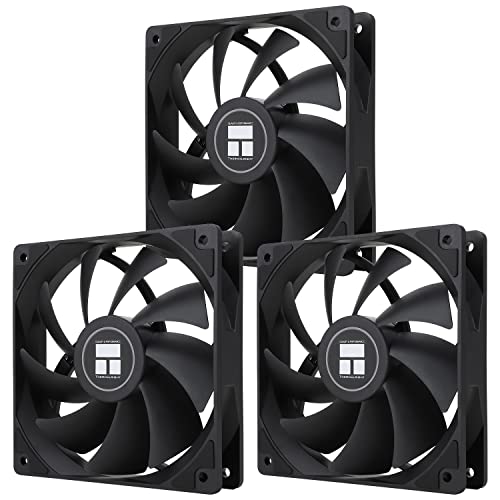
Thermalright TL-C12C X3 CPU Fan 120mm Case Cooler Fan, 4pin PWM Silent Computer Fan with S-FDB Bearing Included, up to 1550RPM Cooling Fan(3 Quantities)
【High Performance Cooling Fan】 Automatic speed control of the motherboard through the 4PIN PWM fan cable interface, which...
As an affiliate, we earn on qualifying purchases.
As an affiliate, we earn on qualifying purchases.
Current Trends in PC Cooling for High-Performance Workstations
In recent years, there has been a shift toward larger fans and lower RPMs to balance cooling efficiency with noise reduction. The emphasis on airflow design and fan selection has grown as AI workloads increase, requiring more effective thermal management. Brands like Noctua, Arctic, and be quiet! continue to lead with innovations that prioritize quiet operation without sacrificing cooling capacity.
Previous guides focused on high-RPM fans for maximum airflow, but 2026 developments favor larger fans that move air slowly, which significantly reduces noise. This approach aligns with the broader trend of silent, high-performance computing environments.
"Big and slow fans outperform small, fast ones in both noise and cooling efficiency, especially for continuous workloads like AI training."
— Thorsten Meyer, expert in PC cooling

CORSAIR 7000D Airflow Full-Tower ATX PC Case – High-Airflow Front Panel – Spacious Interior – Easy Cable Management – 3X 140mm AirGuide Fans with PWM Repeater Included – Black
Build your legacy with the 7000D AIRFLOW, a full-tower case for your most ambitious PC builds – offering...
As an affiliate, we earn on qualifying purchases.
As an affiliate, we earn on qualifying purchases.
Remaining Questions About Long-Term Reliability and Compatibility
While the recommended fans are highly rated, long-term durability in continuous operation environments and compatibility with all case sizes or custom setups remain to be fully confirmed. Additionally, the optimal fan curve settings for different workloads are still under testing, and user experiences may vary based on specific hardware configurations.

DARKROCK 3-Pack 120mm Black Computer Case Fans High Performance Cooling Low Noise 3-Pin 1200 RPM Hydraulic Bearing Quiet Long life Up to 30,000 hours 5 Years After-sales Service
High Performance Cooling Fan: The design of nine fan blades, the maximum speed reaches 1200 RPM, and it...
As an affiliate, we earn on qualifying purchases.
As an affiliate, we earn on qualifying purchases.
Next Steps for Building a Quiet, High-Performance AI Workstation
Manufacturers are expected to release updated fan models with improved bearings and noise profiles. Builders should focus on implementing large, low-RPM fans with proper airflow paths, and testing different fan curves to optimize noise and cooling. Future developments may include smarter fan control systems that adapt dynamically to workload demands.

DIYhz Water Cooling Computer Radiator, 12 Pipe Aluminum Heat Exchanger Liquid Cooling Radiator Heat Sink 120mm for CPU PC Laser Water Cool System DC12V Black with Tube
★ Product Name: Water Cooling Radiator; Outer Size: 155 x 120 x 27mm / 6.10'' x 4.72'' x...
As an affiliate, we earn on qualifying purchases.
As an affiliate, we earn on qualifying purchases.
Key Questions
Are larger fans always quieter?
Generally, yes. Larger fans can move the same amount of air at lower RPMs, producing less noise compared to smaller fans running faster.
Can I use these fans in any case?
Most of these fans are compatible with standard case sizes (120mm and 140mm), but it's important to check your case's specifications for fan mounting options.
What is the best fan setup for a silent AI workstation?
Use large fans (140mm) on intake and exhaust, running at low RPMs, with static-pressure fans on radiators or dense heatsinks, all configured with a gentle fan curve to prioritize silence.
How do I tune my fan curve for optimal silence?
Start with a flat, low RPM fan curve and gradually increase the speed at higher temperatures, ensuring fans run as slowly as possible while maintaining adequate cooling.
Source: ThorstenMeyerAI.com