
📊 Full opportunity report: IdeaNavigator AI: One Evidence-Mined Idea a Day on ThorstenMeyerAI.com — validation score, market gap, and execution plan.

Get business pricing on office and shipping supplies
- Business-only prices and quantity discounts
- Tax-exempt purchasing
- Multiple users, one account, clear invoices
TL;DR
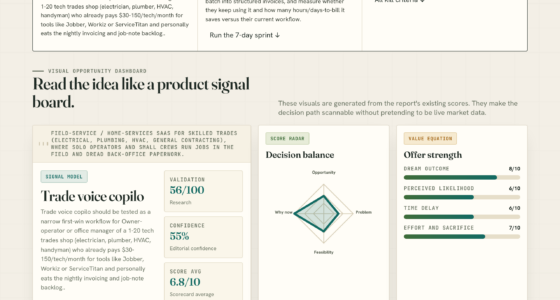
IdeaNavigator AI automatically generates and scores one evidence-backed software idea daily by mining online complaints. It aims to improve idea validation and reduce costly failures in product development.
IdeaNavigator AI has begun publicly releasing one evidence-mined software idea each day, generated and scored automatically from online complaints, aiming to reduce the risk of building unwanted products.
The system, built by the startup behind IdeaClyst, mines complaints from sources like app reviews, Hacker News, GitHub issues, and Stack Overflow to identify genuine user frustrations. It then converts these into fully scoped software ideas, which are scored 0–100 based on supporting evidence. The system runs entirely on a single Mac mini, executing the entire process—idea generation, evidence mining, scoring, and syndication—automatically. The output is one idea per day, with the pipeline actually producing two, but shipping only the more conservative suggestion publicly. The scoring verdicts include ‘Build,’ ‘Validate,’ ‘Research,’ or ‘Rethink,’ with the majority of ideas being rejected or marked for further validation, thereby aiming to prevent costly development of unproven concepts. This approach emphasizes evidence-based decision-making over intuition or market speculation, potentially transforming how startups and developers validate ideas before investing resources.IdeaNavigator AI — one evidence-mined idea a day
Idea generation is cheap; validation is the bottleneck. Mine real complaints, scope an idea, score it 0–100 — and let the verdict tell you when not to build.
Verdict: Validate. Promising — but a high score is a prior, not a proof. The point of the gauge is the verdicts that say not yet.
Independent commentary, produced with AI assistance under human editorial oversight. The views are the author’s own and may change. IdeaNavigator AI generates, mines and scores ideas via automated pipelines; scores and verdicts are programmatic priors that may contain errors or bias and are not validated demand — verify independently before building. As an Amazon Associate the author earns from qualifying purchases; pages may contain affiliate links. Product and company names are trademarks of their respective owners; mention does not imply endorsement.
Impact on Software Development and Idea Validation
This innovation addresses a core challenge in software creation: building the right product. By focusing on real, demonstrated demand signals rather than assumptions, IdeaNavigator AI could significantly lower the failure rate of new products. It shifts the cost structure of idea validation from expensive, slow manual research to automated, continuous evidence gathering. For entrepreneurs and teams, this means fewer wasted months on unvalidated ideas and a more disciplined approach to product development. If successful at scale, it could redefine early-stage validation processes, making evidence-based decision-making the norm and reducing the startup graveyard of ideas that felt promising but lacked real demand.
As an affiliate, we earn on qualifying purchases.
Background on Idea Validation Challenges
Traditionally, idea generation in software development is inexpensive, but validation is costly and time-consuming. Many startups and developers build products based on hunches, leading to high failure rates. The concept of mining online complaints and feedback as a demand signal has gained traction, but automating this process into an evidence-based scoring system remains novel. The startup behind IdeaNavigator has previously operated a private validation workspace called IdeaClyst, which informed this public initiative. The system's autonomous operation on a Mac mini is a notable departure from traditional manual validation methods, emphasizing low-cost, continuous evidence gathering.
"Our system turns the noisy, scattered complaints across the internet into a disciplined pipeline of validated ideas, reducing the risk of building the wrong thing."
— Thorsten Meyer, founder of the startup
As an affiliate, we earn on qualifying purchases.
Uncertainties About System Effectiveness and Adoption
It is not yet clear how accurately the scoring system predicts successful product-market fit or how many ideas will ultimately be built from the daily suggestions. The long-term impact and adoption by startups or larger companies remain to be seen, and there is limited data on the system's real-world success rate at this stage.
As an affiliate, we earn on qualifying purchases.
Next Steps for Development and Validation
The startup plans to monitor the performance of the ideas generated and scored by the system, gather user feedback, and refine the algorithms. They will likely publish case studies or success stories if any ideas lead to actual products. Scaling the system, integrating with other development tools, and demonstrating tangible outcomes will be critical milestones.
As an affiliate, we earn on qualifying purchases.
Key Questions
How does IdeaNavigator AI identify valid complaints?
It mines publicly available sources like app reviews, Hacker News discussions, GitHub issues, and Stack Overflow questions to find genuine user frustrations that indicate unmet needs.
Can this system guarantee successful product ideas?
No, the system provides evidence-based scores and verdicts to guide validation efforts but does not guarantee market success or product viability.
Will this replace traditional idea validation methods?
It aims to complement and automate parts of the validation process, reducing costs and increasing speed, but human judgment and market testing remain essential.
What types of complaints does the system focus on?
The system focuses on detailed complaints and requests from online communities where users express frustrations with existing tools or products, indicating potential opportunities.
How often will new ideas be generated and shared?
The system produces two ideas daily, but only publishes one, maintaining a steady cadence to balance quality and volume.
Source: ThorstenMeyerAI.com
Fall Picks
fall essentials
As an affiliate, we earn on qualifying purchases.