📊 Full opportunity report: Vertigo relief app on IdeaNavigator AI — validation score, market gap, and execution plan.
TL;DR
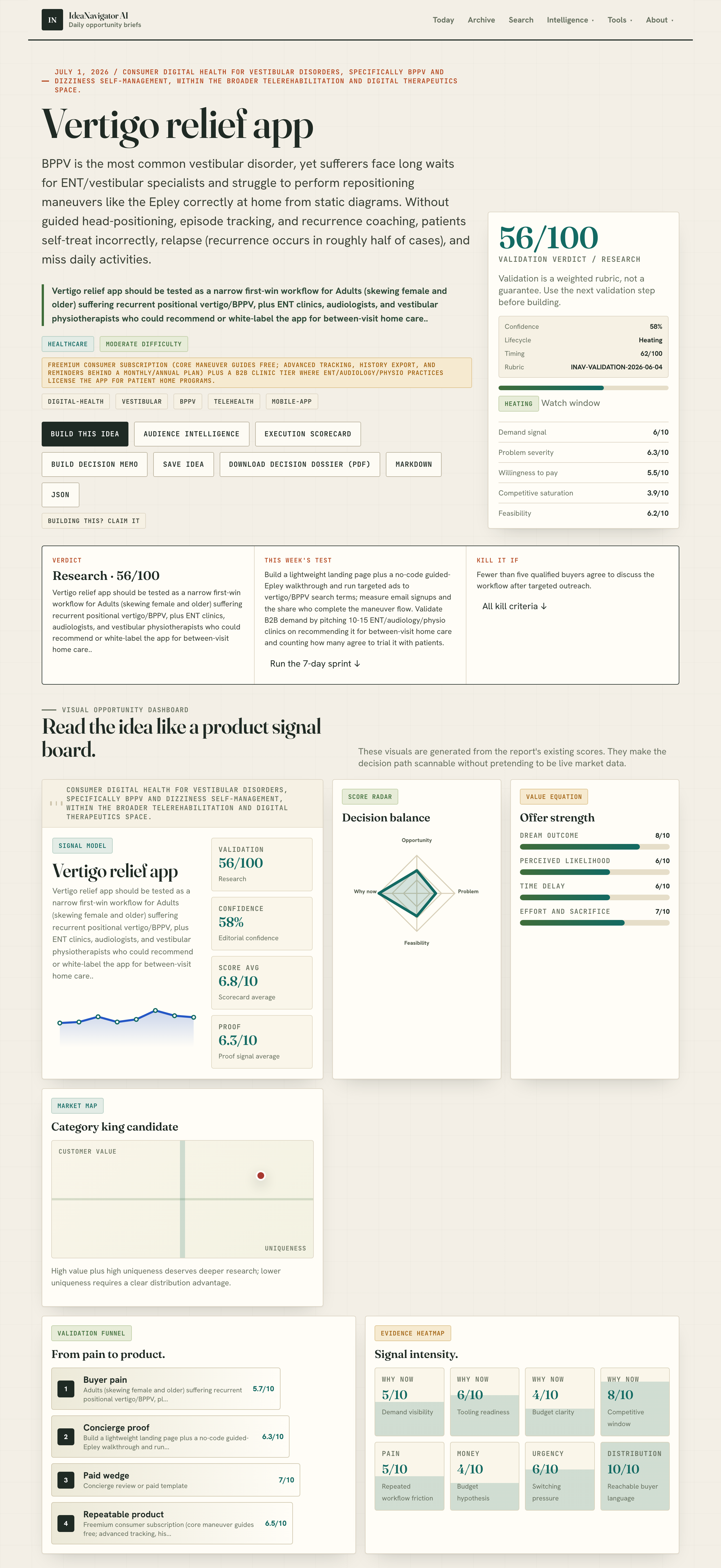
A new vertigo relief app is being developed to assist adults with BPPV in self-managing their condition through guided maneuvers and episode tracking. The app aims to fill a gap in home care and could be adopted by clinics for patient support. Validation and market interest are underway.
A new vertigo relief app is being developed to assist adults suffering from benign paroxysmal positional vertigo (BPPV) in performing repositioning maneuvers at home. The app aims to address the common challenge of correctly executing maneuvers like the Epley, which patients often struggle with, leading to recurrent episodes. You can learn more about the unbundling of the budget app and how innovative apps are transforming home care. This development is significant because it could improve self-management, reduce relapse rates, and support clinical care, especially as telehealth becomes more prevalent.
The app is designed for adults, skewing toward older women, who experience recurrent vertigo episodes caused by BPPV, the most common vestibular disorder. It will feature guided step-by-step instructions for maneuvers such as the Epley and Brandt-Daroff, enhanced with animated visuals, audio cues, and gyroscope-based head-angle feedback using smartphone sensors. Additionally, users will be able to log dizziness episodes, triggers, and severity, creating a symptom history over time.
Developers plan to offer a freemium model: basic maneuver guidance will be free, while advanced features like detailed symptom tracking, history export, and reminders will be subscription-based. The app could also be licensed by ENT clinics, audiologists, and vestibular physiotherapists to recommend to patients for between-visit care. Validation efforts include testing a no-code guided Epley walkthrough via targeted ads and measuring user engagement and completion rates, alongside pitching clinics to adopt the app for patient use.
Potential Impact on Vertigo Self-Management and Clinical Care
This app could significantly improve how patients manage recurrent vertigo at home, reducing reliance on long wait times for specialist care and decreasing misapplication of repositioning maneuvers. By providing guided, real-time feedback, it may lower relapse rates and improve quality of life for sufferers. For clinics, integrating such a tool could streamline patient support and expand telehealth offerings, aligning with the broader shift toward digital therapeutics and remote rehabilitation.
Epley maneuver guide app
As an affiliate, we earn on qualifying purchases.
As an affiliate, we earn on qualifying purchases.
Growing Market and Telehealth Shift Accelerate Development
The development of this vertigo app comes amid increased adoption of telehealth and digital health tools, accelerated by the COVID-19 pandemic. The digital vestibular rehabilitation market was valued at approximately USD 498 million in 2024 and is projected to grow at a compound annual growth rate of about 13.5% through 2033, reflecting rising acceptance among healthcare providers and payers. Current challenges include patients’ difficulty performing maneuvers correctly at home and limited access to vestibular specialists, creating a demand for effective self-management solutions.
Previous efforts have focused on static diagrams and basic instructions, but the integration of smartphone sensors offers real-time, personalized guidance. The app’s success will depend on validation of its usability and clinical effectiveness, as well as adoption by healthcare providers.
“This app could fill a critical gap in home care for BPPV, especially if it proves effective in guiding patients through maneuvers safely and accurately.”
— an anonymous researcher

Halo Rejuvenator® Cervical Rehabilitation Device, 1 lb, Neck Muscle Strengthening and Mobility, Improves Upper Body Posture via Sensorimotor Training
BALANCED DESIGN: One pound proportionally balanced exercise tool for cervical muscle strengthening and increased neck mobility. Excellent for…
As an affiliate, we earn on qualifying purchases.
As an affiliate, we earn on qualifying purchases.
Uncertainties Around Clinical Validation and Adoption
It is not yet clear how effectively the app will perform in real-world settings or whether patients will reliably use it correctly without direct supervision. The clinical validation process is still in early stages, and acceptance by ENT clinics and physiotherapists remains to be tested through pilot programs. Additionally, regulatory considerations and reimbursement pathways for digital therapeutics are still evolving, which could impact adoption.

Dizziness and Vertigo Tracker: A Symptom Log Book for Recording Dizzy Spells, Vertigo Episodes, Triggers, Medication, Balance Issues and Daily Notes
As an affiliate, we earn on qualifying purchases.
As an affiliate, we earn on qualifying purchases.
Next Steps Include Pilot Testing and Clinic Trials
Developers plan to launch a lightweight landing page and run targeted ads to gauge interest and collect user feedback on maneuver guidance. Parallel efforts include pitching ENT and physiotherapy clinics to trial the app with patients, measuring engagement, and assessing clinical outcomes. Further validation studies will determine the app’s safety, accuracy, and efficacy before broader rollout and potential regulatory approval.

DizzyFIX Vertigo Relief Trainer for Benign Paroxysmal Positional Vertigo or BPPV, Inner Ear Balance Device for Particle Repositioning Maneuver, Non-Drug Solution & Relieves Dizziness
REGAIN INNER EAR BALANCE: The DizzyFIX Vertigo Relief Trainer is a revolutionary device that can help people suffering…
As an affiliate, we earn on qualifying purchases.
As an affiliate, we earn on qualifying purchases.
Key Questions
How does the app guide users through vertigo maneuvers?
The app provides animated step-by-step instructions, audio cues, and uses the smartphone’s gyroscope to give real-time feedback on head positioning, ensuring correct execution of maneuvers like the Epley.
Is this app a substitute for medical treatment?
No. The app includes a prominent disclaimer emphasizing it is not a substitute for professional medical advice. Users are advised to consult a healthcare provider if symptoms worsen or red-flag signs appear.
Will healthcare providers recommend this app?
That depends on the results of validation and pilot programs. Developers are actively pitching clinics to adopt the tool as part of between-visit care, aiming for integration into standard vestibular rehabilitation protocols.
When will the app be available to the public?
The app is currently in development with initial testing underway. A broader release is expected after validation studies and regulatory review, which could take several months to a year.
How will the app handle patient data and privacy?
The app will comply with relevant data privacy regulations, including secure data storage and user consent, especially for symptom logging and history export features.
Source: IdeaNavigator AI