TL;DR

Get office and shipping supplies delivered free — and shop member deals
- Fast, free delivery on millions of items
- Access to Prime Big Deal Days deals on October 6–7
- Prime Video, Amazon Music and more included
Halloween themed promotional products are branded giveaways, retail items, or event favors built around spooky-season designs. Choose them by audience and setting: sealed treats and stickers suit high-volume events, while reusable bags, drinkware, and apparel can stay in use longer. Check safety, artwork, delivery timing, and any QR-code link before ordering.
A logo on a Halloween tote can outlast a bowl of candy by months. That is the small trick behind a good seasonal giveaway: it should feel fun in the moment and useful once the last pumpkin comes down.
Halloween themed promotional products include branded treats, bags, glow items, apparel, drinkware, and other event favors designed with seasonal colors or motifs. They can help your business welcome customers, celebrate employees, or add a memorable touch to a community event—but the right choice depends on who will receive it and where.
This guide gives you a practical way to choose products, make them feel like your brand rather than generic party stock, and avoid common planning snags. You’ll find ideas for children, adults, and workplace events, plus a simple ordering checklist for safety, artwork, QR codes, and timing. These are marketing-planning suggestions, not financial, tax, or legal advice; check applicable venue rules and product requirements for your situation.
Choose Halloween giveaways for the audience and distribution setting: stickers and sealed treats suit many high-volume events, while mugs, totes, and apparel m…
Make seasonal artwork support your brand with readable logos, a consistent palette, and proofs checked at actual product size.
For children’s events, review age guidance, small-part hazards, food ingredients, allergens, and applicable venue policies.
Use reusable items when recipients are likely to keep and use them; do not rely on a sustainability claim the product details cannot support.
Confirm supplier lead times, shipping dates, QR-code links, and a distribution plan before the October rush.
What Halloween promotional products can do beyond decorate a table
Halloween promotional products are branded giveaways, merchandise, or event items designed around spooky-season colors and motifs. They give you a tangible way to connect a campaign with the costumes, parties, school activities, and neighborhood gatherings that make Halloween a participatory season.
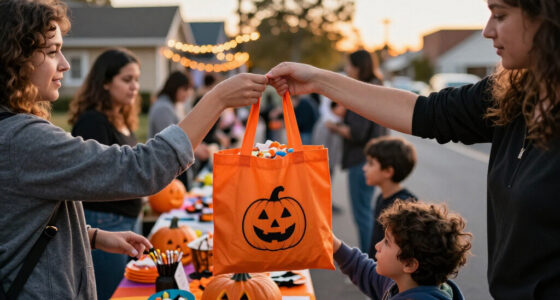
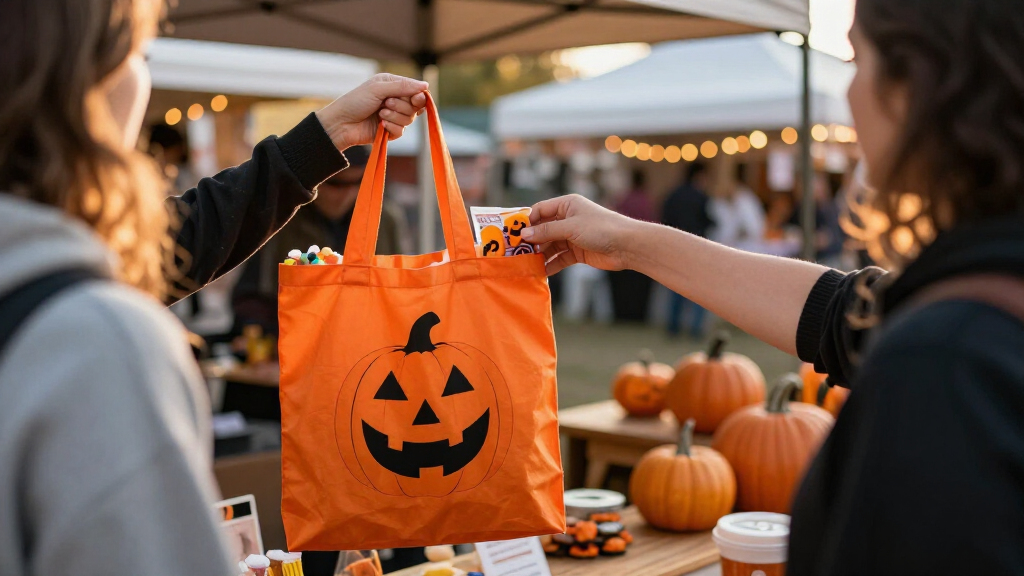
Think of a giveaway as a tiny stage for your brand. A bright orange treat bag can carry a family-friendly message home from a community fair; a mug with a discreet bat illustration can make an employee’s morning coffee feel seasonal without turning the office into a haunted house. The design creates the first impression, but the item’s usefulness affects whether people keep it. That matters because a product people use again can renew the brand impression naturally, while an item with no practical role may be noticed once and quickly discarded.
Common choices range from candy, stickers, and treat bags to glow items, apparel, reusable totes, and drinkware. A simple sticker may suit a busy event where hundreds of people pass your booth: it is inexpensive, compact, and quick to distribute, though it may have limited staying power. A reusable cup may make more sense for a smaller customer appreciation gathering, where the higher cost per item can be balanced by a more personal interaction and repeated use. Match the item to the moment, rather than choosing a product just because it looks spooky.
For example, a neighborhood business hosting a family event might pair sealed treats with branded bags, while a café could offer a limited-edition cup linked to a seasonal menu. A useful product gives people a reason to remember the interaction; it does not guarantee a sale or make every giveaway worthwhile. Think of it as a friendly hello, not a magic marketing spell.
Halloween themed promotional tote bags
As an affiliate, we earn on qualifying purchases.
As an affiliate, we earn on qualifying purchases.
Pick a giveaway that fits your audience and event
The strongest Halloween giveaway is the one that fits the people receiving it, the place they’ll use it, and the job you want it to do. A school event, office party, and retail promotion may all need different products, even when they share the same pumpkin-orange palette. Making the choice this way helps prevent two common mismatches: a product that is awkward for staff to distribute and one that recipients do not want to carry home.
For a children’s event, choose items that are age-appropriate and easy to hand out, such as stickers, pencils, or sealed treats. Check food ingredients and allergen details, and look at age guidance and small-part hazards for non-food items. At a workplace celebration, socks, mugs, snack packs, and desk accessories can feel more fitting than a bag of plastic toys. The difference is not just taste: workplace items need to fit adult routines, while children’s giveaways may need extra attention to handling, safety, and supervision.
A useful way to compare options is to ask whether each one suits the audience, whether it is simple to distribute, and whether it will get used. A treat bag can be a strong choice for trick-or-treaters; a tote may be more practical at a shopping event where visitors already need somewhere to put brochures or purchases. Neither is automatically better—the setting decides. Also consider what each option asks of your event team: lightweight items are easy to store and hand out, while bulky or fragile products can require more space and careful handling.
| Audience or setting | Products to consider | Check before ordering |
|---|---|---|
| Children and families | Stickers, pencils, sealed treats, age-suitable glow items | Allergens, age guidance, small parts, venue rules |
| Employees | Mugs, socks, reusable cups, snack packs | Useful fit, food details, delivery to the workplace |
| Customers or event visitors | Totes, drinkware, themed apparel, QR-linked packaging | Imprint area, artwork readability, mobile link testing |
Imagine a busy market booth with a line forming. A small sticker is quick to hand over, while a bulky gift needs more storage and slows the queue. The product should make the event smoother, not turn the giveaway table into a bottleneck.
As an affiliate, we earn on qualifying purchases.
Make your Halloween design feel like your brand
A branded Halloween giveaway feels distinctive when its seasonal artwork supports your identity instead of burying it under generic ghosts and pumpkins. Keep a recognizable logo, campaign message, or color palette in the design, then use Halloween details to add character. This balance matters because the seasonal theme gets attention, but recognizable branding helps recipients connect the item with your business after the event.
Start with the real printing area. A detailed illustration that looks crisp on a computer screen may become a muddy smudge on a small sticker or fabric tag. Ask for a proof at actual size, check that the logo can be read quickly, and avoid squeezing a long slogan beside a tiny QR code. Simple shapes often survive small print better than elaborate scenes. There is a practical tradeoff here: more detail can make a design feel custom, but too much detail can reduce legibility and make the finished item look cluttered.
Personalization can go beyond a logo: custom colors, limited-edition artwork, names, or themed packaging can make an item feel connected to a particular event. For instance, a bookstore could use a consistent deep-purple and orange palette across a treat bag and event sign, then add a short message inviting visitors to a seasonal reading night. The products feel linked without repeating the same oversized logo everywhere.
A QR code can connect packaging or a hangtag to a contest, menu, event page, or seasonal offer. Put it where someone can scan it without wrestling with the product, and test it on the finished proof with more than one phone. A code that opens a slow or expired page turns a clever detail into a dead end. Keep the destination live throughout the campaign and make the next step clear, such as “See the event menu.” A code also takes up printable space, so use it only when the linked content is worth the space and the recipient can understand why to scan.
Good branding leaves room for fun. If a person can spot your brand and understand the seasonal idea at a glance, the design is doing its job.
Halloween sticker packs for giveaways
As an affiliate, we earn on qualifying purchases.
As an affiliate, we earn on qualifying purchases.
Use reusable items when people will genuinely keep them
Reusable Halloween products make sense when recipients are likely to use them again; a reusable label alone does not make an item a low-waste choice. Totes, cups, and decorations can last beyond one event, but only if the material, construction, and design suit real use. The distinction matters because a product’s potential lifespan is not the same as its actual lifespan: if it is inconvenient or unwanted, it can become clutter just as quickly as a single-use item.
Consider the difference between a sturdy tote and a thin bag that tears on the walk home. The first may become a grocery or library bag; the second may be discarded immediately. A durable cup with a design people like can return to a desk, while an awkward novelty item might sit in a drawer. The best measure is not how long the product could last, but whether its recipient has a reason to keep it. Familiar sizes, comfortable handles, and easy-to-clean surfaces can make reuse more likely than novelty alone.
For a neighborhood event, a reusable bag could hold event information, a sealed treat, and a map of nearby activities. At an employee gathering, a cup in a familiar size may work better than a decorative item with no clear purpose. Keep packaging modest where practical, and describe materials accurately. Avoid promising environmental benefits you cannot support with product details.
There is a tradeoff: reusable products often cost more per item and may need more storage or planning than stickers or candy. That can still make sense for a smaller group or a customer gift, while low-cost items suit high-volume distribution. Consider the full fit, not only the unit price: a more expensive item can be poor value if few people want it, while a simple sticker can be a sensible choice when fast, broad distribution is the goal. As an example, a shop expecting many walk-in visitors might put out stickers for everyone and reserve a limited number of quality totes for a specific campaign. The choice follows the audience and budget, not a blanket rule that every giveaway should be reusable.
custom Halloween apparel for events
As an affiliate, we earn on qualifying purchases.
As an affiliate, we earn on qualifying purchases.
Order early and check the details before October
Order custom Halloween products early enough to approve proofs, allow production and shipping, and leave a buffer for delays. Lead times vary by supplier and item, so ask for a schedule rather than assuming every product will arrive on the same timeline. Ordering early is not just about avoiding a late box: it gives you time to correct artwork, choose a substitute if an item is unavailable, or adjust quantities before the event makes those choices difficult.
Work through the details in order. First, confirm the event date, quantity, and delivery location. Then check product specifications, minimum quantities, customization options, and the printable area. Review the artwork at its actual size, approve a proof, and get the expected ship and arrival dates in writing. A box of perfect treat bags arriving two days after the event is still a miss.
- Set the use case: Write down who receives the product, where distribution happens, and what you want the giveaway to support.
- Check product suitability: Review age guidance, small parts, food ingredients, allergens, and relevant venue policies.
- Approve the design carefully: Confirm logo legibility, colors, spelling, imprint placement, and any QR-code destination.
- Confirm the delivery plan: Check quantity, packaging, shipping date, arrival buffer, and who will store and distribute the items.
Suppose your community fair is in late October and you want customized bags. Ask the supplier when artwork must be approved and when the finished order should arrive; then allow time for a late shipment or a correction. For food items, verify ingredient and allergen information, and follow the rules that apply to your event. For glow products, check age guidance and battery or component information before placing an order. These checks can narrow the choices, but doing them before purchase is easier than discovering a mismatch after products arrive.
Make your giveaway useful after the event ends
A Halloween giveaway earns a longer life when it connects the event to a clear next step, such as a return visit, a staff celebration, or a useful seasonal resource. The product is the handoff; the experience around it gives people a reason to remember your brand. A useful next step should feel like part of the interaction rather than a demand for attention, so keep it relevant to why someone accepted the item.
For example, a café could attach a small card to a seasonal cup with a QR code leading to its autumn menu. A community organization might put event details and a simple schedule on a tote tag so families can keep the information while moving between activities. Keep the call to action brief and relevant: a crowded tag with several offers can feel like a tiny billboard rather than a gift.
Plan the distribution, too. Place smaller items where staff can reach them quickly, and explain who should receive premium gifts so volunteers do not have to make decisions in a rush. If you have 300 stickers and 40 totes, give the team a clear plan for both. This small bit of organization prevents popular items from disappearing before the intended audience arrives. It also makes it easier to see whether demand matched your expectations rather than confusing a distribution problem with an unpopular product.
After the event, look at what people actually took and used, what ran out, and whether the QR page received visits. Those observations can guide next year’s order, but they are not proof that an item caused a purchase. A simple note—“totes ran out early; cups were left on the table”—can be more useful than guessing from memory. Treat each campaign as a chance to learn what fits your audience better next time.
Frequently Asked Questions
What are the most popular Halloween promotional products?
Candy, treat bags, stickers, glow items, themed apparel, reusable totes, drinkware, and small party favors are common choices. Pick according to the audience and setting: a sticker suits fast, high-volume handouts, while drinkware may work better for a smaller workplace event.
What Halloween giveaways work well for children?
Age-suitable stickers, pencils, reflective or glow items, and sealed treats are popular options. Before distributing them, check age guidance, choking hazards, food ingredients, allergens, and any school or venue rules.
When should a business order custom Halloween products?
Order early enough to approve artwork, allow for production and shipping, and leave a buffer before the event. Exact lead times vary by product and supplier, so ask for a schedule tied to your delivery date instead of relying on a general estimate.
How can a company make Halloween merchandise feel branded rather than generic?
Use a consistent color palette, a short campaign message, and seasonal artwork that leaves the logo readable. Check a proof at the product’s actual size; a design that works on a screen may lose detail on a small tag or sticker.
Can Halloween promotional products include a QR code?
Yes. A package, tag, or larger product surface can carry a QR code linking to a menu, promotion, event page, or seasonal content. Test it on the finished design with a phone and keep the mobile destination working for the whole campaign.
Conclusion
The best Halloween giveaway is not the scariest, flashiest, or most expensive one. It is the item that fits your audience, carries your brand clearly, and earns a place in someone’s hands after the event is over.
Pick one practical product, check the details before you order, and give the design enough room to be playful. A good seasonal keepsake should feel less like another piece of promo stock and more like a little orange spark of the event.
Halloween Picks
halloween
As an affiliate, we earn on qualifying purchases.