
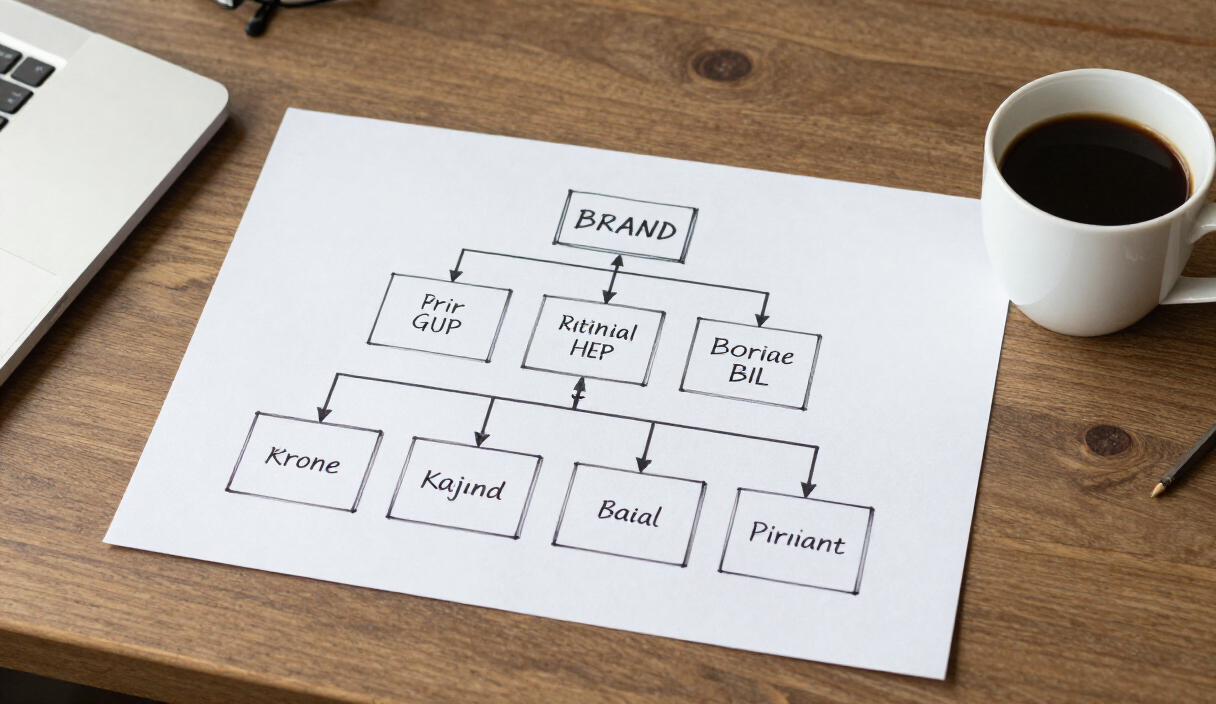
Building in public is often treated as a communications strategy: share progress, post screenshots, publish launch notes and invite an audience behind the scenes. That can be useful, but it misses the more demanding version of the practice. For founders and operators, building in public can be a decision discipline. It forces a company to show not only what it is making, but also how it is narrowing its scope, structuring its brand and distinguishing current reality from future plans.

Get business pricing on office and shipping supplies
- Business-only prices and quantity discounts
- Tax-exempt purchasing
- Multiple users, one account, clear invoices
Business & Gründer · Gewerkton case study
Build in public.
Decide in public.
The founder discipline is not publishing more activity. It is making scope, status and rejection visible while the company is still taking shape.
Brand architecture
1 × 3
One brand, three product lines
A branded house divides responsibilities without asking the market to learn three separate corporate stories.
Strategic editing
10 → 1
Domains consolidated
Ten addresses became one home: a public footprint designed to read as one system, aligned with the master brand and EUIPO trademark.
Protected boundaries
2 no’s
Adjacency is not strategic fit
Honest roadmap
Fall ’26
Public beta planned
The product is in beta now. Clear labels keep current reality separate from future intent.
Agent-directed delivery
21
Software packages in one night
A solo founder directed coding agents using Codex and Claude. Throughput was paired with scrutiny.
- Negative controls
- Mutation tests
Gewerkton offers an instructive case. The voice-first construction documentation and defect management platform has one brand, three product lines, a consolidated domain strategy and an EUIPO trademark. Just as importantly, its direction is defined by what was deliberately rejected: no CAD clone and no payment product.
The product is in beta now, with a public beta planned for fall 2026. That status matters because this is not a retrospective about a finished company polishing its origin story. It is a live example of choices being made while the product, operating model and public presentation are still taking shape.
Building in public should expose decisions
A useful build-in-public record should answer harder questions than “What shipped this week?” It should reveal what belongs inside the business, what remains outside it and which claims are supported by something available today.
Those questions are uncomfortable because they make trade-offs visible. A long feature list can disguise uncertainty. A clear boundary cannot. Once a founder states that the company will not become a CAD clone or a payment product, future decisions can be tested against that position. The public statement becomes a constraint.
This is where building in public becomes operational rather than performative. The audience sees the choices, but the founder also gains a written standard for evaluating the next tempting idea. Does it strengthen the product’s defined role, or does it open another category that would need its own technology, positioning and operating logic?
For Gewerkton, the defined role is voice-first construction documentation and defect management for global markets. It was born in the German market and has its deepest German commercial integration through GAEB, REB, XRechnung and DATEV. At the same time, it supports 27 content languages and offers regional AI-provider choice across EU, US and Asian providers, including providers in mainland China.
That combination describes the intended scope without requiring the business to claim every adjacent category. The lesson for founders is straightforward: a product can be ambitious in geography, language and technical coordination while still being disciplined about what kind of company it will become.
Products Worth Considering

Apple Mac mini Desktop Computer with M5 Pro Chip (2026)

Dell UltraSharp 27 Thunderbolt Hub Monitor (U2726DER)

Brother TD-2020A 2‑Inch Direct Thermal Desktop Label Printer with USB
As an affiliate, we earn on qualifying purchases.
One brand is a strategic choice
Gewerkton uses a branded-house structure: one brand with three product lines. That may sound like a naming detail, but it is also an allocation decision. Every separate brand creates another identity to explain, maintain and connect to the rest of the business. A branded house makes the relationship explicit.
The three product lines have distinct jobs:
- Gewerkton Field is the voice-first construction site app, covering dictation to evidence, defects, daywork reports, takt and portal.
- Gewerkton Studio is the browser workspace for plans and models. Where no model exists, the site team creates one in the browser.
- Gewerkton Cloud handles operations and model or data coordination between Field, Studio and third parties.
The structure gives each line a clear area without presenting them as unrelated businesses. Field carries the work on site. Studio provides the browser workspace for plans and models. Cloud coordinates operations and data across the other product lines and third parties. The names divide responsibilities while the master brand keeps the overall proposition coherent.
That coherence is especially valuable while a company is in beta. Product boundaries may continue to sharpen, but the market does not have to learn three independent corporate stories. One brand can hold the larger idea while the product-line names explain where different work happens.
Ten domains became one
The consolidation of ten domains into one follows the same logic. Domain accumulation is easy. A new product idea, regional initiative or campaign can make another address feel justified. Over time, however, every additional domain becomes another place where positioning, navigation and product status can drift.
Bringing ten domains under one home is a form of strategic editing. It says that the company wants its public footprint to reflect one system rather than a collection of experiments. It also aligns with the branded-house decision: one brand should have one obvious centre.
The EUIPO trademark adds another visible commitment to that centre. A trademark does not decide product strategy, but in this case it sits alongside the brand architecture and domain consolidation as part of the same pattern. The company has chosen a name, organised its product lines beneath it and reduced its web presence to a single destination.
Founders often think of focus as a feature-roadmap issue. It is broader than that. Focus appears in naming, domains, navigation, claims and the number of concepts customers must hold in their heads. Consolidation is not merely tidying. It is a decision about what the business wants to make legible.
The rejected list may be more valuable than the roadmap
The most useful part of this story is not the number of product lines or domains. It is the rejected list: no CAD clone and no payment product.
Both exclusions create a clear edge around the company. Studio works with plans and models, and where no model exists, a site team can create one in the browser. That does not mean the business has to turn Studio into a clone of an established software category. Likewise, workflows connected to commercial documentation do not require Gewerkton to become a payment product.

This distinction is central to founder-led product work. Adjacency is not the same as strategic fit. A capability can sit close to the workflow and still pull the company away from its core. The closer an idea is to the existing product, the easier it is to rationalise. That is precisely why a rejected list is useful.
A roadmap records intended movement. A rejected list records protected boundaries. Without those boundaries, every conversation can produce another “logical extension,” and the product gradually becomes a bundle of neighbouring ambitions. Saying no protects the meaning of what has already been built.
For operators, the practical value is equally strong. Teams work more confidently when they know which requests should not redirect them. The exclusion does not need to be hostile to the idea itself. It simply states that the idea belongs outside the chosen product.
The roadmap should be an honesty tool
Roadmaps become dangerous when they turn possibilities into implied promises. A planned feature can acquire the tone of an available one simply because it appears on a polished page. Build-in-public companies should be especially careful here: frequent communication creates more opportunities for aspiration and reality to blur.
Gewerkton’s use of in-planning chips and beta badges offers a clearer approach. The labels separate what exists, what is being tested and what remains planned. They are small interface elements, but they carry strategic weight. They make uncertainty visible instead of hiding it behind launch language.
The beta label is particularly important. Gewerkton is in beta now, and its public beta is planned for fall 2026. Those are plain statements of current status and intended timing. They give readers a truthful frame for everything else on the roadmap.
For a founder, that kind of labelling can prevent a roadmap from becoming a sales script. For an operator, it creates a shared vocabulary. “In planning” is not the same as “available.” “Beta” is not the same as a finished release. The difference should remain obvious wherever products are presented.
Honest status labels do not weaken an ambitious story. They make the ambition credible because the audience can see where the company stands. The goal is not to remove uncertainty from product development. It is to name uncertainty accurately.
Speed still needs verification
Gewerkton is being built by a solo founder directing a fleet of coding agents using Codex and Claude. In one night, that fleet shipped 21 software packages, verified with negative controls and mutation tests.
The number demonstrates how much implementation leverage an agent-directed model can create. The verification detail is just as important. Speed without a method for challenging the output would tell an incomplete story. Negative controls and mutation tests place scrutiny beside throughput.
That operating model also raises the value of clear decisions. When implementation capacity expands, indecision can become more expensive, not less. A fleet can move quickly in the wrong direction. The founder’s role therefore includes establishing boundaries that can guide rapid execution: one brand, three product lines, a consolidated web presence and explicit exclusions.
Agentic development does not make product judgement optional. It makes judgement more consequential. If many packages can ship in a short period, the difficult question is no longer only whether something can be built. It is whether it should belong to the product at all.
Global scope without one compulsory AI provider
The same boundary-led thinking appears in Gewerkton’s BYO-AI model. The platform supports 13 AI providers, lets customers bring their own keys and makes the region selectable across the EU, US and Asia, including mainland China. The stated principle is no vendor lock-in.
Data residency is also a choice: EU cloud or the customer’s own infrastructure. Together, provider choice, regional selection and infrastructure choice support a product intended for global markets without forcing every project into one provider arrangement.
The multilingual scope is similarly concrete. Gewerkton supports 27 content languages. Its deployment fields include cross-border teams in the EU, US and APAC working on the same project, each in their own language while the evidence original remains unambiguous. For projects in Asia, Chinese, Korean and Vietnamese crews can work multilingually from capture to report, with data residency selected by the customer.
The marketing site reflects the same approach. It is available in 27 languages, uses zero trackers, has no cookie banner and runs on a fully egress-free architecture. Gewerkton has also produced a media bank of more than 51 clips and posters.
A defined product can still cover varied project conditions
Focus does not mean serving only one construction setting. The documented deployment fields show how the same product direction can apply across different site conditions.
For wind farms and renewables, the relevant conditions are distributed sites, rotating crews, field acceptance and offline capture in dead zones. Data centres and industrial plants involve many trades working in parallel under tight deadlines, with meeting decisions becoming trade-sorted task lists.
In housing and building construction, the workflows include defects with a photo and deadline, dictated daywork reports and a signature on the device at handover. Infrastructure and tunnel projects bring long durations, many change orders and instructions backed by original audio.
These are different environments, but the connecting thread is evidence and coordination from the field. The company’s marketing line captures that position: “On site, what counts is what’s proven.”
That line also explains why the rejected categories matter. A company does not need to reproduce every tool used around a construction project to support what must be captured, proven and coordinated on site. The product can connect Field, Studio, Cloud and third parties without claiming ownership of every neighbouring transaction or design workflow.
Saying no is the scaling skill
Founders are often measured by how much they can initiate. The harder skill is deciding what will not be allowed to dilute the company. That means rejecting attractive adjacencies, reducing duplicated public surfaces and marking future work honestly.
Gewerkton’s build-in-public story is useful because its choices reinforce one another. The branded house keeps Field, Studio and Cloud connected. Consolidating ten domains creates one centre for that house. The EUIPO trademark supports the commitment to one identity. The no-CAD-clone and no-payment-product decisions protect the product boundary. In-planning chips and beta badges distinguish intention from availability.
None of those choices eliminates the need for future decisions. They provide a framework for making them. A new proposal can be tested against the brand, the three product lines, the core field workflow and the public exclusions. A roadmap item can be labelled according to its real status. A product claim can be checked against the fact that the platform remains in beta.
That is build-in-public as a decision discipline. The public output is not merely a stream of progress. It is a visible record of focus: what the company is, what it is becoming and what it has deliberately decided not to build.