
📊 Full opportunity report: IEP Negotiation Simulators: Rehearsal Before The Real Table on IdeaNavigator AI — validation score, market gap, and execution plan.

Get business pricing on office and shipping supplies
- Business-only prices and quantity discounts
- Tax-exempt purchasing
- Multiple users, one account, clear invoices
TL;DR
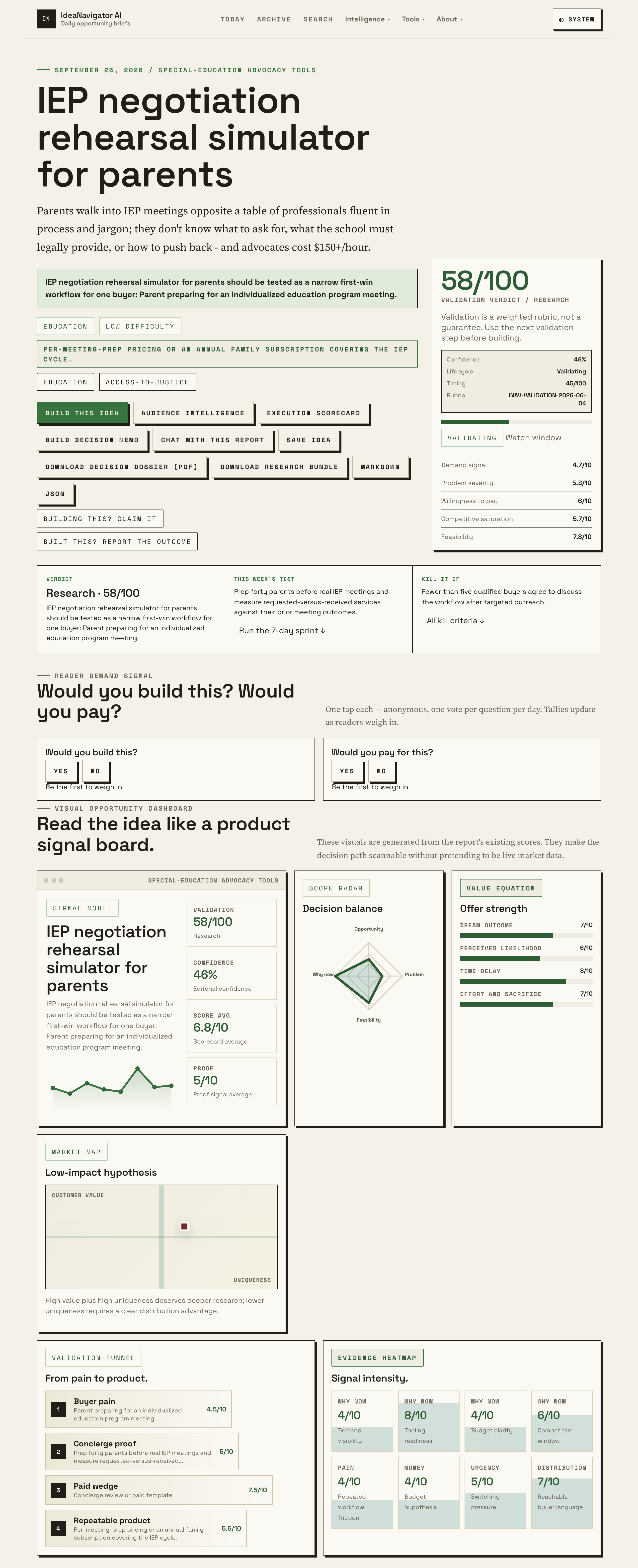
IdeaNavigator AI has outlined a proposed IEP meeting simulator that would help parents review education records, prepare requests and rehearse conversations with school staff. The concept has not been shown to improve meeting outcomes; its proposed test would involve 40 parents and compare requested and received services with their prior outcomes.
The proposed workflow would let a parent upload a child’s current individualized education program (IEP) and evaluation reports. The simulator would explain the documents in plain language, produce a list of possible requests with legal grounding, and let the parent practice a meeting through role-play that includes realistic pushback from school staff.
The idea targets parents preparing for an IEP meeting. IdeaNavigator AI says such parents can face professionals familiar with the process and its terminology, while advocates may cost $150 or more per hour. That cost figure is presented as part of the proposal; no geographic scope, pricing survey or other basis for it is provided.
For an initial validation, the proposal calls for preparing 40 parents before real meetings, then comparing requested and received services with each parent’s outcomes from a prior meeting. It also sketches two possible revenue models: payment for individual meeting preparation or an annual family subscription covering the IEP cycle. No pricing, study results or subscription terms are given.
Could Practice Change IEP Meetings?
If developed and shown to help, a simulator could give parents a way to organize their questions and rehearse how to respond during a meeting without paying an advocate for every preparation session. Its proposed document review and role-play focus on the meeting itself, where families may need to explain a request and respond to questions from school personnel.
That potential remains a hypothesis. The proposal offers no results showing that parents using a simulator secure more services, understand their rights more accurately or feel better prepared. A comparison with prior meeting outcomes could provide an early measure, but it would not by itself establish that the tool caused any difference: family circumstances, student needs and school decisions can vary between meetings.
The proposed legal grounding also matters. Parents could rely on explanations when making requests about a child’s education, so the accuracy and limits of any legal information would affect how useful the product is. The proposal does not describe how legal content would be checked, updated or tailored to different jurisdictions.
The Proposed Meeting Preparation Workflow
An IEP is a plan for the education and services of a student who qualifies for special education under applicable rules. Meetings bring families and school personnel together to discuss a student’s needs and plan. The concept focuses on helping a parent prepare for that discussion, rather than describing a tool for schools or a system that makes decisions about eligibility or services.
IdeaNavigator AI presents recent advances in language-model role-play, rising special-education identification rates and tighter district resources as reasons to explore the idea. Those points are the proposal’s rationale; it provides no figures, dates or independent evidence to quantify the trends or show that meetings have become more adversarial.
The product remains at the idea and validation stage in the information provided. No developer, release date, working demonstration, partnerships or completed parent study is identified. The description therefore supports reporting on a proposed workflow, not on an available service.
Evidence and Legal Scope
It is unclear whether a simulator has been built, whether parents can currently use one, or how its document analysis and role-play would work in practice. The proposal does not identify the laws or jurisdictions its explanations would cover, who would review those explanations, or how uploaded education records would be stored and protected.
There are also no reported findings from the planned 40-parent test. The comparison method, time frame and definition of a prior outcome are unspecified, as are the services that would be measured. Until those details and results are available, the tool’s accuracy, usefulness and effect on services remain unverified.
A 40-Parent Test Is Proposed
The next stated step is to prepare 40 parents for upcoming IEP meetings and compare what services they request and receive with outcomes from their previous meetings. IdeaNavigator AI has not provided a schedule or said that recruitment or testing has begun. Any later assessment would need to explain how outcomes are measured and account for differences between meetings before readers can judge what the results show.
Key Questions
Is the IEP simulator available now?
The information describes a proposed product and does not confirm a launch, public access or a working version.
What would the simulator do?
The proposed tool would review a parent’s IEP and evaluation reports, explain them in plain language, suggest requests with legal grounding and simulate meeting conversations with school staff.
Has it been shown to improve services for students?
No results are reported. A test involving 40 parents is proposed, with requested and received services compared against prior meeting outcomes.
How would the product be paid for?
The proposal suggests charging per meeting-preparation session or offering an annual family subscription. It gives no prices or subscription details.
Source: IdeaNavigator AI
Halloween Picks
halloween
As an affiliate, we earn on qualifying purchases.