📊 Full opportunity report: Enhancing Social Care Efficiency With Automated Benefit Check Technology on IdeaNavigator AI — validation score, market gap, and execution plan.

Get business pricing on office and shipping supplies
- Business-only prices and quantity discounts
- Tax-exempt purchasing
- Multiple users, one account, clear invoices
TL;DR
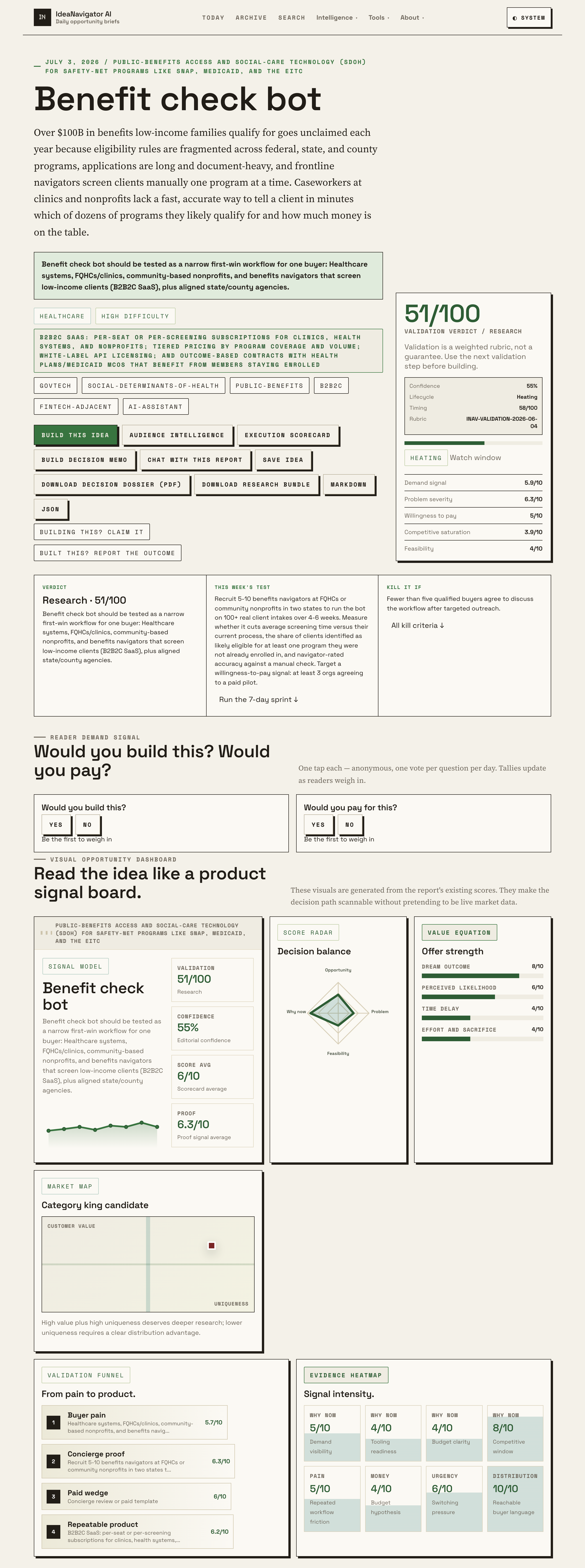
A new AI-powered benefit check bot is being tested to improve efficiency in screening low-income clients for public benefits. It addresses a major gap after a nonprofit closure and responds to increased eligibility redeterminations. Early pilots aim to validate its impact on screening speed and accuracy.
A new AI-based benefit check bot is being piloted at community clinics and nonprofits to streamline eligibility screening for public benefits. This development responds to a significant gap created by the 2024 closure of Benefits Data Trust, a major nonprofit that previously managed such screenings for multiple states. The technology aims to help frontline workers identify benefits for low-income clients more quickly and accurately, potentially transforming social care workflows and reducing unclaimed benefits.
The benefit check bot is a white-label conversational screening tool designed for integration into clinics’ websites or used directly by navigators via SMS. It asks clients a series of yes/no and multiple-choice questions, then generates a list of likely-eligible programs, including SNAP, Medicaid, EITC/CTC, WIC, and LIHEAP, with estimated benefit amounts and next-step application links. The initial pilot will focus on 2-3 states, with participating organizations logging anonymized outcomes to assess performance.
Developed amid a shifting policy landscape, the tool addresses the over $100 billion in benefits that low-income families leave unclaimed annually due to fragmented eligibility rules and lengthy application processes. The closure of Benefits Data Trust in 2024 has left many health systems and state agencies without a trusted outsourced capacity for benefits navigation. The new AI solution leverages conversational technology to deliver fast, multilingual, and multi-program screening at near-zero marginal cost, making it a promising alternative to expensive call centers.
Early validation efforts involve recruiting 5-10 benefits navigators at Federally Qualified Health Centers (FQHCs) and community nonprofits in two states. These pilots will evaluate whether the bot reduces screening time, improves identification of eligible clients, and maintains accuracy compared to manual processes. The goal is to secure at least three paid pilot commitments, which would demonstrate market interest and potential for broader adoption.
This technology could significantly improve the efficiency of benefits screening, reducing the time frontline workers spend on manual eligibility checks. By automating the process, organizations may identify more eligible clients and increase benefits uptake, which is vital as millions of dollars in benefits go unclaimed each year. The tool’s multilingual capabilities and low marginal cost make it especially valuable in diverse, resource-constrained settings, potentially leading to better social outcomes and reduced administrative burdens.
Furthermore, the development fills a critical gap left by the closure of Benefits Data Trust, which previously managed benefits enrollment for multiple states. As eligibility redeterminations accelerate due to Medicaid unwinding and other policy shifts, such automated tools could become essential for maintaining access and reducing workload for overstretched staff. If successful, this pilot could accelerate broader deployment across safety-net programs nationwide.
benefit eligibility screening software
As an affiliate, we earn on qualifying purchases.
As an affiliate, we earn on qualifying purchases.
Background on Benefits Access and Automation Efforts
Over the past decade, efforts to improve benefits access have increasingly incorporated digital solutions, yet manual screening remains common in many safety-net organizations. The 2024 shutdown of Benefits Data Trust, a key nonprofit that provided outsourced benefits screening for seven states, created a notable gap, leaving many organizations without a dedicated capacity to identify unclaimed benefits efficiently.
Simultaneously, the post-pandemic Medicaid redetermination process has triggered a surge in eligibility checks, adding pressure on clinics, health plans, and state agencies to verify and renew benefits. Traditional manual processes are slow, labor-intensive, and often inconsistent, leading to significant delays and missed opportunities for benefits enrollment.
In response, technology developers and policymakers have begun exploring AI-driven solutions, including conversational bots, to automate screening workflows. These tools leverage natural language processing and decision trees to quickly assess eligibility across multiple programs, often in multiple languages, and at a fraction of the cost of human call centers. The current pilot builds on this trend, aiming to validate its practical utility in real-world settings.
AI-powered social benefits check tool
As an affiliate, we earn on qualifying purchases.
As an affiliate, we earn on qualifying purchases.
Uncertainties and Challenges in Deployment
It is still unclear how accurately the bot will perform across diverse client populations and different state benefit rules. The pilot aims to measure accuracy against manual checks, but results are not yet available. Additionally, questions remain about scalability, integration with existing systems, and user acceptance among frontline staff and clients. The long-term impact on benefits uptake and administrative workload will require further study.
multilingual benefits eligibility chatbot
As an affiliate, we earn on qualifying purchases.
As an affiliate, we earn on qualifying purchases.
Next Steps for Broader Adoption and Validation
Following the initial pilot, organizers plan to analyze screening accuracy, time savings, and client outcomes. If results are positive, they will seek additional funding and partnerships to expand deployment across more states and programs. Further development may include refining AI models, expanding multilingual capabilities, and integrating with state and federal benefits systems. The ultimate goal is to establish the tool as a standard component of social care workflows nationwide.
social care workflow automation tools
As an affiliate, we earn on qualifying purchases.
As an affiliate, we earn on qualifying purchases.
Key Questions
How does the benefit check bot work?
The bot uses a series of yes/no and multiple-choice questions to assess eligibility for various public benefits, then provides a list of likely-eligible programs with estimated benefits and application steps.
What benefits programs does it cover?
Initially, the pilot focuses on SNAP, Medicaid, EITC/CTC, WIC, and LIHEAP, with potential to expand to other programs as development continues.
Who is testing the technology?
Benefits navigators at Federally Qualified Health Centers and community nonprofits in two states are participating in the pilot.
What are the main challenges for deployment?
Key uncertainties include accuracy across diverse populations, integration with existing systems, and user acceptance. Results from the pilot will clarify these issues.
How soon could this technology be widely adopted?
If pilot results are promising, broader deployment could occur within the next 1-2 years, depending on funding, partnerships, and system integration efforts.
Source: IdeaNavigator AI
Evergreen bestsellers Picks
bestsellers
As an affiliate, we earn on qualifying purchases.