
📊 Full opportunity report: Follow Your TRT Lab Work And Symptoms Over Time on IdeaNavigator AI — validation score, market gap, and execution plan.

Get business pricing on office and shipping supplies
- Business-only prices and quantity discounts
- Tax-exempt purchasing
- Multiple users, one account, clear invoices
TL;DR
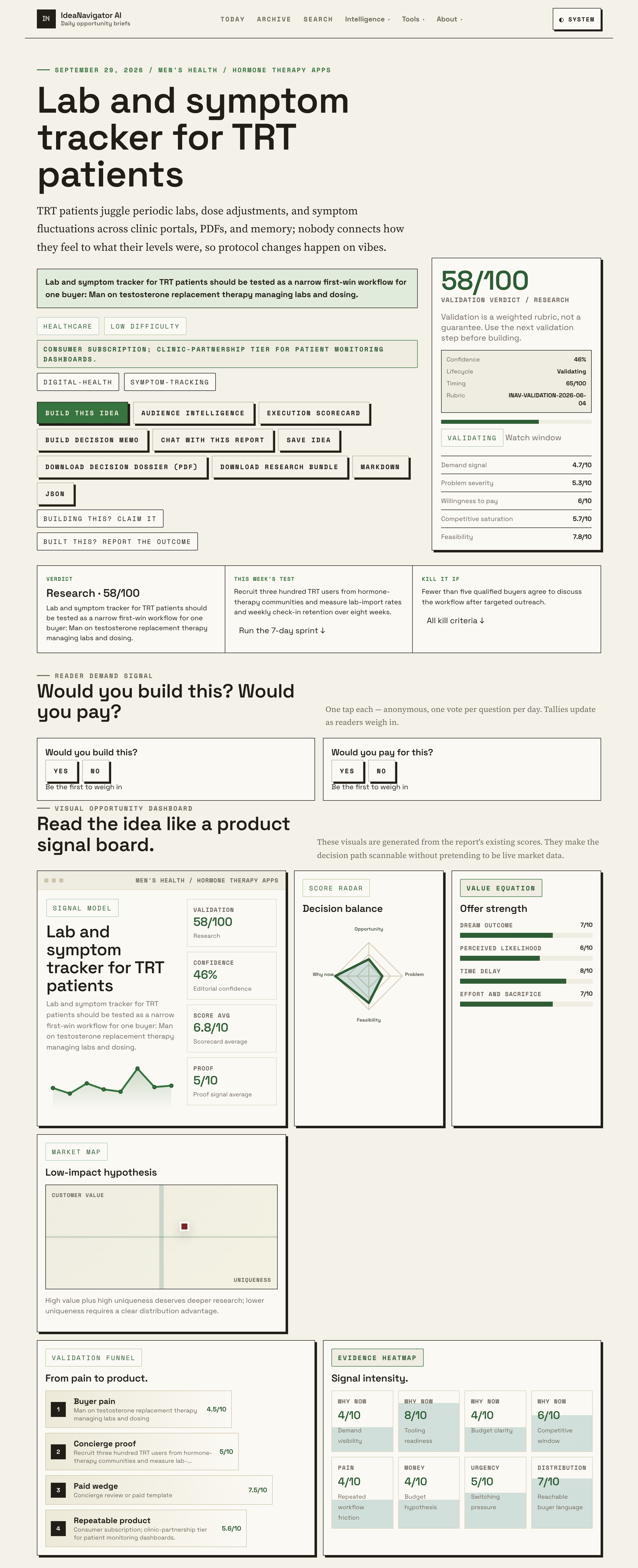
IdeaNavigator AI has outlined a proposed lab and symptom tracker for men managing testosterone replacement therapy. The concept would connect imported lab results, dose changes and daily symptom check-ins; it is a product proposal, not a launched service or a clinically validated tool.
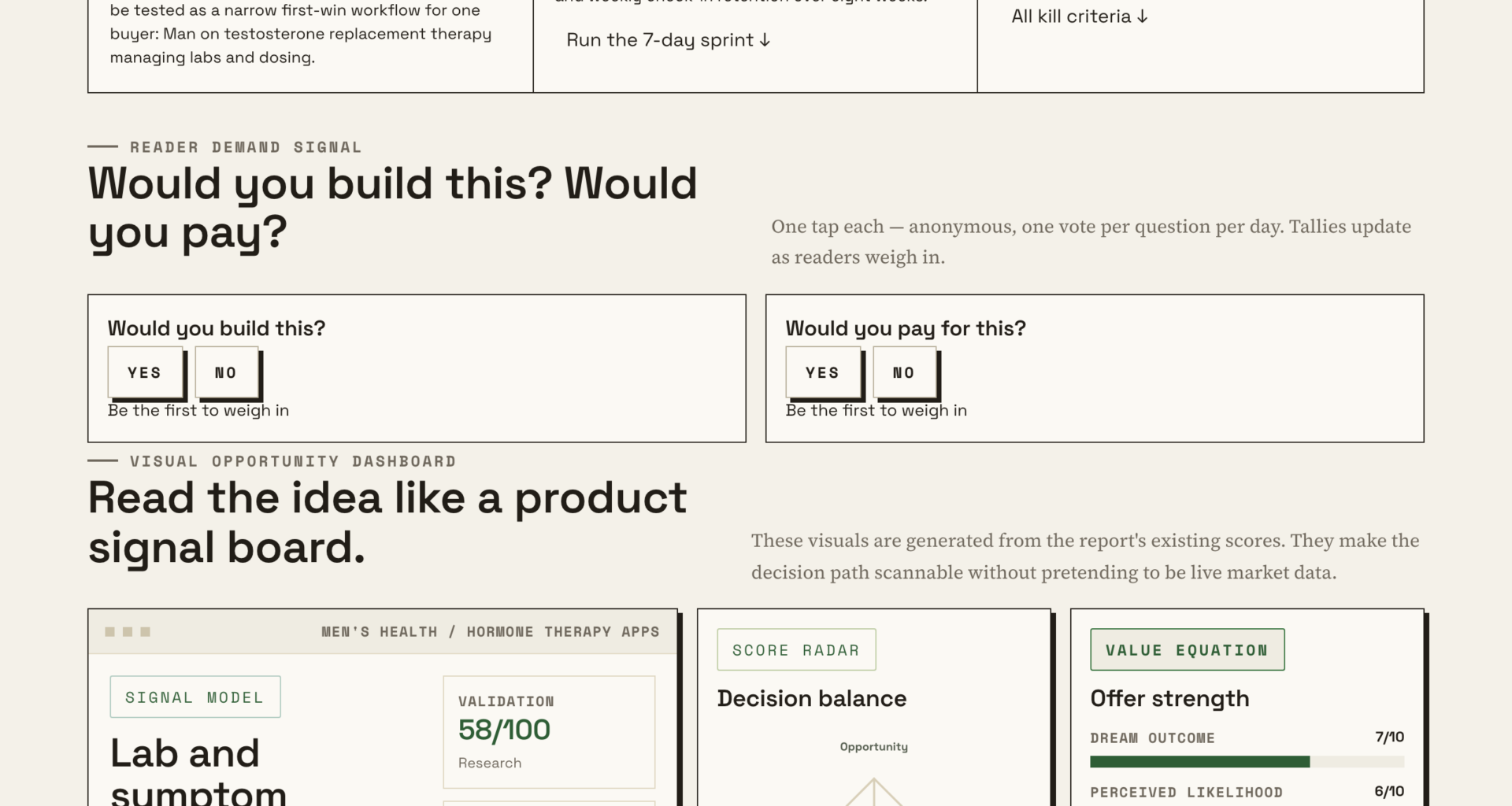
IdeaNavigator AI has proposed an eight-week test of a lab and symptom tracker for men receiving testosterone replacement therapy (TRT), aiming to see whether users will import lab results and keep up weekly check-ins. According to the product proposal, the app would connect hormone test results with dose changes and reported symptoms. The proposal identifies care tracking as the problem it aims to address; it provides no trial results or launch announcement.
IdeaNavigator AI’s product proposal describes a minimum viable product that would let users import lab PDFs, chart hormone panels over time and record dose changes alongside daily symptom check-ins. The proposal also describes trend summaries for clinic visits and flags for values outside target ranges. It does not specify which hormone measurements, target ranges or symptom scales the product would use.
To test demand, the proposal calls for recruiting 300 TRT users from hormone-therapy communities and measuring lab-import rates and weekly check-in retention over eight weeks. These are proposed validation measures, not reported findings. The proposal gives no recruitment date, operating partner or results.
The proposal suggests a business model combining a consumer subscription with a possible clinic-partnership tier offering patient-monitoring dashboards. It includes no pricing, clinic commitments or details about how the app would exchange information with providers.
Connecting Dose Changes With Symptoms
IdeaNavigator AI’s proposal argues that patients managing treatment across clinic portals, PDFs and personal recollection could benefit from having lab results, dose history and symptoms in one timeline. Its central proposition is that this record could make it easier to review what changed between appointments with a clinician.
That potential remains untested. A chart or automated flag would not, by itself, establish why a symptom changed or whether a dose adjustment is appropriate. The proposal describes a tracking and visit-preparation tool; it reports no clinical evidence that the app improves treatment decisions or health outcomes.
Products Worth Considering

Canon imagePROGRAF PRO-1100 17-Inch Professional Wireless Inkjet Photo Printer

Dell UltraSharp 27 Thunderbolt Hub Monitor (U2726DER)
Dell UltraSharp 32 U3226QER 4K Thunderbolt Hub Monitor
As an affiliate, we earn on qualifying purchases.
Fragmented TRT Records Prompt Proposal
IdeaNavigator AI’s product brief describes TRT patients as tracking periodic lab work, dose adjustments and changes in how they feel across separate clinic systems and documents. The brief argues that this fragmentation can leave patients and clinicians without a shared view of how symptoms relate in time to measured hormone levels. That is the problem the proposed tracker is designed to address.
The brief cites growth in TRT prescriptions and telehealth clinics as reasons to explore a patient-facing tool, but provides no prescription counts, market estimates or clinic data to quantify the trend. The scale of demand is therefore not established in the proposal, which identifies the market as men’s health and hormone-therapy apps.
Clinical Scope Still Undeclared
IdeaNavigator AI’s proposal does not identify a developer, clinical adviser, clinic partner or product launch schedule. It also does not say whether the suggested eight-week test has begun, how participants would be recruited, or what results would count as successful validation.
Key product and care questions remain open, including how target ranges would be set, how out-of-range values would be presented, and whether a clinician would review alerts or trend summaries. The proposal does not describe privacy protections, medical-record integrations, regulatory status or safeguards against users treating automated flags as treatment instructions.
Recruitment and Retention Measures
IdeaNavigator AI’s proposal identifies recruiting 300 TRT users and tracking lab imports and weekly check-ins for eight weeks as the next stated step. If carried out, the test could show whether users engage with the core tracking features over the study period. The proposal specifies no thresholds for acceptable import rates or retention.
Further information would be needed to assess whether the concept advances beyond product validation: whether a working app is built, what clinicians think of its summaries and alerts, how patient data is handled, and whether any measured changes affect care. The available proposal does not confirm that development or testing is underway.
Key Questions
Has the TRT tracking app launched?
No launch is confirmed. IdeaNavigator AI’s material describes a proposed product and an eight-week validation plan.
What would the proposed app track?
According to the product proposal, it would combine imported lab PDFs, dose changes and daily symptom check-ins, then chart trends and prepare summaries for clinic visits.
How would the idea be tested?
IdeaNavigator AI’s proposal calls for recruiting 300 TRT users and measuring lab-import rates and weekly check-in retention over eight weeks. It reports no results.
Would the app recommend TRT dose changes?
The proposal describes trend summaries and flags for values outside target ranges, but does not say the app would recommend dose changes. It also does not specify clinical review or the target ranges.
Source: IdeaNavigator AI