

🔍 Read the full analysis: What Makes These 10 Best Mesh WiFi Systems Worth Considering In 2027? on ThorstenMeyerAI.com

Get business pricing on office and shipping supplies
- Business-only prices and quantity discounts
- Tax-exempt purchasing
- Multiple users, one account, clear invoices
TL;DR
ThorstenMeyerAI.com’s 2027 guide compares 10 mesh Wi-Fi systems, from budget dual-band models to Wi-Fi 7 options. It names the TP-Link Deco XE75 its best overall pick, but actual performance depends on home construction, device compatibility, internet speed and placement.
ThorstenMeyerAI.com’s 2027 guide compares 10 mesh Wi-Fi systems for different home sizes, internet plans and smart-home setups, naming the TP-Link Deco XE75 its best overall choice. The guide favors Wi-Fi 6E as a price-performance balance while presenting Wi-Fi 7 systems as options for buyers seeking newer technology, not as a universal need.
The guide’s central tradeoff is backhaul capacity versus price. Tri-band systems can reserve a band for connections between mesh nodes, leaving more capacity for household devices. Dual-band models share their wireless spectrum between node links and client traffic, a design the source says may be adequate for smaller homes with moderate device counts.
Its featured recommendations include the NETGEAR Orbi 770 Series and Amazon eero Pro 7 among Wi-Fi 7 options, and the Deco XE75 as a Wi-Fi 6E alternative. It also cites the TP-Link Deco X55 and Amazon eero 6+ as dual-band choices. These are editorial recommendations from the source, not results from a test dataset supplied here.
The guide says its selection criteria were coverage consistency, backhaul efficiency and setup simplicity. It also considered stated coverage, node count, app-based onboarding, price and features such as multi-gigabit Ethernet or smart-home integration. The source does not provide full model-by-model benchmark results or a detailed scoring table in the supplied material.
The 10 picks
- 1
 Amazon eero Pro 7 tri-band mesh Wi-Fi 7 router (newest model) – Supports inte…View on Amazon →
- 2
 NETGEAR Orbi 770 Series WiFi 7 Tri-Band Mesh System, 3-Pack, Covers Up to 8,0…View on Amazon →
- 3
 Amazon eero 7 dual-band mesh Wi-Fi 7 router (newest model) – Supports interne…View on Amazon →
- 4
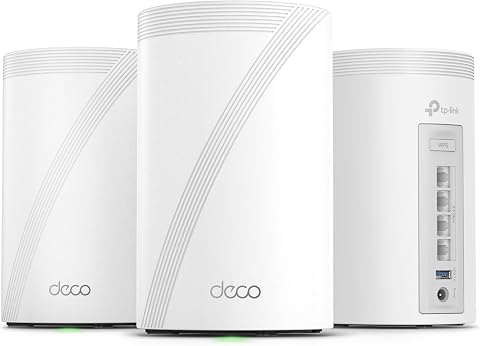 TP-Link Deco 7 Pro Tri-Band WiFi 7 BE10000 Whole Home Mesh System (3-Pack)View on Amazon →
- 5
 Amazon eero 6+ Dual-Band Wi-Fi 6 Mesh System, 3-PackView on Amazon →
- 6
 NETGEAR Orbi 370 Series WiFi 7 Mesh System for Home (RBE373) – Wireless Route…View on Amazon →
- 7
 TP-Link Deco 7 BE5000 Dual-Band Wi-Fi 7 Mesh SystemView on Amazon →
- 8
 TP-Link Deco XE75 AXE5400 Tri-Band Wi-Fi 6E Mesh System, 3-PackView on Amazon →
- 9
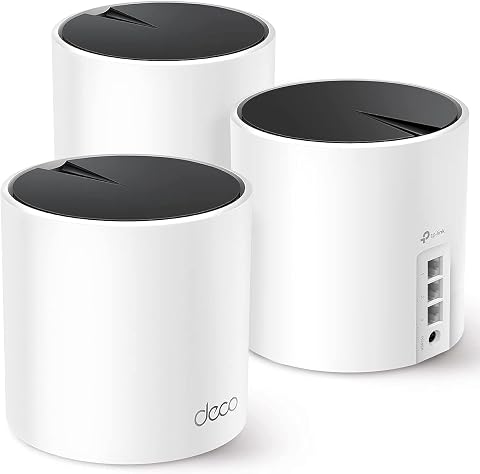 TP-Link Deco X55 AX3000 Wi-Fi 6 Mesh System (3-Pack)View on Amazon →
- 10
 TP-Link Deco S4 AC1900 Mesh Wi-Fi System (3-Pack)View on Amazon →
Choosing Between Wi-Fi 6E and Wi-Fi 7
The ranking gives shoppers a way to compare systems without treating the newest wireless standard as automatically necessary. A Wi-Fi 7 router cannot deliver its full benefits to devices that do not support Wi-Fi 7, and the source notes that compatible networking equipment and a suitable internet plan also affect the results a household can see.
For readers, the practical decision is whether their home and devices can use the extra capacity. A household on a 1Gbps plan with ordinary browsing and streaming needs may not gain enough from a premium Wi-Fi 7 system to justify the cost. Larger homes, congested wireless environments and homes with many high-bandwidth users may have a stronger reason to compare tri-band models and node placement.
Compatibility matters beyond speed. The guide describes eero’s Alexa integration and smart-home functions as a potential benefit for households already using that ecosystem. A mesh system can affect coverage throughout a home, but choosing a model based on brand claims alone may leave users with unused features or insufficient signal through walls.
Products Worth Considering

Samsung 49-inch Odyssey OLED G9 (G91SD) Dual QHD Curved Gaming Monitor

Canon imagePROGRAF PRO-1100 17-Inch Professional Wireless Inkjet Photo Printer

Apple Mac mini (2026) with M5 Pro chip and AppleCare+ (3‑year)
As an affiliate, we earn on qualifying purchases.
How the Guide Frames Its Picks
The source groups the choices around a progression from dual-band Wi-Fi 6 to Wi-Fi 6E and Wi-Fi 7. Wi-Fi 6E adds access to the 6GHz band, which can reduce competition with older devices operating on other bands where compatible client devices are available. Wi-Fi 7 adds newer capabilities, but the guide characterizes its value as dependent on compatible hardware and faster internet service.
Mesh systems use multiple nodes to extend a home network. Their performance depends on how nodes communicate with one another as well as how they connect to phones, computers and other devices. The guide distinguishes dedicated wireless backhaul from shared-band designs, and warns that advertised coverage figures may not reflect conditions in homes with brick, concrete or multiple floors.
The source also compares form factor and connectivity. It describes compact Deco S4 units as easier to place discreetly and larger Orbi nodes as having stronger antenna performance, but the supplied text does not include a controlled comparison supporting those descriptions. Ethernet port speeds and counts are another factor: Gigabit ports can limit wired throughput on faster internet plans, while some households may need an additional network switch.
“The TP-Link Deco XE75 stands out as the best overall pick for balancing Wi-Fi 6E performance with reasonable cost.”
— ThorstenMeyerAI.com guide
What the Rankings Do Not Establish
The supplied source does not identify the guide’s publication date, prices, retailer availability or test conditions. It also does not show detailed speed measurements, latency figures, test-home layouts, or the complete rationale for each of the 10 rankings. The recommendations therefore should be read as the publisher’s buying guidance, not as independently verified claims of real-world performance.
Coverage figures can vary with building materials, node location, interference and client hardware. The guide itself cautions that manufacturers’ square-footage claims may be optimistic, but it does not provide measured coverage for each system. Nor does the supplied text confirm whether every feature mentioned is available in every regional model or software version.
The source’s Wi-Fi 7 and internet-plan advice is broad rather than tailored to an individual household. Actual benefit depends on compatible devices, service speed and network configuration; the guide does not give a precise threshold at which upgrading becomes worthwhile for every reader.
Check Your Home Before Buying
Readers should compare the guide’s picks with their home’s floor area, number of floors, wall materials and current internet speed. Before buying, check device compatibility, Ethernet port speeds, node expandability and current prices, then confirm that the exact model supports the smart-home features or network controls they need.
Any later update to the rankings would be more useful if it included dated prices, a full list of all 10 picks, and comparable tests across the same home layout and client devices. Until then, the article offers a framework for narrowing options, but buyers should treat performance and coverage as dependent on their own setup.
Key Questions
Which mesh Wi-Fi system does the guide rank highest?
The guide names the TP-Link Deco XE75 its best overall pick, citing its Wi-Fi 6E capability and balance of performance and cost. That is the publisher’s recommendation, not a result independently verified by the supplied source material.
Do most households need Wi-Fi 7?
Not necessarily. The guide presents Wi-Fi 7 as a fit for buyers seeking newer connectivity, but says compatible devices and networking equipment are needed to use its benefits. A household with a 1Gbps plan and moderate needs may find Wi-Fi 6E or a less expensive system sufficient.
What is mesh backhaul?
Backhaul is the connection between mesh nodes. Some tri-band systems dedicate a wireless band to node-to-node traffic; dual-band systems share available bands with household devices, which may affect throughput as network demands increase.
How many mesh nodes should I buy?
That depends on the home’s size, layout and construction. The guide cautions that advertised coverage can be optimistic, especially with thick walls or multiple floors. Check the manufacturer’s coverage estimate and consider whether the system lets you add compatible nodes later.
Source: ThorstenMeyerAI.com