
📊 Full opportunity report: Change-order risk detector for landscaping contractors on IdeaNavigator AI — validation score, market gap, and execution plan.

Get business pricing on office and shipping supplies
- Business-only prices and quantity discounts
- Tax-exempt purchasing
- Multiple users, one account, clear invoices
TL;DR
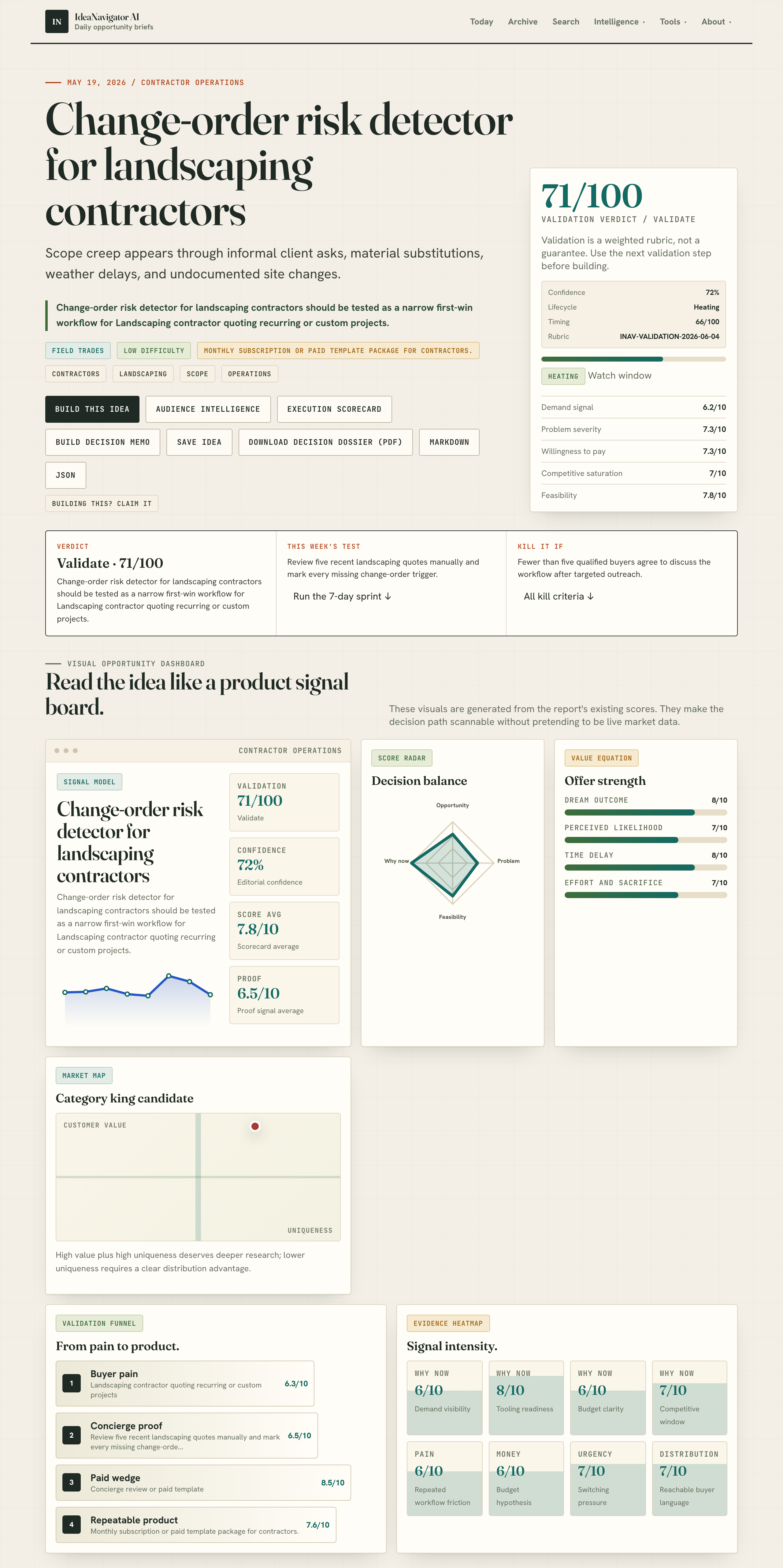
A change-order risk detector tailored for landscaping contractors is entering testing. It aims to identify scope creep early, helping small firms manage margins amid high uncertainty.
A new change-order risk detector for landscaping contractors is entering initial testing, targeting recurring and custom project quotes to reduce scope creep and improve margin control amid ongoing industry uncertainties.
The proposed tool is designed as a quote and job-note checker that flags missing exclusions, change-order triggers, and approval language in project proposals. It is intended for small to medium-sized landscaping contractors who face frequent informal client requests, material substitutions, weather delays, and undocumented site changes.
Developed by IdeaNavigator AI, the detector will be tested by reviewing five recent landscaping quotes manually, marking missing change-order triggers to validate its effectiveness. The tool aims to be available via a monthly subscription or as part of a paid template package, providing a scalable solution for contractor operations.
Why This Change-Order Risk Detector Matters for Landscaping Firms
This development addresses a critical challenge for small landscaping contractors: managing scope creep that erodes margins and complicates scheduling. By proactively identifying potential change orders during the quoting process, the tool could help firms avoid unexpected costs and disputes, ultimately improving profitability and project control.
As labor, materials, and scheduling uncertainties remain high, such a tool could become a vital part of contractor workflows, especially for those lacking extensive project management systems. Its success could influence broader adoption of automated risk detection in the industry.
Products Worth Considering

Canon PIXMA TR160 Wireless Portable Color Inkjet Printer

LG UltraGear 27-Inch QHD OLED Gaming Monitor, 240Hz, 0.03ms, G-SYNC Compatible, FreeSync Premium Pro, HDMI 2.1, Black

Apple Mac mini (2018), 3.0 GHz 6-Core Intel Core i5, 32 GB RAM, 256 GB SSD
As an affiliate, we earn on qualifying purchases.
Industry Challenges Driving Change-Order Risk Management
Small landscaping contractors often operate with limited administrative resources and rely heavily on informal communication with clients. Scope creep through unrecorded client requests, material substitutions, and weather delays frequently leads to budget overruns and project delays. Currently, most contractors manually review quotes, which is time-consuming and prone to oversight.
The industry has seen increasing interest in digital tools to streamline operations, but few solutions specifically target early detection of change-order risks during the quoting phase. The development of this detector reflects a broader push toward automation and risk mitigation in contractor workflows.
“The change-order risk detector aims to provide small contractors with a simple, scalable way to flag potential scope issues before they escalate.”
— an anonymous researcher
Uncertainties About Effectiveness and Adoption
It is not yet clear how accurately the detector will identify all relevant change-order triggers or how contractors will adopt and integrate it into their existing workflows. The initial testing involves only five recent quotes, so broader validation is still needed.
Further, the impact on contractor margins and client relationships remains to be seen once the tool is widely deployed.
Next Steps for Validation and Industry Rollout
Following initial testing, the developers plan to refine the detector based on feedback and expand testing to a larger sample of quotes. If successful, a pilot program could be launched with select contractors, followed by broader industry adoption. Monitoring results over the coming months will determine its effectiveness in real-world scenarios.
Key Questions
How will the change-order risk detector be integrated into existing contractor workflows?
It is expected to be a standalone tool or part of a template package that contractors can use during the quoting process to review and flag potential change-order issues before submitting proposals.
Will the detector work for all types of landscaping projects?
The initial focus is on recurring and custom projects where scope creep is most common. Its effectiveness for large or highly complex projects remains to be tested.
What are the costs associated with using this tool?
The planned pricing model includes a monthly subscription or a paid template package, but specific costs have not yet been announced.
When will the tool be available for general use?
The development is still in the testing phase; a wider rollout could occur within the next few months if initial results are promising.
Could this tool replace manual review of quotes?
It is designed to assist, not replace, manual review—aiming to reduce oversight and improve accuracy in identifying potential change-order risks.
Source: IdeaNavigator AI