
📊 Full opportunity report: A Guide To Consent Tracking For Youth-Services Vendors on IdeaNavigator AI — validation score, market gap, and execution plan.

Get business pricing on office and shipping supplies
- Business-only prices and quantity discounts
- Tax-exempt purchasing
- Multiple users, one account, clear invoices
TL;DR
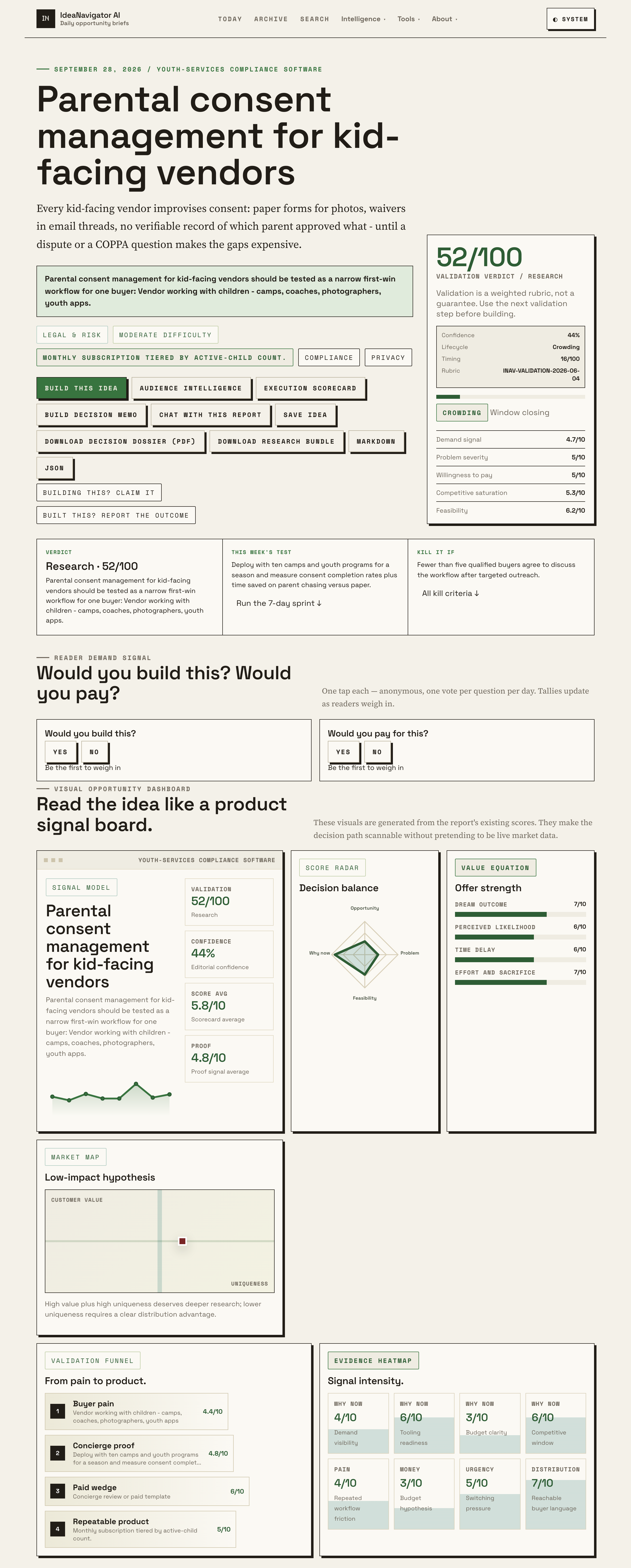
IdeaNavigator AI has identified parental consent management as a practical software opportunity for small vendors serving children — camps, coaches, photographers and youth apps. The proposal argues that expanding COPPA enforcement and state privacy laws are pushing these vendors toward verifiable, auditable consent records they currently lack.
A new product proposal from IdeaNavigator AI identifies parental consent management as a narrowly scoped, near-term software opportunity aimed at small vendors who work with children — camps, coaches, photographers and youth apps. The proposal argues that these businesses currently improvise consent through paper forms and email threads, leaving them exposed as children’s privacy enforcement expands under updated COPPA rules and a growing patchwork of state laws.
According to the IdeaNavigator AI analysis, the core problem is that every kid-facing vendor improvises consent: paper forms for photo usage, waivers buried in email threads, and no verifiable record of which parent approved what. The gaps stay invisible, the proposal argues, until a dispute or a COPPA question makes them expensive to fix after the fact.
The proposed minimum viable product is a vendor-branded consent flow that parents complete on their phones. It would cover four consent categories identified in the proposal: photo use, data collection, medical authorization and liability waivers. The system would include identity verification scaled to the risk level of each consent type, a per-child consent ledger, automatic expiry tracking, and an instant audit export for when records are challenged or regulators ask questions.
The proposed business model is a monthly subscription tiered by active-child count, which keeps pricing proportionate to a vendor’s actual seasonal workload rather than charging flat enterprise rates. The target market is described as youth-services compliance software — a segment the proposal characterizes as underserved because existing compliance tools are built for schools and large platforms rather than independent camps, coaches and photographers.
Why Small Youth Vendors Are Exposed
The proposal’s timing argument rests on two converging pressures. First, children’s privacy enforcement is expanding — the analysis points to updated COPPA rules and a wave of state-level privacy laws that extend obligations beyond the large online platforms COPPA was originally written for. Second, the proposal states that parents increasingly challenge photo and data use, meaning disputes can arise from a single social media post of a camp group photo, not just from formal regulatory action.
For a small vendor, the practical consequence is that a consent record is no longer just paperwork — it is the difference between a defensible response and an expensive scramble. The proposal positions this as the reason a modest tool, built around one narrow workflow, could find buyers quickly: the pain is concrete, recurring each season, and becomes urgent the moment a parent or regulator asks for proof of what was approved and by whom.
The emphasis on audit export reflects this. The value is not collecting consent once but being able to produce a timestamped, attributed record months later, including whether a consent has expired or been withdrawn — something email threads and paper binders cannot reliably do.
Products Worth Considering

Canon SELPHY CP1500 Wireless Photo Printer Bundle with 108 Sheets of KP-108 Paper, 3 Ink Cartridges, and Cleaning Cloth

Canon SELPHY CP1500 Wireless Compact Photo Printer Bundle with RP-108 Ink and Paper Set, Black

Canon SELPHY CP1500 Compact Photo Printer Bundle with Two KP-108IN Ink and Paper Sets, Black
As an affiliate, we earn on qualifying purchases.
The Paper-and-Email Status Quo
Youth-services vendors have historically handled consent manually. Camps distribute paper photo releases at registration, coaches collect liability waivers by hand, and independent photographers often confirm photo usage rights through informal messages. The IdeaNavigator AI proposal describes this as a no verifiable record environment: the forms exist, but reconstructing who signed what, for which child, and when — especially after staff turnover or a change of season — is difficult or impossible.
The regulatory backdrop has shifted around these practices. COPPA, the U.S. federal children’s online privacy law, has been updated in recent years, and multiple states have passed their own privacy statutes with provisions touching minors’ data. According to the proposal, this expansion is what pushes even small vendors toward defensible consent records, since the legal exposure is no longer limited to major platforms.
What the Proposal Leaves Untested
The proposal is a product concept, not a launched company or validated business, and several elements remain unproven. The market claim — that small vendors will pay a monthly subscription for consent tooling — is asserted rather than demonstrated, and no pricing figures, competitor analysis or revenue projections are included.
The validation step itself is unexecuted: the analysis recommends deploying with ten camps and youth programs for a full season to measure consent completion rates and time saved compared with paper, but no such deployment has occurred or been reported. Whether parents will reliably complete phone-based consent flows, and whether identity verification can stay both lightweight and legally adequate across different consent risk tiers, is not yet known.
It is also unclear how the proposed tool would handle variation among state laws and COPPA requirements, or whether vendors in low-liability niches would see enough risk to subscribe at all. These are open questions the proposal identifies implicitly but does not answer.
The Ten-Camp Validation Season
The path laid out in the proposal is deliberately narrow: build the vendor-branded mobile consent flow, then deploy with ten camps and youth programs for one season. The two metrics to watch are consent completion rates — whether parents actually finish the flows — and time saved on parent chasing compared with the paper-based status quo.
If those numbers hold up, the logical extension is broader distribution across the youth-services vendor category, including independent coaches, photographers and youth apps, with the per-child pricing model scaling alongside each vendor’s enrollment. If completion rates fall short, the proposal implies the friction point would need to be identified before the workflow can be sold as a labor-saving tool. For now, the concept remains at the proposal stage with no announced builder, launch date or customer commitments.
Source: IdeaNavigator AI
Key Questions
What is the consent tracking tool proposed to do?
According to the IdeaNavigator AI proposal, it would let parents complete vendor-branded consent flows on their phones covering photo use, data collection, medical authorization and liability. It would maintain a per-child consent ledger with expiry tracking and produce an instant audit export.
Who is the intended customer?
Small vendors working with children: camps, coaches, photographers and youth apps. The proposal frames them as underserved by existing compliance software built for schools and large platforms.
Why is this being proposed now?
The proposal points to expanding children’s privacy enforcement — COPPA updates and state privacy laws — combined with parents more frequently challenging photo and data use, which pushes small vendors toward defensible consent records.
Does this product exist yet?
No. It is a product proposal. The recommended validation step — a one-season deployment with ten camps and youth programs — has not been reported as completed, and no builder, pricing or launch date has been announced.
How would the business make money?
Through a monthly subscription tiered by active-child count, according to the proposal, keeping costs proportionate to each vendor’s seasonal enrollment rather than charging flat rates.
Source: IdeaNavigator AI