
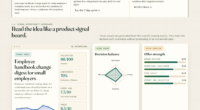
📊 Full opportunity report: Creative industries. The bifurcated reality. on ThorstenMeyerAI.com — validation score, market gap, and execution plan.

Get business pricing on office and shipping supplies
- Business-only prices and quantity discounts
- Tax-exempt purchasing
- Multiple users, one account, clear invoices
TL;DR
In 2026, creative industries are experiencing a bifurcation: top-tier professionals augment their work with AI tools, while routine roles decline sharply, leading to a ‘middle squeeze.’ This pattern reflects a structural shift driven by AI adoption.
Recent data from 2025 and early 2026 confirms a sharp decline in mid-level creative jobs, driven by AI-driven substitution and augmentation, signaling a structural bifurcation in the creative industries that impacts employment patterns and skill demands.
Graphic design job postings dropped 33% in 2025, with similar declines in content production roles. Meanwhile, AI-collaboration job postings surged over 340% between 2023 and 2024, indicating rapid adoption of AI tools in creative workflows. Only 31% of designers now use AI for core tasks, compared to 59% of developers, highlighting a significant adoption gap.
Market data shows that AI-generated advertising imagery is rated more aesthetically appealing than human-made content, and in some cases, AI-generated stock photos outperform human stock images in click-through rates by up to 50%. These shifts have led to a 21% reduction in freelance opportunities for creative roles such as graphic design, writing, and translation, reflecting a ‘middle squeeze’ pattern where routine tasks are increasingly automated or substituted.
Research from Hui et al. (2024), cited by Brookings, confirms that displacement effects are strongest in sub-markets where skills align closely with large language model functionalities, leading to a decline in demand for routine creative services on freelance platforms. The pattern is consistent across multiple creative sub-fields, emphasizing a skill-tier bifurcation: top-tier professionals augment their work with AI, routine roles decline, and the middle tier faces compression.
Creative industries.
The bifurcated reality.
Graphic designer postings -33% · AI-collaboration roles +340% · content production -28% · 90% content marketers using AI · stock photo bimodal click-through distribution · 21% freelance opportunity slash. The fourth distinct structural-pattern Phase 1 produces — creative-skill-spectrum bifurcation.
This is Atlas Essay 05 — the fourth and final Dimension 1 sector forensic in Phase 1. Creative industries produces the fourth distinct structural-pattern: creative-skill-spectrum bifurcation, a.k.a. the “middle squeeze.” Top-tier creative work augments — brand strategy, art direction, AI-orchestration · AI-collaboration job postings +340% 2023-2024. Commodity-tier creative work substitutes — stock photography, routine copy, template design · graphic designer postings -33% in 2025 · content production roles -28%. Middle creative-professional tier faces structural compression — the squeeze that makes the bifurcation pattern empirically distinct from cohort-bifurcation (Essay 02), sub-sector heterogeneity (Essay 03), and operational-scale displacement (Essay 04). Multi-source convergence: Brookings · Hui et al. Organization Science · Envato 2026 (1,780 creatives) · Figma 2025 · HubSpot · European Parliament study · Hartmann et al. 2025. Phase 1’s four-pattern integration is structurally complete.
Five sub-fields. One pattern.
Creative industries has the most empirically-fragmented evidence base across sub-fields of any Phase 1 sector. The consistent across-sub-field finding is the bifurcation pattern itself — top-tier augments, commodity substitutes, middle compresses, in every sub-field documented.
signal
vs quality
vs specialized
distribution
cutting
Three tiers. The middle squeeze.
The structural-empirical pattern across the five sub-fields. Creative industries displacement operates on a substitutable-output axis distinct from cohort, sub-sector, and operational-scale axes of the prior sectors. Top-tier augments, commodity substitutes, middle compresses.
Five factors. Substitutable-output.
The analytical decomposition extended to creative industries. Creative industries operates on a fifth attribution factor — the substitutable-output axis — that is structurally distinct from cohort-specific, pyramid-model, and operational-scale dynamics of the prior three sectors.
here
specific
Four patterns. Phase 1 complete.
The integrative observation Essay 05 produces. Phase 1 has now produced empirical evidence for four structurally distinct displacement patterns — operating across four structurally distinct axes determined by sectoral characteristics. “AI-driven labor displacement” is a family of patterns, not a single phenomenon.
axis
axis
operational axis
spectrum axis
Creative industries is the bifurcated reality empirically confirmed. Top-tier creative work augments — brand strategy, art direction, AI-orchestration · AI-collaboration roles +340%. Commodity-tier creative work substitutes — stock photography, routine copy, template design · graphic-design job postings -33%. Middle creative-professional tier faces structural compression — the “middle squeeze” pattern. This is the fourth distinct structural-pattern Phase 1 produces — creative-skill-spectrum bifurcation operating on a skill-tier axis rather than cohort, sub-sector, or operational axes. The Atlas framework’s Phase 1 empirical-evidence foundation is structurally complete. Four sector forensics. Four distinct structural-patterns. Five attribution factors. Essay 06 crystallizes the integrative synthesis.
Implications of the ‘Middle Squeeze’ in Creative Work
This shift signifies a fundamental change in the creative labor market, where AI acts as both an augmentative and substitutive force. Top-tier professionals leverage AI to enhance their output, maintaining or increasing their value. Conversely, routine creative roles face decline, leading to job compression at the middle skill levels. This bifurcation raises questions about future employment stability, skill requirements, and the evolving nature of creative work, impacting workers, firms, and industry structures.Products Worth Considering

HP Sprocket Photo Booth Machine Instant Color Photo Printer with 10.1 Touchscreen, LED Ring Light, 250+ Frames, 3×4 ZINK Paper, QR Code Shar

HP Sprocket Photo Booth Instant Color Printer Bundle

HP Sprocket Panorama Portable Color Photo and Label Printer
As an affiliate, we earn on qualifying purchases.
Empirical Evidence of Structural Displacement in Creative Sectors
The phenomenon of AI-driven displacement in creative industries is supported by multiple data sources, including job posting analyses, platform usage metrics, and academic research. Graphic design, illustration, copywriting, and stock photography are among the sub-fields most affected, with clear evidence of declining job opportunities at the routine, middle skill levels.
Historically, creative roles have been resistant to automation; however, recent advances in AI tools like Canva, Midjourney, Jasper, and Runway have shifted this landscape. Canva’s dominant 44% market share in AI-assisted design illustrates how accessible high-quality visual content creation has become for non-professionals, further compressing middle-tier roles. The ‘middle squeeze’ pattern observed in creative industries mirrors similar trends in software engineering, professional services, and customer support, but with unique features tied to skill-specific AI capabilities.
“The empirical evidence supports a ‘middle squeeze’ pattern in creative industries, where routine roles decline sharply due to AI substitution, while top-tier professionals augment their work, creating a bifurcated labor market.”
— Thorsten Meyer
Unclear Long-Term Impact of AI on Creative Employment
While current data confirms a ‘middle squeeze’ pattern, it remains unclear how these trends will evolve in the longer term. It is uncertain whether top-tier professionals will continue to augment their work with AI without displacement, or if further automation will encroach on higher-value roles. Additionally, the sector’s adaptation, such as new skill development or shifts in demand, is still emerging and not yet fully understood.
Future Developments and Sector Adaptations
Expect continued monitoring of employment trends, with further research into how creative professionals adapt to AI integration. Industry responses may include new training programs, shifts in project types, or the emergence of new roles that leverage AI as a tool. Policy discussions around worker support and reskilling are likely to increase as the sector navigates this bifurcation.
Key Questions
How is AI currently affecting creative job opportunities?
AI is leading to a decline in routine creative roles, such as stock illustration and basic design, with job postings dropping significantly. At the same time, AI tools are being adopted for augmentation at the top levels, allowing professionals to produce more complex work efficiently.
Are all creative roles equally affected by AI?
No, routine and commodity tasks are most affected, while high-level strategic and highly specialized roles are increasingly augmented rather than replaced. The middle-tier roles face the greatest displacement pressure.
What does the ‘middle squeeze’ mean for creative workers?
It indicates a compression of middle-tier jobs, leading to fewer opportunities for mid-level professionals and a potential polarization of the sector into high-end augmented work and low-end automated tasks.
Will this trend continue or reverse?
It is uncertain. While current evidence shows a bifurcation pattern, future developments depend on technological advances, industry adaptations, and policy responses, which could alter the trajectory.
Source: ThorstenMeyerAI.com