
🔍 Read the full analysis: 15 AI Automation Tools For Everyday Small Business Operations on ThorstenMeyerAI.com

Get business pricing on office and shipping supplies
- Business-only prices and quantity discounts
- Tax-exempt purchasing
- Multiple users, one account, clear invoices
TL;DR
A roundup from ThorstenMeyerAI.com compares 15 books that teach small-business owners about AI automation; the titles are learning resources, not software platforms. The source favors a broad business guide overall while identifying no-code and ChatGPT-focused books as narrower starting points, but its comparisons rely on titles and stated scope rather than verified details of each book’s contents.
ThorstenMeyerAI.com has compared 15 books on AI automation for small businesses, as detailed in the original roundup, recommending a broad, multi-department guide as its overall pick while pointing beginners toward titles framed around no-code workflows or practical ChatGPT ideas. The roundup evaluates learning resources, not working automation software, so readers would still need to select, configure and check the tools used to carry out any process.
The roundup names AI Automation for Small Businesses: A Practical Guide to Automating Marketing, Sales, Customer Service, Operations, and Everyday Work as its best overall choice, a topic also covered in this comparison of small-business AI automation tools. The source says its stated scope spans several common business functions, making it a broad fit for owners exploring more than one use case. That is the publisher’s assessment, not evidence that the book delivers specific business results.
For a more guided entry point, the comparison highlights AI Automation Made Simple for Small Business, whose title emphasizes no-code workflows. It also identifies ChatGPT for Business: The 10X Playbook as a source of workflow ideas readers may adapt. The source describes other titles as emphasizing everyday tasks, a do-it-yourself approach, a 30-day plan or business growth, but does not provide enough detail here to verify their contents individually.
The author says the comparison uses the books’ titles, stated audiences and promised formats to infer their likely roles. The source specifically cautions that this limited information cannot confirm which software integrations, step-by-step instructions or outcomes any particular book includes. Its ordering should be treated as a buying guide, not as a controlled test of the books or automation products.
The 15 picks
- 1
 Smart AI for Small Business: 50 Simple Hacks to Grow Revenue, Cut Costs, and…View on Amazon →
- 2
 The Small Business Owner’s AI Handbook: How to Use Artificial Intelligence to…View on Amazon →
- 3
 AI Tools for Small Business: A Practical Guide to Automation, Saving Time, an…View on Amazon →
- 4
 AI-Powered Automation and Workflows for Small Business OwnersView on Amazon →
- 5
 ChatGPT for Business: The 10X Playbook — 100 AI Workflows to Save Time, Grow…View on Amazon →
- 6
 AI Automation for Small Businesses: Build Smarter Workflows, Save Time, Reduc…View on Amazon →
- 7
 Claude AI Made Practical: A Beginner’s Guide to Everyday Work, Small-Business…View on Amazon →
- 8
 AI Automation for Small Businesses: A Practical Guide to Save Time, Work Smar…View on Amazon →
- 9
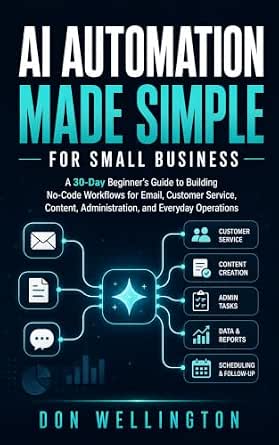 AI Automation Made Simple for Small Business: A 30-Day Beginner’s Guide to No…View on Amazon →
- 10
 AI Automation for Small Business: Simple AI Workflows for Everyday TasksView on Amazon →
- 11
 AI Automation for Small Business: A Practical Guide to Automating Marketing,…View on Amazon →
- 12
 AI for Small Business, Volume I: Getting Started — Set It Up Yourself, No Tec…View on Amazon →
- 13
 AI for Small Business: From Marketing and Sales to HR and OperationsView on Amazon →
- 14
 AI Automation for Small Businesses: Build Semi-Passive Income Systems Without…View on Amazon →
- 15
 AI for Entrepreneurs and Small Business Owners: How to Compete with Larger Bu…View on Amazon →
Choosing a Practical Starting Point
The list addresses a real operational question for small-business owners: where to start with automation when repetitive marketing, sales, customer-service and administrative work competes for limited staff time. A guide that matches a specific task and the owner’s technical confidence may be more useful than a broad introduction that does not address the business’s actual software or process.
But a book cannot, by itself, connect a company’s apps or guarantee that an automated workflow works reliably. Owners need to assess their existing email, customer-management, payment and task systems, then verify compatibility with the software providers. They also need to account for the time required to review generated work, particularly for messages sent to customers or records containing sensitive information.
Products Worth Considering

Apple MacBook Air 13-inch with M5 chip, 16GB Memory, 1TB SSD, Starlight

Apple iPad 11-inch with A16 Chip, 128GB, Wi-Fi 6, and Liquid Retina Display, Silver

Dell UltraSharp U4025QW 40-Inch Curved 5K2K WUHD LED Monitor
As an affiliate, we earn on qualifying purchases.
How the 15-Book Comparison Was Made
The source frames the titles as business learning resources and says it gave weight to practical workflow coverage, accessibility for nontechnical owners and relevance to routine business functions. It contrasts broad guides with books whose titles point to more specific learning paths, such as no-code setup or use of a particular AI assistant.
That method has an explicit limit: the supplied comparison information is largely based on title wording and stated scope, rather than a documented examination of each book’s examples, instructions or software coverage. Readers should check a book description or sample pages before buying if they need detailed setup guidance or support for a particular app.
“These are learning resources, not automation platforms.”
— ThorstenMeyerAI.com roundup
What the Book Titles Cannot Confirm
The source material does not list all 15 titles or provide full reviews of each book. It also does not verify specific instructions, supported apps, integrations, pricing or demonstrated results. Descriptions such as “no-code” or “30-day plan” are signals in a title or stated framing, not proof of how detailed or effective the book’s guidance is.
It is also unclear whether the books address data handling, error monitoring or ongoing maintenance in sufficient detail. Those issues depend on the workflow and the software selected. Owners should verify technical and privacy requirements with the relevant providers rather than assuming a book’s general advice applies to their systems.
Before Trying a Workflow
The source recommends starting with a recurring task that takes noticeable staff time, writing down its current steps and identifying the desired result. A business can then choose a guide aligned with that task and its team’s experience, while checking sample pages for practical instructions and examples.
Before using an automation with customers or business records, owners should verify that the required apps connect, test the workflow on low-risk cases and set rules for human review. The roundup does not report a next publication, product test or follow-up milestone; the next step for readers is to validate a chosen guide’s advice against their own software and operating procedures.
Key Questions
Are these 15 picks automation software?
No. The roundup describes them as books and learning resources. Readers would need separate AI and business software to build and run workflows.
Which book does the source recommend overall?
It names AI Automation for Small Businesses: A Practical Guide to Automating Marketing, Sales, Customer Service, Operations, and Everyday Work as its best overall pick, based on the broad scope indicated by its title.
What does the roundup suggest for beginners?
It points to AI Automation Made Simple for Small Business for its no-code framing and to ChatGPT for Business: The 10X Playbook for workflow ideas. The source does not verify the depth of either book’s instructions.
How should a business choose a guide?
Start with a repetitive task, define its steps and desired outcome, then check whether the guide’s examples and software coverage fit the business. Test any resulting workflow and set human review rules for customer-facing or sensitive work.
Source: ThorstenMeyerAI.com