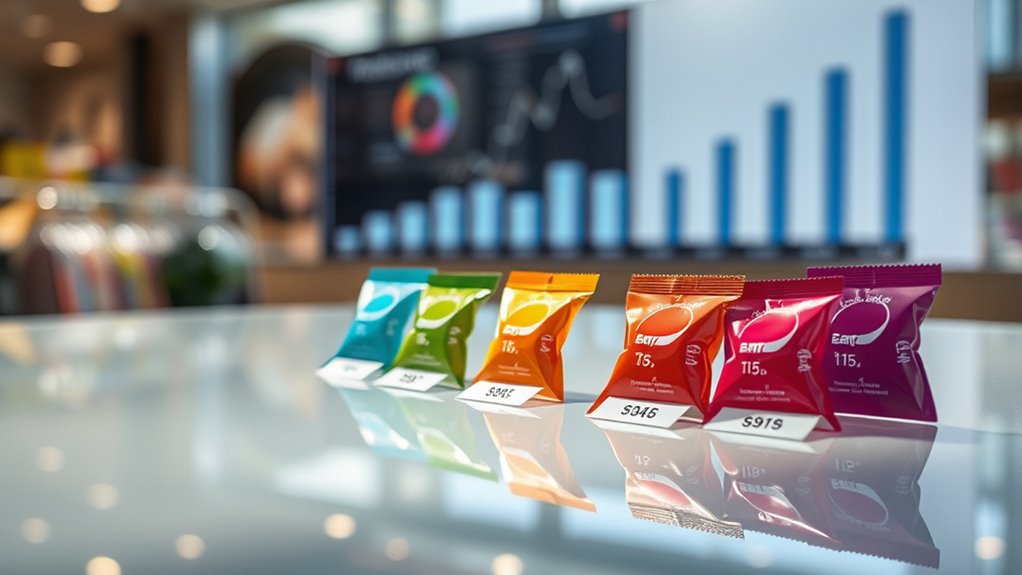

To find the ideal price for your product, start by understanding your customers’ perceptions and behavioral biases, such as pricing just below round numbers. Analyze competitors’ prices to gauge market expectations and position your product accordingly. then, test different price points through methods like A/B testing or limited-time offers. Monitor sales, customer responses, and profit margins to refine your approach. Continuing to explore these strategies will help you identify the most effective pricing to maximize profit.
Key Takeaways
- Start with competitor analysis and consumer psychology insights to select initial price points.
- Use A/B testing or limited-time offers to gather real-world sales and customer response data.
- Monitor sales volume, revenue, and profit margins at different prices to identify trends.
- Adjust prices iteratively based on data patterns and customer feedback for optimal profitability.
- Incorporate visual and psychological cues, like contrast ratios, to influence perceived value and demand.

Have you ever wondered how businesses determine the best price for their products or services? It’s a complex process that combines understanding consumer psychology with thorough competitor analysis. Knowing what customers value and how they perceive prices can make all the difference in setting a price that maximizes profit without turning potential buyers away. When you immerse yourself in consumer psychology, you realize that people don’t always act purely rational; instead, their perceptions, emotions, and biases heavily influence their willingness to pay. For instance, a price just below a round number, like $9.99 instead of $10, can seem considerably cheaper to consumers, even if the difference is minimal. Recognizing these subtle cues helps you craft prices that feel like better deals, increasing the chances of conversions.
Simultaneously, competitor analysis is crucial to guarantee your pricing stays competitive. By examining what similar businesses charge, you gain insights into the market’s expectations and boundaries. If your prices are too high compared to competitors, you risk losing customers to more affordable options. Conversely, pricing too low might suggest inferior quality or erode your profit margins. Comparing features, brand positioning, and customer feedback within your niche allows you to identify where your product fits and how much value customers associate with it. This knowledge equips you to position your prices strategically, balancing affordability with perceived value.
Testing price points isn’t just about setting a number and hoping for the best; it’s an iterative process rooted in data and real-world feedback. Start by selecting a few different price levels based on your competitor analysis and consumer psychology insights. Then, implement these prices in controlled environments—like limited-time offers, A/B testing on your website, or different sales channels. As you gather data, look for patterns: How do sales volumes change? Are there noticeable shifts in customer behavior? Do certain price points generate more revenue or higher profit margins? These insights help you refine your approach, guaranteeing you’re not just guessing but actively learning what works best. Understanding contrast ratio can further inform the perception of value at different price points, as higher contrast ratios often correlate with higher perceived image quality.

iHealth COVID-19, Flu A&B 3-in-1 Antigen Rapid Test, Results in 15 Minutes, FDA Authorized OTC Flu & COVID Home Test, with Non-invasive Nasal Swab, Easy to Use & No Discomfort (1 Pack, 2 Tests Total)
FDA Authorized 15-Minute Flu A&B, COVID Test Kit: Over-the-counter flu and COVID test for home use with rapid…
As an affiliate, we earn on qualifying purchases.
As an affiliate, we earn on qualifying purchases.
Frequently Asked Questions
How Often Should I Re-Test My Product’s Price Points?
You should re-test your product’s price points every few months or when market conditions shift. Regular market research and competitor analysis help you stay ahead, revealing if your prices still match customer demand and industry trends. Keep an eye on customer feedback and sales data, adjusting prices accordingly. This proactive approach guarantees you optimize profit while remaining competitive in a dynamic market.
What Tools Are Best for Conducting Price Testing?
Think of your price testing as charting a course through uncharted waters. You’ll want survey tools like Typeform or Google Forms to gather customer insights, and A/B testing platforms like Optimizely or VWO to compare different prices directly. These tools act as your compass and map, guiding you toward the sweet spot where customers are enthusiastic to buy and your profits soar. Use them wisely, and you’ll navigate to success.
How Do I Interpret Mixed Results From Price Experiments?
When you see mixed results from price experiments, focus on understanding price elasticity and customer segmentation. Recognize that different segments may respond uniquely, influencing overall outcomes. Analyze which groups show sensitivity or resistance to price changes, and identify patterns. Use this insight to tailor your pricing strategies, adjusting for segments that drive revenue and profitability, rather than relying solely on average results.
What if My Target Customers React Negatively to Price Changes?
If your target customers react negatively to price changes, focus on understanding their customer perception and emotional response. Engage with them through surveys or feedback to identify concerns. Adjust your messaging to emphasize value and quality, easing their worries. Consider gradual price adjustments or added benefits to soften the impact. By addressing their emotional response directly, you can rebuild trust and improve the overall perception of your pricing strategy.
Can Testing Price Points Hurt My Brand Reputation?
You’ll be glad to know that only about 20% of customers notice small price changes, so testing price points usually doesn’t hurt your brand perception. If you communicate transparently and stay consistent, your customer trust remains strong. However, frequent or drastic changes might cause confusion. Keep testing thoughtfully, and you’ll fine-tune prices without risking your reputation or alienating loyal customers.

Differential Evolution: A Practical Approach to Global Optimization (Natural Computing Series)
As an affiliate, we earn on qualifying purchases.
As an affiliate, we earn on qualifying purchases.
Conclusion
Now that you know how to test different price points, you’re equipped to find that sweet spot where your product hits the jackpot. Don’t be afraid to experiment—think of it as revealing the secret to unlimited success. The right price isn’t just a number; it’s your ticket to skyrocketing profits and unstoppable growth. So go ahead, test boldly, and watch your sales soar beyond even your wildest dreams!
Price Management: Strategy, Analysis, Decision, Implementation
As an affiliate, we earn on qualifying purchases.
As an affiliate, we earn on qualifying purchases.

Handbook on the Psychology of Pricing: 100+ effects on persuasion and influence every entrepreneur, marketer and pricing manager needs to know
As an affiliate, we earn on qualifying purchases.
As an affiliate, we earn on qualifying purchases.