
TL;DR

Get business pricing on office and shipping supplies
- Business-only prices and quantity discounts
- Tax-exempt purchasing
- Multiple users, one account, clear invoices
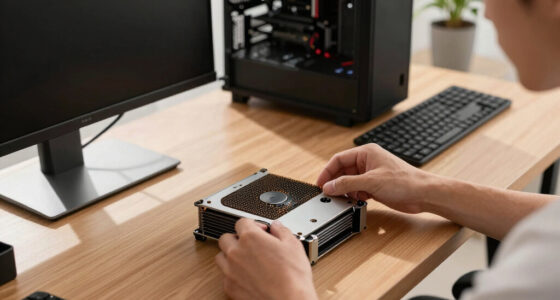
Apple announced the Mac Studio featuring up to 512GB of unified memory, capable of loading large frontier-scale AI models locally. While it can load these models, performance speed and practical use cases vary, and some limitations remain.
Apple has announced a new Mac Studio that can hold up to 512GB of unified memory, capable of loading frontier-scale AI models locally. This development is significant for AI researchers, developers, and privacy-focused users because it offers a desktop solution that can handle large models without relying on cloud infrastructure. While the marketing emphasizes the ability to run these models locally, the actual performance and suitability depend on specific workloads and use cases.
The new Mac Studio, unveiled on 25 August 2026, comes in two configurations: the M5 Max and the M5 Ultra. The M5 Ultra, which is the focus here, features a 36-core CPU, an 80-core GPU, and up to 512GB of unified memory with a bandwidth of 1.2 terabytes per second. This configuration is built by connecting two M5 Max chips via Apple’s UltraFusion interconnect, creating a single, powerful processor with integrated neural accelerators.
Apple claims that the M5 Ultra offers up to 4.3x faster AI performance than the previous M3 Ultra and nearly 10x faster than the M1 Ultra in certain benchmarks. The key feature is the large, unified memory pool that allows loading models with hundreds of billions of parameters directly into local memory, a feat previously limited to data centers with specialized hardware. Preorders are open, with general availability scheduled for September 22, and the high-memory version expected in late October, costing around $10,800 before storage upgrades.
However, the real-world performance and practical usability of this machine for AI workloads depend on several factors, including memory bandwidth and compute capability. While the capacity to load frontier-scale models is a breakthrough, the speed at which these models can be run (throughput) is limited compared to dedicated data center accelerators. This means the Mac Studio is suited for experimentation, development, and small-scale inference rather than large-scale deployment or serving multiple users efficiently.
Impact of the Mac Studio’s Memory Capacity on AI Development
This development is notable because it provides individual researchers and small teams with a desktop device capable of loading large, open AI models that previously required cloud or data center resources. The ability to run frontier-scale models locally enhances data privacy, reduces reliance on cloud infrastructure, and enables faster experimentation. However, users should understand that loading a model is different from running it at high throughput. The machine’s bandwidth and compute limits mean it is best suited for research, prototyping, and small-scale inference rather than production deployment at scale.
As an affiliate, we earn on qualifying purchases.
Background on AI Hardware and Apple’s Silicon Advancements
Prior to this release, running large AI models locally was typically limited to specialized data center hardware with multiple GPUs, high memory bandwidth, and custom accelerators. Apple’s shift to unified memory architecture and the integration of neural accelerators into its silicon has been a key factor enabling this new class of desktop AI hardware. The announcement follows a trend of tech companies seeking to democratize access to large models, which have traditionally been confined to cloud environments due to hardware constraints. The Mac Studio’s release is part of Apple’s broader push into AI and machine learning, leveraging its custom silicon to offer high-performance capabilities on a desktop platform.
“The Mac Studio with 512GB of unified memory is the first desktop capable of running large AI models locally without cloud dependency.”
— Apple spokesperson
AI development workstation with high memory
As an affiliate, we earn on qualifying purchases.
As an affiliate, we earn on qualifying purchases.
Performance and Practical Usability of Frontier Models on Mac Studio
While the Mac Studio can load large frontier-scale models, the actual inference speed remains uncertain for many workloads. Benchmarks measuring real-world performance are still pending, and the impact of memory bandwidth and compute limits means that it may not meet the needs of high-throughput applications or large-scale serving. The software ecosystem for AI development on Apple silicon is still evolving, which could affect workflow compatibility and efficiency.
large memory desktop computer for AI models
As an affiliate, we earn on qualifying purchases.
As an affiliate, we earn on qualifying purchases.
Expected Benchmarks and Software Ecosystem Development
In the coming weeks, independent benchmarks and real-world testing will clarify how well the Mac Studio performs with large AI models across various workloads. Developers and researchers will evaluate its suitability for different tasks, from experimentation to deployment. Additionally, improvements in AI tooling and software support for Apple silicon are anticipated, which could enhance usability and performance. The high-memory models will become available in late October, offering more options for those seeking to leverage this hardware for AI development.
professional AI inference hardware
As an affiliate, we earn on qualifying purchases.
As an affiliate, we earn on qualifying purchases.
Key Questions
Can the Mac Studio run large AI models faster than cloud-based GPUs?
While the Mac Studio can load large models locally thanks to its high memory capacity, its inference speed is limited by bandwidth and compute power compared to dedicated data center GPUs. It is suitable for experimentation and small-scale inference, not high-throughput deployment.
What workloads is the Mac Studio best suited for?
The Mac Studio is ideal for AI research, development, privacy-sensitive inference, and small-team projects where local control and data privacy are priorities. It is less suited for serving many users or large-scale production environments.
Will software limitations affect AI workflows on Apple silicon?
Yes, the AI tooling ecosystem on Apple silicon is still maturing. Some workflows may require porting or optimization, and performance may vary depending on software support and workload complexity.
When will the high-memory models be available?
The 512GB memory configuration is expected to arrive in late October, with preorders already open. Pricing will be significantly higher than the base models due to memory costs.
Does this mean I can replace a GPU cluster with a Mac Studio?
Not entirely. While the Mac Studio can load large models and run them locally, it cannot match the throughput and scalability of dedicated GPU clusters used in production environments.
Source: ThorstenMeyerAI.com
Halloween Picks
halloween
As an affiliate, we earn on qualifying purchases.