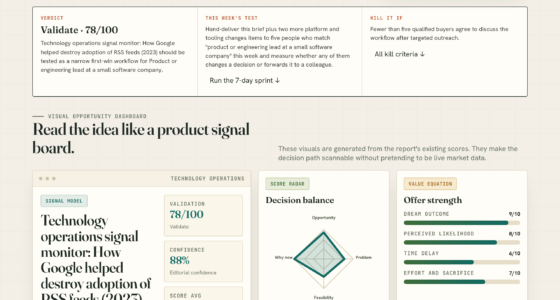
📊 Full opportunity report: Muse Glimmer: 30B Model For 24/7 Agents on IdeaNavigator AI — validation score, market gap, and execution plan.

Get business pricing on office and shipping supplies
- Business-only prices and quantity discounts
- Tax-exempt purchasing
- Multiple users, one account, clear invoices
TL;DR

IdeaNavigator AI has identified a Hacker News item about Muse Glimmer, described as a 30-billion-parameter model for always-on local agents, as a possible signal for operations teams. The available information does not verify the model’s release, technical performance, licensing, or local deployment requirements; it recommends testing the idea through a role-focused monitoring brief.
IdeaNavigator AI has flagged a Hacker News item about Muse Glimmer, described as a 30-billion-parameter model for always-on local agent workflows, as a possible development for operations teams adopting AI. The proposal is not a verified model announcement: it outlines a way to monitor such signals and test whether a short, role-specific briefing helps small-team operations leads make decisions.
The item is framed as an AI operations signal for a particular audience: an operations lead rolling out AI tools across a small team. IdeaNavigator AI says these leads can struggle to catch relevant changes because AI capability and policy news is spread across news sites, forums and filings. Its proposed response is a monitor that filters items for that audience and summarizes what changed, why it may matter and what action to consider.
The proposal says the Muse Glimmer item surfaced on Hacker News with a signal score of 88 out of 100. It does not explain how that score is calculated, what comparison or time window it uses, or whether it represents user engagement, model confidence or another measure. The score should be treated as a property of the proposed monitoring assessment, not as independent evidence of the model’s performance or importance.
The suggested minimum viable product would watch Hacker News and similar feeds for AI capability and policy changes, then filter and brief items for operations leads. To test demand, IdeaNavigator AI proposes hand-delivering the Muse Glimmer brief and two other AI-related updates to five people matching that role this week. The test would track whether a recipient changes a decision or forwards a brief to a colleague; a subscription is the proposed business model, not an established product or revenue stream.
Muse Glimmer: 30B Model For 24/7 Agents
A Hacker News item describes Muse Glimmer as a 30-billion-parameter model for always-on local agents. Its release, capabilities and deployment requirements are unverified; the immediate proposal is to test whether role-focused AI briefings help operations leads.
What the proposal covers
The idea is a monitoring service for small-team operations leads adopting AI tools.
Operations leads
Filter scattered AI capability and policy updates for decisions that may affect a small team.
Short briefings
Explain what changed, why it may matter and what action to consider.
Subscription
A proposed model for the service; no product, price or revenue is established.
From signal to decision
The suggested MVP turns feed items into role-specific updates.
Monitor Hacker News and similar sources for AI capability and policy changes.
Select developments that may affect an operations lead.
Connect the update to a possible team decision or action.
What is known about Muse Glimmer?
The item summary is not enough to support a deployment decision.
- 30-billion-parameter model
- Intended for always-on local agent workflows
- Surfaced on Hacker News
- Developer and release status
- Performance, licensing and safety
- Hardware needs and local deployment
A small demand test
The proposed trial looks for signs that the brief affects real work.
A Test for AI Operations Briefings
For a small team introducing AI tools, the practical question is not simply whether a new model is large or technically interesting. It is whether the development changes tool selection, deployment plans, policies or staff workflows. A filtered briefing could reduce the effort required to spot relevant developments, but the proposal provides no evidence yet that readers will act on it or pay for it.
The Muse Glimmer description also points to issues an operations lead would need to examine before considering an always-on local agent: hardware and operating costs, data handling, reliability, security and human oversight. These are questions prompted by the stated use case, not established facts about this model. Without technical documentation and a specific deployment example, the item alone cannot support a recommendation to adopt it.
The proposed five-person test is a modest way to distinguish attention from operational value. A forward or changed decision would offer an early signal of usefulness, but a small informal trial would not establish broad demand, product-market fit or the reliability of the monitoring system.
Products Worth Considering

Logitech MX Mechanical Wireless Illuminated Keyboard, Tactile Quiet, Graphite

Dell XPS Tower 8960 Desktop, Intel Core i7-13700, NVIDIA GeForce RTX 4060, 16GB DDR5, 512GB SSD

Canon SELPHY CP1500 Compact Photo Printer Bundle with Two KP-108IN Ink and Paper Sets, Black
As an affiliate, we earn on qualifying purchases.
From Model Signal to Team Decision
The material describes a monitoring opportunity and an MVP concept, rather than a conventional product launch report. It identifies a specific intended user, a problem—scattered AI updates—and a proposed service that converts selected items into briefings. No launch date, model developer, technical paper, repository or product page is included for Muse Glimmer.
In the proposed workflow, feeds such as Hacker News supply candidate developments, a role-based filter selects what may affect an operations lead, and a short brief connects the item to a possible decision. The stated rationale is that AI capabilities and policies can change quickly enough that a same-day update may be more useful than a generic weekly roundup. That is the proposal’s reasoning; no comparison of response times or user outcomes is provided.
The business concept is a subscription for early, role-filtered AI updates. The immediate validation step is to deliver three briefs to five matching readers and observe whether they affect a decision or are shared. The stated test measures those reactions, but gives no pricing, recruitment method, duration beyond “this week,” or threshold for deciding whether to proceed.
Model Details Still Unverified
The available information does not establish who developed Muse Glimmer, whether it has been released, or where the original Hacker News post can be reviewed. It also supplies no model card, benchmark results, licensing terms, hardware requirements, safety evaluations or evidence that the model can run continuously on local equipment. The 30-billion-parameter description and always-on use case are claims in the item summary, not independently documented findings here.
It is also unclear how IdeaNavigator AI produced the 88/100 signal score, what feeds the proposed monitor would cover beyond Hacker News and similar sources, and how it would distinguish consequential changes from routine announcements. No results from the five-person validation test, subscription price, or evidence of existing customers are provided. The proposal therefore supports reporting on a potential monitoring service, not a conclusion that the model or business has been validated.
Five-Reader Validation Is Proposed
IdeaNavigator AI proposes delivering the Muse Glimmer brief and two additional AI capability or policy updates to five people who fit the target operations role this week. The planned indicators are whether a recipient changes a decision or forwards an item to a colleague. No completed test or result is reported, and no follow-up date is given.
For the model itself, the next useful evidence would be a verifiable developer announcement, technical documentation and reproducible information about local deployment. For the monitoring idea, a next step would be to report the test’s reader responses, explain how the signal score and relevance filter work, and state whether any subscription offering is being developed.
Until those details are available, operations teams can treat the item as a prompt for further verification, not as a confirmed recommendation to deploy Muse Glimmer or change an AI rollout plan.
Source: IdeaNavigator AI
Key Questions
What is Muse Glimmer?
The item is described as a 30-billion-parameter model intended for always-on local agent workflows. The available information does not identify its developer or provide documentation confirming its release or capabilities.
Has Muse Glimmer been independently verified?
No verification is included here. The description, model size and intended workflow are presented in the item summary, without a model card, benchmark results or deployment evidence.
What is IdeaNavigator AI proposing?
It proposes a monitor that filters AI capability and policy updates for operations leads and turns relevant items into briefings covering what changed, why it matters and what to do.
What does the 88/100 score mean?
The proposal reports that score for the Hacker News signal but does not explain its calculation, comparison baseline or time window. It should not be read as a measure of model performance.
What happens next?
The proposed next step is to deliver three briefs to five operations leads and observe whether the information changes a decision or is forwarded. Results have not been provided.
Source: IdeaNavigator AI