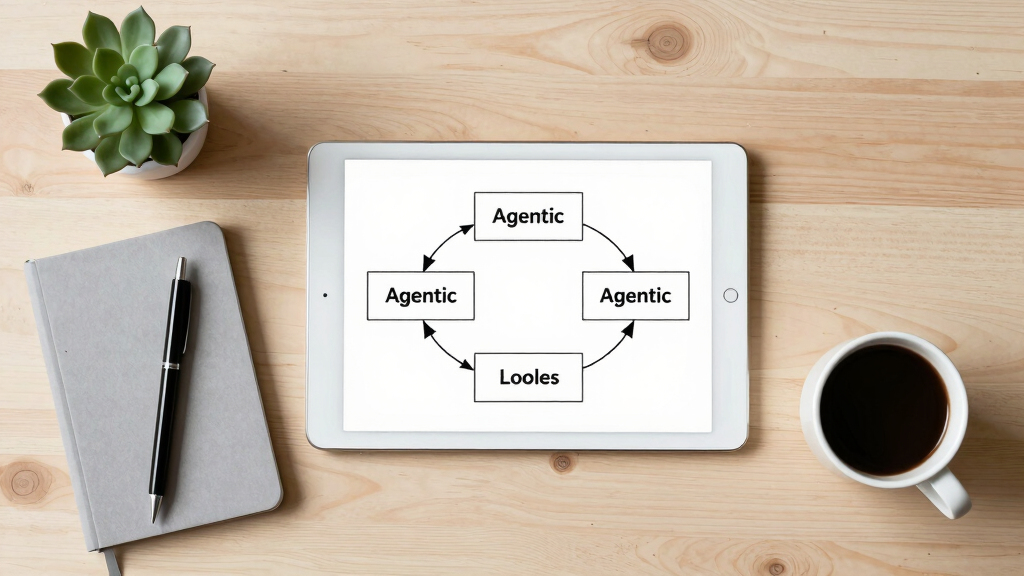

📊 Full opportunity report: The Delegation Ladder: The Four Agentic Loops, And What Each One Lets You Stop Doing on ThorstenMeyerAI.com — validation score, market gap, and execution plan.
TL;DR
The article explains the four levels of agentic loops in AI engineering, from turn-based checks to fully autonomous processes. Each rung offers different control and efficiency benefits, shaping how AI systems are managed.
Anthropic’s Claude Code team has formalized a four-rung framework for AI loops, defining how control shifts from human oversight to autonomous operation. This development clarifies how different levels of delegation impact AI system design, management, and efficiency. It matters because understanding these loops helps businesses and developers optimize AI workflows while maintaining control and quality.
The framework categorizes AI loops into four levels, each representing a degree of delegation. Rung 1 — Turn-based involves the human handing off verification tasks to the agent, which checks its own work before returning results. This is the most basic form, akin to current prompt-based interactions with added self-verification.
Rung 2 — Goal-based allows the agent to decide when to stop based on predefined success criteria, reducing human oversight in completion. This is useful for iterative tasks where the agent can determine when a goal is achieved, such as reaching a performance score or passing a test suite.
Rung 3 — Time-based introduces scheduled or event-driven triggers, enabling the system to run routines automatically at set intervals or in response to external events. This level supports ongoing monitoring and updates, like checking pull requests or summarizing daily reports without human intervention.
Rung 4 — Proactive removes human prompts entirely, creating autonomous workflows triggered by events or schedules. These systems can orchestrate multiple agents, handle complex workflows, and operate continuously, exemplified by feedback pipelines that triage bug reports or manage large-scale data processing.
Anthropic emphasizes that not all tasks require the highest level of automation. They advise starting with simple loops and only climbing the ladder as tasks justify greater delegation, balancing control, cost, and quality.
The delegation ladder: four agentic loops, and what each lets you stop doing
Strip the hype and a “loop” is simple — an agent repeating work until a stop condition is met. The useful lens isn’t the mechanics, it’s what you hand off. Four loop types = four rungs of delegation, from a tool you operate to a process that runs.
The whole framework reduces to one question about your own work: where am I the bottleneck, and which single piece can I hand off? Can you write the check? Is the goal concrete? Does the work arrive on a schedule? That answer picks your rung — and you climb one step at a time. The real skill isn’t operating a loop; it’s the judgment of what to delegate and how far — enough hands off to gain leverage, enough on the wheel that “runs without you” doesn’t become “runs away from you.”
Implications for AI System Design and Management
This framework offers a clear map for businesses and developers to understand how much control they can delegate to AI systems. By choosing the appropriate rung, organizations can optimize efficiency, reduce manual oversight, and scale operations while maintaining necessary checks. It also highlights the importance of system discipline—such as verification mechanisms and clean code—to ensure high-quality outcomes as automation levels increase.
Understanding these loops informs strategic decisions about AI deployment, especially in high-stakes or complex workflows. It encourages a cautious approach—start simple and only escalate delegation when justified—helping prevent potential failures or quality issues from over-automation.
Building AI Agents for Network Operations: Design LLM-powered NetOps workflows with Python, Ollama, MCP, and tool calling
As an affiliate, we earn on qualifying purchases.
As an affiliate, we earn on qualifying purchases.
Evolution of AI Control Frameworks
The concept of looping in AI is not new, but Anthropic’s formalization provides a structured way to think about delegation. Historically, AI systems operated mainly at the prompt level, with humans overseeing outputs. Recent advances in model capabilities and automation have prompted a shift toward more autonomous systems.
This framework builds on prior ideas of iterative prompting and automation, offering a ladder that guides developers in progressively reducing human involvement. It aligns with broader trends toward autonomous AI workflows seen in industry applications, from customer service bots to data pipelines.
Anthropic’s emphasis on system integrity and verification reflects ongoing concerns about AI reliability and control, especially as systems become more autonomous and complex.
“This ladder clarifies how control can be systematically delegated, helping both technical teams and business leaders make informed decisions about AI automation.”
— Thorsten Meyer, AI researcher
Robotic Process Automation: Guide To Building Software Robots, Automate Repetitive Tasks & Become An RPA Consultant
As an affiliate, we earn on qualifying purchases.
As an affiliate, we earn on qualifying purchases.
Unanswered Questions About Practical Implementation
While the framework is well-defined, it remains unclear how organizations will implement these loops at scale, especially in complex or high-stakes environments. Specific best practices for transitioning between levels, managing costs, and ensuring safety are still emerging. Additionally, the impact on human oversight and accountability in fully autonomous systems requires further exploration.

AI Orchestration Systems: AI Orchestration Guides | Business Process Automation | AI in Business Transformation | Adaptive Workflow Systems | Modern AI Technologies | Scalable Automation Platforms
As an affiliate, we earn on qualifying purchases.
As an affiliate, we earn on qualifying purchases.
Next Steps for Adoption and Standardization
Organizations are likely to experiment with these loops in controlled settings, gradually increasing automation levels while monitoring outcomes. Industry groups and standards bodies may develop guidelines to support safe and effective deployment. Further research will focus on integrating verification mechanisms and managing the transition between loop levels without compromising quality or safety.

Claude Code & Cursor Mastery Handbook (2026): Build Autonomous AI Software Systems with Agentic Workflows, Multi-Agent Architectures, and Production-Ready Pipelines
As an affiliate, we earn on qualifying purchases.
As an affiliate, we earn on qualifying purchases.
Key Questions
What is the main purpose of the four-agentic loops framework?
The framework helps define how control and delegation in AI systems can be structured, from simple turn-based checks to fully autonomous workflows, enabling better management and scaling of AI applications.
How does this framework impact AI safety and quality?
By encouraging the use of verification, goal-setting, and disciplined system design at each level, it aims to maintain high standards of safety and quality as automation increases.
Can organizations skip levels on the ladder?
Yes, the framework suggests starting at the simplest effective level and only climbing when the task justifies it, balancing control, cost, and risk.
What are the risks of fully autonomous loops?
Potential risks include loss of oversight, unintended behavior, and reduced accountability, which is why careful system design and verification are crucial at higher levels.
Source: ThorstenMeyerAI.com