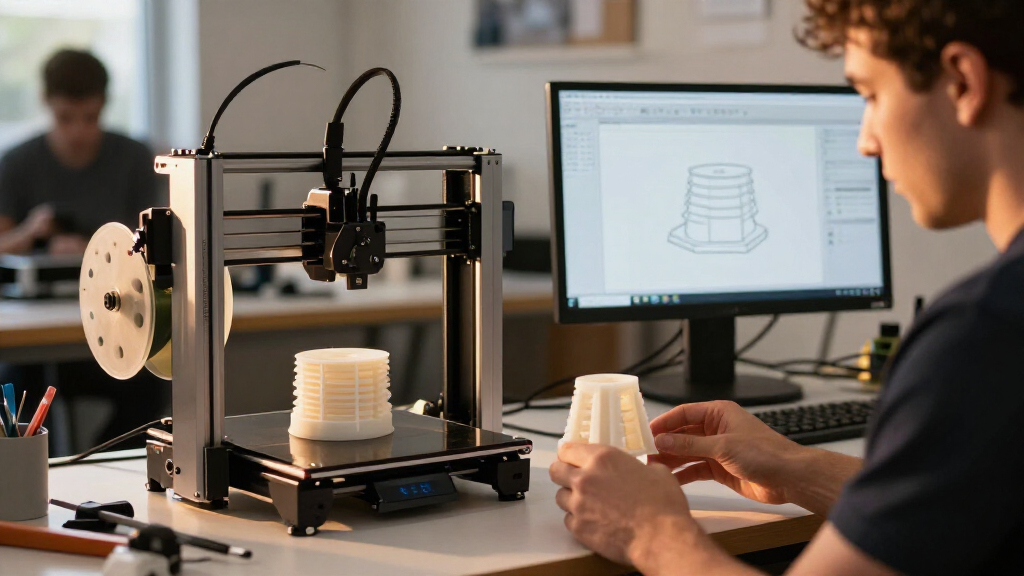

🔍 Read the full analysis: Where AI Helps Most In 3D Printing—and Where Expectations Run High on ThorstenMeyerAI.com

Get business pricing on office and shipping supplies
- Business-only prices and quantity discounts
- Tax-exempt purchasing
- Multiple users, one account, clear invoices
TL;DR
A November 29 report from ThorstenMeyerAI.com finds the clearest current uses for AI in 3D printing are generative design and monitoring nozzle-based printers for errors. The report says text-to-CAD is not yet reliable enough to trust, and AI-generated or optimized parts still require human review and physical testing.
AI is already helping with 3D-printed part design and printer monitoring, but it cannot yet turn a text prompt into a part that can be trusted without expert checks, according to a report published November 29 by ThorstenMeyerAI.com. The report points to NASA generative-design work and a University of Cambridge printer-monitoring system while stressing that parts carrying loads still need engineering review and physical tests.
The report identifies generative design as the strongest documented use case. At NASA’s Goddard Space Flight Center, research engineer Ryan McClelland uses commercial software to produce shapes based on requirements entered by engineers, such as connection points, bolt locations and areas the structure must avoid. The software then proposes a design by repeatedly evaluating how forces move through it and removing material that carries little stress.
For a bracket designed for NASA’s EXCITE balloon telescope, McClelland’s paper says two expert engineers spent two days on a conventional design. The AI-assisted version took about 30 minutes for one engineer to enter requirements and about an hour of computing, the paper reports. Those figures describe that specific example, not a general measure of time saved across projects. The supplied source excerpt does not give a full account of the comparison’s final performance results.
AI can also monitor some printers as they work. The report describes a University of Cambridge system that learned to identify and correct common nozzle errors during a print. This application concerns material-extrusion printers, which build parts by laying down melted material. The report says text-to-CAD systems remain research rather than dependable production tools: generated code that runs does not prove that the resulting model is dimensionally or mechanically correct.
From idea to printed part: where AI looks over your shoulder
The orange marker shows where AI helps today. The last word still belongs to a real test.
Design: you set the loads, bolts and keep-out zones. The software proposes the shape.
Check: simulation predicts how the part bends. Only a real test shows how strong it is.
Print: a camera next to the nozzle spots common errors and corrects them during the print.
Every step: AI guesses from patterns. For parts that carry weight, people still test.
Where AI Can Save Engineering Time
The distinction matters because a convincing design is not necessarily a safe or functional part. Generative design can reduce material and shorten design work when engineers specify the right loads, constraints and clearances. But the computer only addresses the conditions it is given. An omitted force, fastener or required space can lead to a polished-looking result that fails its purpose.
Printer monitoring could help catch visible production problems sooner, especially for people using nozzle-based machines. But the report frames a camera system as an additional check, not a guarantee. Users still need to inspect early layers and assess the finished object. For parts that carry weight, protect people or are used in flight, the practical stakes are higher: a missed defect or flawed assumption can have consequences beyond a wasted print.
The report also notes that US intellectual-property rules do not treat AI as a human creator or inventor. It says purely AI-made output receives no US copyright and only humans can be named as inventors. Those legal points are separate from whether a part works, but they matter to organizations deciding how to document and protect AI-assisted design work.
Products Worth Considering

Apple MacBook Air 15-inch with M5 chip, 32GB memory, 512GB SSD, Midnight

Canon SELPHY CP1500 Wireless Compact Photo Printer Bundle with Ink, Paper, and Shoulder Bag

FLEXISPOT Adjustable Bed Base with Massage and Zero-Gravity Position, Queen
As an affiliate, we earn on qualifying purchases.
From CAD Model to Printed Part
The report follows the usual production path: an engineer creates a model in computer-aided design (CAD), checks its behavior through analysis or simulation, and sends it to a slicer. The slicer divides the model into layers and generates machine instructions, often called G-code. A printer then follows those instructions to build the object layer by layer.
AI can enter at several points, but each point has different limits. Generative-design software proposes a shape from human-defined requirements; simulation and engineering checks help evaluate it; and printer-monitoring software can look for errors during production. These functions do not amount to a single system that reliably takes an idea in plain language through design, validation and manufacturing.
The report cites NASA material describing repeated iterations as common in additive manufacturing because unexpected print failures occur. It also says a NASA engineer has cautioned that an algorithm “can sometimes make structures too thin.” NASA’s AI-designed parts still go through stress analysis and testing. That process is a useful reminder that software-generated geometry does not replace the engineering checks applied to consequential hardware.
““Code that runs is not the same as a part that is right.””
— ThorstenMeyerAI.com report
Limits of Current AI Print Tools
The source describes promising examples, but it does not establish how often generative design or printer monitoring improves outcomes across different machines, materials and industries. The NASA time comparison is a single bracket example, and the excerpt does not provide enough information to judge its full performance against the conventional design. The Cambridge system is described as detecting and correcting common nozzle errors, but the source does not give its error rates or explain how it performs across printers and print conditions.
It is also unclear when text-to-CAD systems might become reliable enough for routine engineering use. The report provides no timeline or broad benchmark for that step. More generally, AI predictions are based on data patterns; the report’s central caution is that those predictions cannot substitute for a person’s assessment of requirements or for testing a finished part.
Human Checks Remain the Next Step
For now, users should treat AI design and monitoring features as aids within an established workflow. Home users can use printer cameras as another way to spot problems, while still checking early layers and inspecting completed prints. Engineering teams can use generative design to explore shapes, then verify that the requirements are complete and that the proposed part performs as intended.
For flight hardware and other high-consequence applications, the report points to the existing pattern: stress analysis followed by testing. The next useful evidence will be broader results showing how AI systems perform across materials, machines and real production conditions. Until then, the report’s practical conclusion is restrained: AI can help at specific stages, but people remain responsible for validating the part.
Key Questions
Where is AI most useful in 3D printing today?
The report identifies generative design and printer monitoring as its clearest current uses. Generative-design tools propose part shapes from constraints supplied by engineers; monitoring systems can flag or correct some printing errors.
Can AI turn a text prompt into a reliable 3D-printed part?
Not reliably, according to the report. It describes text-to-CAD as a research area and says that code or a model that appears to work is not proof that the resulting part is correct or safe.
Does an AI-designed part still need testing?
Yes. The report says parts that carry loads or have safety uses still need human review, engineering analysis and physical testing. NASA’s AI-designed work follows those checks.
Can a printer camera guarantee a successful print?
No guarantee is established in the report. A camera system may detect common nozzle problems, but users should continue checking prints, including their early layers and finished parts.
Source: ThorstenMeyerAI.com