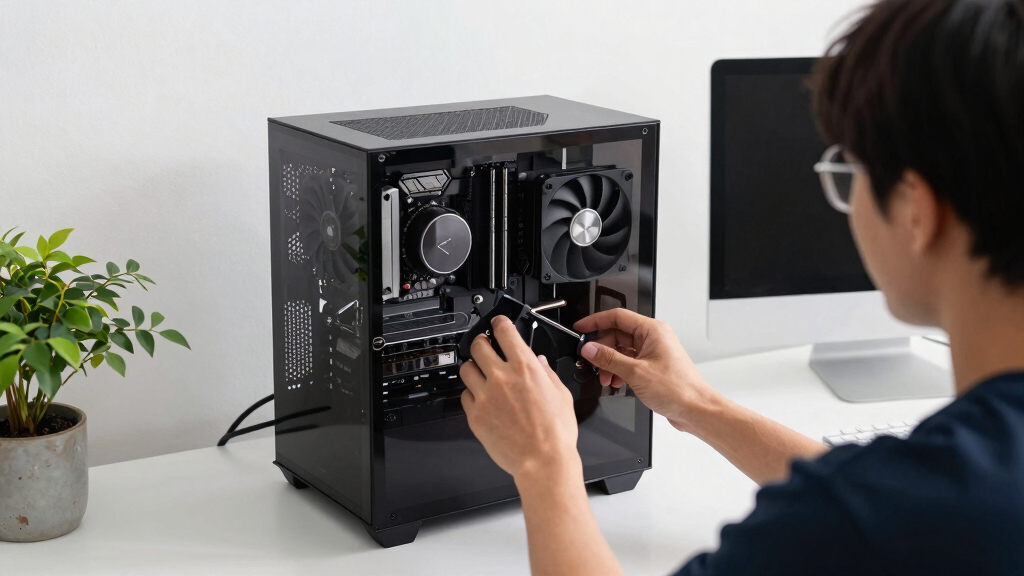

📊 Full opportunity report: Quiet GPUs for Local AI: Acoustic and Thermal Roundup on ThorstenMeyerAI.com — validation score, market gap, and execution plan.
Play games included with Prime
Start a Prime free trial and play with Amazon Luna on your devices.
Start playingAs an affiliate, we earn on qualifying purchases.
TL;DR
This article reviews the most silent and thermally efficient GPUs for local AI in 2026, emphasizing undervolting and cooling strategies. The RTX 5090 stands out as the top choice, but many models can be optimized for quiet operation.
In 2026, the most powerful GPUs for local AI can be made significantly quieter and cooler through undervolting and improved cooling designs, with the RTX 5090 emerging as the top consumer choice for quiet, high-performance inference.
This roundup evaluates GPUs based on their acoustic and thermal profiles, emphasizing that power management and cooler design are more influential on noise levels than silicon alone. The RTX 5090, with 32GB VRAM, is identified as the leading option for a high-end, quiet AI rig, especially when paired with a good cooling solution and power capping. For budget-conscious users, the RTX 4090 or used RTX 3090 offer reliable alternatives with manageable noise profiles. Mid-tier options like the RTX 5080 and RTX 4060 Ti provide efficient, low-power solutions suitable for smaller models, while the RTX PRO 6000 Blackwell with 96GB VRAM targets professional, dense deployment scenarios. Experts advise undervolting and choosing partner cards with large, slow-spinning fans and zero-RPM modes to minimize noise, demonstrating that cooling and power limits are the critical factors in quiet GPU operation.Quiet GPUs
for local AI.
The GPU makes ~70% of your heat and most of your noise. But here’s the secret: the chip doesn’t decide how loud your card is — the cooler design and your power settings do. Match your VRAM tier in Part 2, then make it quiet.
Capping to 70–80% sheds a huge amount of heat for almost no inference loss — because inference is memory-bound. A capped 5090 is dramatically cooler & quieter than stock. Do this first.
Within one GPU model, partner cards differ enormously. For a single card, a large triple-fan open-air with zero-RPM idle runs slow & quiet. For multi-GPU, the calculus flips →
With room to breathe, a large triple-fan open-air cooler spreads heat across a big fin stack and runs its fans slowly. The quietest choice — what most people should buy.
Why Quiet GPUs Matter for Local AI Setups
Quiet, well-cooled GPUs are essential for local AI applications because they reduce noise pollution and heat output, making high-performance inference feasible in smaller or shared workspaces. Proper thermal and acoustic management extends hardware lifespan and improves user comfort, especially for continuous operation. The ability to undervolt and select optimal cooling solutions allows users to build powerful yet unobtrusive AI rigs, broadening accessibility for individual developers and small labs. This shift toward quieter hardware also influences GPU design priorities, encouraging manufacturers to innovate cooling and power efficiency, which benefits the entire AI community.As an affiliate, we earn on qualifying purchases.
2026 GPU Landscape and Cooling Strategies
In 2026, GPU options for local AI are defined by VRAM tiers, with high-end models like the RTX 5090 offering 32GB VRAM and professional cards with 96GB. The importance of undervolting and cooling design has grown, as many high-performance cards are inherently loud and hot. Previous models such as the RTX 4090 and RTX 3090 continue to serve as cost-effective options, especially when paired with efficient cooling and power management. The industry has increasingly focused on thermal solutions like large triple-fan designs and zero-RPM modes, enabling quieter operation under sustained loads. This evolution reflects a broader trend toward balancing raw performance with practical acoustics and thermal management in local AI deployments."Power-capping and choosing the right cooling variant are the most effective ways to significantly reduce GPU noise and heat, regardless of silicon design."
— Thorsten Meyer, AI hardware expert
thermal cooling GPU for AI inference
As an affiliate, we earn on qualifying purchases.
As an affiliate, we earn on qualifying purchases.
Remaining Questions About GPU Quietness in 2026
It is not yet clear how different partner cooler designs will perform in diverse multi-GPU setups or how firmware updates might further improve noise profiles. Additionally, the long-term impact of undervolting on GPU durability and performance stability under continuous AI workloads remains under observation. The availability and pricing of top-tier quiet models could also influence adoption trends.As an affiliate, we earn on qualifying purchases.
Future Developments in Quiet GPU Technology
Upcoming GPU releases are expected to feature integrated cooling innovations, further optimized power management, and firmware enhancements aimed at reducing noise. Manufacturers may also introduce more customizable cooling solutions and software controls, enabling users to fine-tune acoustics and thermal performance. Industry focus on quiet operation is likely to drive broader adoption of undervolting techniques and specialized cooler designs, shaping the next generation of AI hardware for local deployment.GPU cooling solutions for quiet operation
As an affiliate, we earn on qualifying purchases.
As an affiliate, we earn on qualifying purchases.
Key Questions
Which GPU is the quietest for local AI in 2026?
The RTX 5090, when paired with a good cooling solution and power capping, is considered the quietest high-performance option for local AI in 2026.
Can I make a high-power GPU like the RTX 5090 quieter?
Yes, undervolting and choosing partner cards with large, slow-spinning fans and zero-RPM modes can significantly reduce noise and heat output, making high-power GPUs much quieter during inference.
Are mid-tier GPUs suitable for quiet local AI setups?
Yes, models like the RTX 5080 and RTX 4060 Ti offer efficient, low-power operation with less heat and noise, ideal for smaller models and moderate workloads.
What cooling strategies are recommended for quiet GPUs?
Large triple-fan open-air designs with generous heatsinks and zero-RPM idle modes are highly effective for minimizing noise during sustained AI inference tasks.
Will future GPU models improve in noise and thermal management?
Likely yes; upcoming releases are expected to incorporate advanced cooling solutions, firmware optimizations, and better power management to further reduce noise and heat in local AI hardware.
Source: ThorstenMeyerAI.com
NFL season / tailgating Picks
team gear
As an affiliate, we earn on qualifying purchases.