For most offices, I’d start with the BUNN VPR: its straightforward pour-over setup and upper and lower warmers suit teams that need brewed coffee ready throughout the day. The Keurig K-1500 is a stronger fit when staff want individual cups, while the NUPANT airpot brewer offers a thermal serving option for meetings and shared spaces. The main choice is between batch capacity and simpler serving, versus single-cup variety and less leftover coffee; water-line models also trade easier refilling for more involved setup. Read on for how all 14 options compare and which office needs each one best serves.

Get business pricing on office and shipping supplies
- Business-only prices and quantity discounts
- Tax-exempt purchasing
- Multiple users, one account, clear invoices
Complete the kit


Key Takeaways
- BUNN VPR is the batch-brewing standout: its two warming surfaces suit offices that want coffee ready in more than one carafe, though it needs manual water filling.
- Keurig’s commercial models serve a different office rhythm: K-1500, K155 Office Pro, and K-2500 make individual cups instead of shared batches, reducing pot waste but requiring compatible pods.
- NUPANT’s airpot brewers prioritize serving flexibility: thermal carafes keep coffee available without relying on a hot plate, making them a distinct fit for meetings and communal areas.
- Several drip models differ mainly by serving capacity: the VEVOR three-carafe and SYBO three-warmer options favor simultaneous availability, while simpler two-carafe brewers take up less serving space.
- Auto-fill is a workflow choice, not an automatic upgrade: NUPANT’s water-line models reduce repeated manual filling but call for a suitable installation point and plumbing access.
| VONCI 12-Cup Commercial Drip Coffee Maker with 2 Carafes and 2 Warmers |  | Best for Fast, Shared-Batch Service | Capacity: 12 cups; 1.8 liters per carafe | Wattage: 1610 watts | Voltage: 110 volts | VIEW LATEST PRICE | See Our Full Breakdown |
| Keurig K-1500 Commercial Single-Serve Coffee Maker, Black |  | Best for Small Offices and Individual Cups | Model: K1500 | Brew sizes: 6, 8, 10, and 12 ounces | Water reservoir: 96 ounces | VIEW LATEST PRICE | See Our Full Breakdown |
| BUNN VPR 12-Cup Commercial Pourover Coffee Brewer with Upper and Lower Warmers |  | Best for High-Volume, Flexible Placement | Model: VPR | Brewer type: Manual pourover | Brewing output: Up to 3.8 gallons per hour | VIEW LATEST PRICE | See Our Full Breakdown |
| VEVOR 12-Cup Commercial Drip Coffee Maker with 3 Carafes and Warming Plates |  | Best for Multiple Pots in Rotation | Capacity: 1.9 quarts; 12–13 cups | Brewing time: About six minutes per pot | Carafes and warmers: Three glass carafes and three warming plates | VIEW LATEST PRICE | See Our Full Breakdown |
| NUPANT Commercial Airpot Coffee Brewer 14-Cup with 74oz Thermal Carafe and Direct Water Line |  | Best Premium Fit for Plumbed Coffee Stations | Brew capacity: 14 cups | Thermal carafe capacity: 2.2 liters (74 ounces) | Water connection: Direct water line with integrated filter | VIEW LATEST PRICE | See Our Full Breakdown |
| 12-Cup Commercial Drip Coffee Maker, 1.8 L |  | Best for Back-to-Back Pots | Capacity: 1.8 L (12 cups) per carafe | Power: 1450 W | Carafes included: 2 glass carafes | VIEW LATEST PRICE | See Our Full Breakdown |
| NUPANT 12-Cup Commercial Drip Coffee Maker with Auto-Fill Water Line, Two Glass Carafes and Warming Plates |  | Best for Plumbed-In Convenience | Model: ARB-386-BD2 | Capacity: 1.8 liters (12 cups) | Wattage and voltage: 1610 W; 120 V | VIEW LATEST PRICE | See Our Full Breakdown |
| SYBO SF-CB-3GA Commercial Coffee Maker with 3 Warmers and Decanters |  | Best for Shared, High-Turnover Service | Model: SF-CB-3GA | Capacity: 12 cups | Power and voltage: 950 W; 120 V | VIEW LATEST PRICE | See Our Full Breakdown |
| SYBO 12-Cup Commercial Pour Over Coffee Maker SF-CB-2GA |  | Best for Compact Batch Brewing | Capacity: 12 cups | Power and voltage: 2500 W; 120 V | Dimensions: 13.9 × 8.2 × 16.5 inches (D × W × H) | VIEW LATEST PRICE | See Our Full Breakdown |
| Keurig K155 Office Pro Single Cup Commercial K-Cup Pod Coffee Maker, Silver |  | Best for Individual Cup Preferences | Model: K155 Office Pro | Reservoir capacity: 90 oz (2.9 quarts) | Brew sizes: 4, 6, 8, and 10 oz | VIEW LATEST PRICE | See Our Full Breakdown |
| Keurig K-2500 Single Serve Commercial Coffee Maker |  | Best for Flexible Single-Serve Service | Brewer type: Commercial single-serve drip coffee machine | Compatible pods: K-Cup | Cup sizes: Five | VIEW LATEST PRICE | See Our Full Breakdown |
| NUPANT Auto-Filling Commercial Airpot Coffee Brewer 2.2L/74oz with Thermal Carafe |  | Best for Hands-Off Group Service | Model: RPA-386 | Capacity: 2.2L / 74 oz. | Water supply: Direct-line automatic filling | VIEW LATEST PRICE | See Our Full Breakdown |
| VEVOR 12-Cup Commercial Drip Coffee Maker with Two Glass Carafes |  | Best for Straightforward Batch Brewing | Model: RB-286 | Capacity: 12 cups | Brewing time: About 6 minutes | VIEW LATEST PRICE | See Our Full Breakdown |
| TQS CAFE Commercial Coffee Maker, Double 12-Cup Stainless Steel |  | Best for Parallel Brewing | Brewer type: Double commercial coffee maker | Brewing stations: Two independent stations | Total capacity: 24 cups total (2 x 12 cups) | VIEW LATEST PRICE | See Our Full Breakdown |
| commercial coffee makers for office | Dimensions | Weight | Capacity | Model |
|---|---|---|---|---|
| VONCI 12-Cup Commercial Drip C | 14 × 8.2 × 16.5 inches | 13.7 pounds | 12 cups; 1.8 liters per carafe | — |
| Keurig K-1500 Commercial Singl | 10.3 × 12.4 × 12.1 inches | 10.2 pounds | — | K1500 |
| BUNN VPR 12-Cup Commercial Pou | 8.7 × 21.8 × 20.2 inches | 19.6 pounds | — | VPR |
| VEVOR 12-Cup Commercial Drip C | 15.94 × 15.94 × 17.91 inches | 18.7 pounds | 1.9 quarts; 12–13 cups | — |
| NUPANT Commercial Airpot Coffe | 16 × 8 × 24 inches | 20.1 pounds | — | — |
| 12-Cup Commercial Drip Coffee | — | — | 1.8 L (12 cups) per carafe | — |
| NUPANT 12-Cup Commercial Drip | 15.94 × 8.07 × 17.91 inches (D × W × H) | — | 1.8 liters (12 cups) | ARB-386-BD2 |
| SYBO SF-CB-3GA Commercial Coff | 14.1 × 16.3 × 17.3 inches (D × W × H) | 17 lb | 12 cups | SF-CB-3GA |
| SYBO 12-Cup Commercial Pour Ov | 13.9 × 8.2 × 16.5 inches (D × W × H) | 16.4 lb | 12 cups | — |
| Keurig K155 Office Pro Single | 10.38 × 14 × 13.8 inches (D × W × H) | 6 lb | — | K155 Office Pro |
| Keurig K-2500 Single Serve Com | 8 x 14.25 x 13 inches | 15 pounds | — | — |
| NUPANT Auto-Filling Commercial | — | — | 2.2L / 74 oz. | RPA-386 |
| VEVOR 12-Cup Commercial Drip C | 17.2 x 8.15 x 24.41 inches | 13.7 pounds | 12 cups | RB-286 |
| TQS CAFE Commercial Coffee Mak | 15 x 20 x 8 inches | 17 pounds | — | — |
More Details on Our Top Picks
VONCI 12-Cup Commercial Drip Coffee Maker with 2 Carafes and 2 Warmers
For an office that serves brewed coffee to a group at once, I’d favor the VONCI’s two-carafe setup over the Keurig K-1500’s individual pod format. Its stated seven-minute brew time helps refill the serving station quickly, while two warming plates let staff keep a second pot ready without interrupting the first. The 9-hole spray head is designed to distribute water evenly across the grounds, a useful feature when consistency matters across full batches.
The tradeoff is that this is a hands-on brewer: staff need to load #4 paper filters and adjust brew strength manually. It also takes more counter commitment than the compact K-1500, and its warming plates suit offices that serve coffee promptly better than teams that want brewed coffee held without ongoing heat. I’d choose it over the BUNN VPR when included carafes and a smaller footprint matter more than high-volume output.
Pros:- Two carafes and two warming plates support serving one pot while another is brewing or waiting.
- Stated seven-minute brew time helps replenish a shared coffee station quickly.
- 9-hole spray head is designed for even water distribution over the grounds.
- Stainless steel housing is straightforward to wipe clean.
Cons:- Requires disposable #4 paper filters, adding a recurring supply and restocking task.
- Manual brew-strength adjustment asks staff to manage each batch.
- At 13.7 pounds, it is less convenient to move than the Keurig K-1500.
Best for: Small and midsize offices that serve several people at once and want two batches available on warmers.
Not ideal for: Teams that prefer individual drink choices, minimal staff involvement, or coffee held in an insulated container instead of on a hotplate.
- Capacity:12 cups; 1.8 liters per carafe
- Wattage:1610 watts
- Voltage:110 volts
- Carafes and warmers:Two tempered glass carafes and two warming plates
- Filter:#4 paper
- Dimensions:14 × 8.2 × 16.5 inches
- Weight:13.7 pounds
- Certification and warranty:ETL Safety Certified; 12 months
Our verdict“Choose the VONCI if your office needs quick, shared pots and two ready-to-serve carafes more than pod convenience or insulated storage.”
Keurig K-1500 Commercial Single-Serve Coffee Maker, Black
I’d place the Keurig K-1500 ahead of batch brewers for a small team where people arrive at different times and want their own cup. Its four brew sizes and STRONG button let each person adjust the serving without asking someone to make a shared pot. The 96-ounce reservoir also means fewer refills than many single-serve machines, while Quiet Brew Technology is a practical fit for open offices where brewing noise can interrupt calls.
That convenience comes with a different kind of office overhead: staff need compatible K-Cup pods, and single servings are a poor match for a busy meeting that needs coffee for a group. Compared with the VONCI, the K-1500 gives people more individual choice but cannot keep multiple full carafes ready. Its stated use is for businesses of up to 15 employees, so I’d skip it for larger teams with steady, high-volume demand.
Pros:- Four brew sizes accommodate different mug sizes and serving preferences.
- STRONG button gives users a bolder brew option.
- 96-ounce reservoir reduces the frequency of manual refills.
- Quiet Brew Technology is suited to shared work areas and call-heavy offices.
Cons:- Requires compatible K-Cup pods, limiting input choice and creating pod restocking needs.
- Single-cup output is less practical than the VONCI’s carafes for serving groups.
- Intended for small businesses and may not keep pace with larger teams.
Best for: Small offices of up to 15 employees where staff want individual servings, multiple cup sizes, and a quieter brew cycle.
Not ideal for: Larger offices, frequent group meetings, or workplaces seeking ground-coffee batch brewing rather than K-Cup pod service.
- Model:K1500
- Brew sizes:6, 8, 10, and 12 ounces
- Water reservoir:96 ounces
- Coffee input:K-Cup pods
- Operation:Fully automatic
- Wattage and voltage:1400 watts; 120 volts
- Dimensions:10.3 × 12.4 × 12.1 inches
- Weight:10.2 pounds
- Special features:STRONG button, Quiet Brew Technology, programmable, indicator light
Our verdict“Pick the K-1500 for a small workplace that values quiet, customizable individual cups over high-volume shared pots.”
BUNN VPR 12-Cup Commercial Pourover Coffee Brewer with Upper and Lower Warmers
The BUNN VPR is the strongest fit here for offices that need repeated batch brewing and cannot install a water line. Its pourover design needs only a power outlet, while the stated output of up to 3.8 gallons per hour suits catering, busy break rooms, or event service better than the Keurig K-1500’s one-cup-at-a-time approach. Upper and lower warmers provide room to keep more than one decanter in service.
That capacity asks more of staff: each brew requires manually pouring cold water into the unit, and decanters are not included. Compared with the VONCI, the BUNN is rated for much higher hourly output and offers more placement flexibility, but it is heavier and wider, with a more involved manual routine. I’d choose it for steady volume, not for an office that wants a turnkey appliance or a small counter footprint.
Pros:- Stated output of up to 3.8 gallons per hour suits sustained serving needs.
- Pourover operation allows placement wherever a suitable power outlet is available.
- Upper and lower warmers can keep multiple decanters available for service.
- SplashGard funnel is designed to help protect users from hot splashes.
Cons:- Requires staff to pour cold water into the brewer for each brewing cycle.
- Standard 12-cup decanters are not included.
- At 21.8 inches wide and 19.6 pounds, it needs more counter space and is harder to relocate than the VONCI.
Best for: Catering teams, busy office kitchens, and event spaces that need repeated batch brewing without a plumbed water connection.
Not ideal for: Small offices seeking simple automatic brewing, or buyers who need included carafes and a compact countertop unit.
- Model:VPR
- Brewer type:Manual pourover
- Brewing output:Up to 3.8 gallons per hour
- Decanter compatibility:Standard 12-cup (64-ounce) decanters
- Warmers:Upper and lower
- Wattage and voltage:900 watts; 120 volts
- Dimensions:8.7 × 21.8 × 20.2 inches
- Weight:19.6 pounds
- Decanters included:No
Our verdict“Choose the BUNN VPR for high-volume batch service and flexible placement if your team can handle manual filling and source decanters separately.”
VEVOR 12-Cup Commercial Drip Coffee Maker with 3 Carafes and Warming Plates
For an office that wants several pots in circulation, the VEVOR’s three carafes and three warming plates offer more serving capacity at the station than the VONCI’s two-carafe arrangement. Its stated six-minute brew time can help replenish coffee quickly, and the removable reusable stainless steel funnel avoids the VONCI’s need for disposable #4 paper filters. Simple switch controls also keep daily operation fairly direct for a shared break room.
The extra serving hardware has a footprint cost: at nearly 16 inches square and 18.7 pounds, this machine is much bulkier and heavier than the Keurig K-1500. It is semi-automatic rather than a pod brewer, so it suits teams comfortable handling ground coffee and cleaning the funnel. I’d rank it for offices serving successive groups, but not for workplaces with limited counter space or a preference for individual drinks.
Pros:- Three glass carafes and warming plates support several pots in rotation.
- Stated brewing time is about six minutes per pot.
- Removable reusable stainless steel funnel avoids disposable paper filters.
- Mechanical switch and indicator light keep operation straightforward.
Cons:- Large footprint and 18.7-pound weight make it difficult to move or fit on a crowded counter.
- Semi-automatic operation requires staff to handle ground coffee and clean the funnel.
- Designed for 120-volt power, which limits use where that supply is unavailable.
Best for: Office managers supporting meetings or shift changes who need several pots available and prefer a reusable coffee filter.
Not ideal for: Small break rooms with limited counter space, or teams that want automatic single-cup brewing and minimal coffee-station cleanup.
- Capacity:1.9 quarts; 12–13 cups
- Brewing time:About six minutes per pot
- Carafes and warmers:Three glass carafes and three warming plates
- Operation:Semi-automatic
- Wattage and voltage:1700 watts; 120 volts
- Coffee input and filter:Ground coffee; reusable #4-size stainless steel funnel
- Materials:Stainless steel body and funnel; glass carafes
- Dimensions:15.94 × 15.94 × 17.91 inches
- Weight:18.7 pounds
Our verdict“Choose the VEVOR when three ready-to-serve pots matter more than a compact footprint or single-cup convenience.”
NUPANT Commercial Airpot Coffee Brewer 14-Cup with 74oz Thermal Carafe and Direct Water Line
The NUPANT airpot brewer is the most specialized option in this group: it pairs a stated 14-cup brew capacity with a thermal carafe and direct water-line connection. That setup suits an office that serves coffee throughout the day and has a fixed station with plumbing access. Unlike the VONCI and VEVOR, it does not rely on warming plates to hold brewed coffee, while the LCD controls offer temperature and cup-volume adjustment rather than the simpler switch operation on those batch brewers.
The convenience depends on installation. The direct water line limits placement, and the 20.1-pound, 24-inch-tall unit is less suitable for a compact counter than the Keurig K-1500. The listed 74-ounce thermal carafe also calls for attention to serving volume when compared with a setup built around several glass carafes. I’d choose this for a plumbed, steady-use coffee station, not a flexible or small office setup.
Pros:- Direct water-line connection with an integrated filter supports automatic filling.
- Thermal carafe holds coffee without a warming plate or power connection.
- LCD controls provide temperature and cup-volume adjustment.
- Stated 14-cup brewing capacity suits regular shared service.
Cons:- Automatic filling depends on a direct water-line connection, restricting placement.
- At 20.1 pounds and 24 inches tall, it is cumbersome for small counters or frequent moves.
- Paper filters are required, unlike the VEVOR’s reusable funnel.
Best for: Facilities teams outfitting a fixed office coffee station with a water connection and a need for insulated, portable serving.
Not ideal for: Small offices without plumbing access, or teams that need a lightweight brewer they can relocate easily.
- Brew capacity:14 cups
- Thermal carafe capacity:2.2 liters (74 ounces)
- Water connection:Direct water line with integrated filter
- Material:304 stainless steel
- Wattage and voltage:1450 watts; 120V AC
- Temperature range:176–203°F
- Coffee input and filter:Ground coffee; paper filter
- Dimensions:16 × 8 × 24 inches
- Weight:20.1 pounds
Our verdict“Choose the NUPANT if you have a plumbed, fixed coffee station and value insulated serving over easy relocation.”
12-Cup Commercial Drip Coffee Maker, 1.8 L
I’d choose this brewer for a small office that serves coffee in batches and wants a straightforward setup without a water-line connection. Its two glass carafes let staff start another 1.8-liter pot while the first is being served, and the separately controlled warming plates keep each pot available without heating both by default. A pot takes about seven minutes, faster than the SYBO SF-CB-3GA’s stated under-10-minute brew time, though the SYBO adds a third warmer for busier service. This model also has a stainless steel housing and funnel, but it relies on paper filters and needs regular descaling. Compared with the NUPANT auto-fill model, it avoids plumbing requirements but offers no automatic water filling. I’d skip it if the office needs a hands-off, high-throughput station.
Pros:- Two carafes support brewing a fresh pot while another is served.
- Independent warming-plate controls let staff warm only the pot in use.
- Brews a 1.8-liter pot in about seven minutes.
- Stainless steel housing and funnel suit regular shared-kitchen use.
Cons:- Needs regular descaling to maintain performance.
- Requires paper filters, adding a recurring supply and restocking task.
- Manual filling is less convenient than the NUPANT model with a direct water line.
Best for: Small and midsize offices that want two pots ready in succession without installing a water line.
Not ideal for: Offices with heavy all-day demand or staff seeking automatic filling; it has only two carafes and requires manual water filling.
- Capacity:1.8 L (12 cups) per carafe
- Power:1450 W
- Carafes included:2 glass carafes
- Brew time:About 7 minutes per 1.8 L pot
- Material:SS304 stainless steel housing and funnel
- Warming plates:2, each with a separate button
- Descaling interval:Approximately 2800 uses
Our verdict“Choose this for a compact office batch-brewing station where two carafes and quick pots matter more than automatic filling.”
NUPANT 12-Cup Commercial Drip Coffee Maker with Auto-Fill Water Line, Two Glass Carafes and Warming Plates
The NUPANT makes the most sense for an office that can connect a brewer to a water line and wants to reduce refill chores. Automatic water filling is its main advantage over the 12-Cup Commercial Drip Coffee Maker, which needs manual filling; both brew a 1.8-liter pot in about seven minutes and include two carafes with independently controlled warmers. Against the SYBO SF-CB-3GA, NUPANT prioritizes refill convenience, while SYBO offers three warmers for serving more pots at once. The tradeoff is operational: this model has no automatic shutoff, so staff must remember to switch it off, and regular descaling remains part of upkeep. Its roughly 16-inch depth and nearly 18-inch height also call for a planned counter location. I’d pass if plumbing access or attentive shutoff routines are unrealistic.
Pros:- Direct water-line connection automates filling.
- Two glass carafes and separate warmer controls support consecutive service.
- Brews a 1.8-liter pot in about seven minutes.
- SS304 stainless steel housing and funnel are suited to shared commercial use.
Cons:- No automatic shutoff; staff must switch it off manually.
- Regular descaling is required.
- Its listed dimensions need a sizable, fixed counter space.
Best for: Office managers outfitting a fixed coffee station with a nearby water connection and frequent daily brewing.
Not ideal for: Small offices without water-line access or workplaces where staff may forget to shut equipment off manually.
- Model:ARB-386-BD2
- Capacity:1.8 liters (12 cups)
- Wattage and voltage:1610 W; 120 V
- Water filling:Automatic or manual; direct water-line connection
- Carafes:2 glass carafes
- Warming plates:2, with separate controls
- Brew time:About 7 minutes per 1.8-liter pot
- Dimensions:15.94 × 8.07 × 17.91 inches (D × W × H)
- Auto-off:No
Our verdict“Pick the NUPANT when a water line can simplify frequent brewing and staff can manage manual shutoff.”
SYBO SF-CB-3GA Commercial Coffee Maker with 3 Warmers and Decanters
For a reception area, training room, or office where several pots may be needed across a busy period, I’d favor the SYBO SF-CB-3GA for its three warmers and decanters. That extra serving position sets it apart from the two-carafe 12-Cup Commercial Drip Coffee Maker and the two-warmer SYBO SF-CB-2GA. Its multi-stream spray head is intended to spread water across the grounds, while drip-free carafes help reduce counter mess in a self-serve kitchen. The brewer handles a 12-cup pot in under 10 minutes and needs no plumbing or special wiring, giving it flexibility that the NUPANT direct-line model lacks. The tradeoff is that someone must pour in cold water for each brew, and its 17-pound weight makes moving it less appealing. It’s a batch-service choice, not a compact or fully automatic station.
Pros:- Three warmers and decanters provide more serving positions than two-carafe brewers.
- Brews a full 12-cup pot in under 10 minutes.
- Multi-stream spray head supports even water distribution.
- Drip-free carafes help limit spills around a shared counter.
Cons:- Requires manual pouring of cold water rather than a direct water-line connection.
- At 17 pounds, it is less convenient to move between locations.
- Three warmers require more counter space and can be unnecessary for low-volume offices.
Best for: Busy offices, meeting rooms, and event spaces that keep multiple pots available for self-service.
Not ideal for: Small kitchens or workplaces seeking automatic water filling; it is relatively heavy and requires manual water pouring.
- Model:SF-CB-3GA
- Capacity:12 cups
- Power and voltage:950 W; 120 V
- Warmers and decanters:3
- Brew time:Under 10 minutes for a full pot
- Material:Stainless steel
- Dimensions:14.1 × 16.3 × 17.3 inches (D × W × H)
- Weight:17 lb
- Warranty:2 years
Our verdict“Choose this SYBO for a busy shared station that benefits from three ready-to-serve pots and can accommodate manual filling.”
SYBO 12-Cup Commercial Pour Over Coffee Maker SF-CB-2GA
I’d shortlist the SF-CB-2GA when counter width is tight but the office still needs batch coffee and a second pot on standby. At 8.2 inches wide, it is much narrower than the three-warmer SYBO SF-CB-3GA, though it gives up that model’s third warming position. Its dual plates support a simple rhythm: brew one pot while keeping another warm. A multi-stream shower head and flat-bottom basket aim for even saturation, and drip-free carafes can make self-serve cleanup easier. Compared with the 12-Cup Commercial Drip Coffee Maker, this SYBO lists a reusable filter and multiple safety certifications, but its 2500 W draw may call for a circuit check before installation. It also weighs 16.4 pounds, so its narrow footprint does not make it especially portable. This is a better fit for steady, moderate service than a high-volume queue.
Pros:- Narrow 8.2-inch width fits counters where wider multi-warmer brewers may not.
- Dual warming plates support continuous service between pots.
- Multi-stream shower head and flat-bottom basket are designed for even extraction.
- Includes two glass carafes and a reusable filter.
Cons:- Its 2500 W power draw may require checking circuit capacity.
- The 16.4-pound unit is not especially easy to move.
- Two warmers provide less serving capacity than the three-warmer SYBO SF-CB-3GA.
Best for: Small office kitchens that need two-pot batch service but have limited counter width.
Not ideal for: Offices with uncertain circuit capacity or high-volume service that would make a third warmer useful.
- Capacity:12 cups
- Power and voltage:2500 W; 120 V
- Dimensions:13.9 × 8.2 × 16.5 inches (D × W × H)
- Weight:16.4 lb
- Filter:#4 reusable filter
- Included carafes:2 glass carafes
- Material:Stainless steel exterior
- Certifications:ETL, CE, ROHS, Intertek
Our verdict“Choose the SF-CB-2GA if you need a narrow batch brewer with two warmers and have suitable electrical capacity.”
Keurig K155 Office Pro Single Cup Commercial K-Cup Pod Coffee Maker, Silver
The K155 Office Pro suits offices where people want separate cups and varied brew sizes rather than a shared pot. Its four cup-size options and adjustable temperature settings give users more control than the batch brewers here, including the SYBO SF-CB-2GA, which is designed to make a pot for several people at once. A 90-ounce reservoir can brew up to 18 cups before refilling, reducing interruptions compared with smaller single-serve setups, while the touchscreen offers a direct interface for a shared kitchen. The cost of that flexibility is slower service when many employees arrive together: each cup is brewed individually, unlike the 12-cup machines. Its plastic construction is also less substantial than the stainless steel batch models, and it depends on K-Cup pods or a reusable filter. I’d choose it for varied individual routines, not a morning rush.
Pros:- Four brew sizes accommodate different mug and serving preferences.
- Large 90-ounce reservoir reduces refill frequency.
- Touchscreen interface provides access to temperature and scheduling settings.
- Drain-and-store feature supports maintenance and transport.
Cons:- Single-cup brewing can create a queue during busy office periods.
- Plastic construction feels less substantial than the stainless steel batch brewers.
- Brewing depends on K-Cup pods or a reusable filter rather than a simple shared pot of grounds.
Best for: Small offices with different drink preferences where employees value individual cups and several brew-size choices.
Not ideal for: Large teams that need several cups quickly or offices wanting to brew loose grounds without a pod-compatible or reusable-filter setup.
- Model:K155 Office Pro
- Reservoir capacity:90 oz (2.9 quarts)
- Brew sizes:4, 6, 8, and 10 oz
- Compatible pods:K-Cup Pods
- Interface:Full-color touchscreen
- Dimensions:10.38 × 14 × 13.8 inches (D × W × H)
- Weight:6 lb
- Voltage:120 V
- Languages:English, Spanish, and French
Our verdict“Pick the K155 for a small team that values individual drink choices more than fast batch service.”
Keurig K-2500 Single Serve Commercial Coffee Maker
I’d choose the Keurig K-2500 for offices where people want individual drinks quickly rather than a shared pot that may sit on a warmer. Its five cup sizes, STRONG setting, and Brew Over Ice option give employees more choice than the batch-focused VEVOR 12-Cup Commercial Drip Coffee Maker, while drinks are ready in under a minute. The touchscreen and option to use a plumbed water line or an optional reservoir make it adaptable to different breakroom setups. Its serviceable modules and NSF-4 cleaning standard also suit regular workplace use. The tradeoff is a K-Cup-only system, which limits coffee options and creates pod waste compared with ground-coffee brewers. Plumbing adds installation needs, while reservoir use means refilling. I’d rank it for choice and speed, not shared-pot volume.
Pros:- Five cup sizes, STRONG brew, and Brew Over Ice support varied drink preferences.
- Brews hot or cold beverages in under one minute for quick individual service.
- Can use a plumbed water line or an optional reservoir to suit different installations.
- Serviceable modules and NSF-4 cleaning compliance fit regular commercial use.
Cons:- K-Cup compatibility restricts coffee selection compared with ground-coffee brewers.
- Plumbed installation requires suitable water-line access; reservoir use requires manual refilling.
- At 15 pounds, it is less convenient to move than a lightweight countertop brewer.
Best for: Offices with mixed hot- and iced-drink preferences that want quick, individually customized servings and can support a pod-based setup.
Not ideal for: Workplaces that serve large groups from shared carafes, prefer freshly ground coffee, or want to avoid pod costs and waste.
- Brewer type:Commercial single-serve drip coffee machine
- Compatible pods:K-Cup
- Cup sizes:Five
- Water setup:Plumbed-in or optional 110 oz. reservoir
- Wattage:1500 watts
- Dimensions:8 x 14.25 x 13 inches
- Weight:15 pounds
- Certifications:NSF-4, UL EPH Classified
Our verdict“Choose the K-2500 if fast, customizable single servings matter more to your office than brewing a shared pot.”
NUPANT Auto-Filling Commercial Airpot Coffee Brewer 2.2L/74oz with Thermal Carafe
The NUPANT RPA-386 suits offices that want a batch ready for a meeting or shared break without keeping it on a warming plate. Its direct-line auto-fill cuts out repeated reservoir filling, while the 2.2L thermal airpot holds enough for a group and keeps coffee hot for up to 24 hours according to the product data. Compared with the VEVOR 12-Cup Commercial Drip Coffee Maker, which supplies two glass carafes and warmers, this NUPANT favors insulated storage and fewer serving vessels over parallel pots. A roughly nine-minute brew is practical for planned service, but it is not a quick single-cup option like the Keurig K-2500. The main constraint is installation: automatic filling depends on a water line. It also uses paper filters, and its 1450W draw may need circuit planning in some workplaces.
Pros:- Direct-line auto-fill reduces manual water handling and refill interruptions.
- The 2.2L airpot serves a group without relying on a hotplate.
- Thermal carafe is specified to retain heat for up to 24 hours and cold for up to 48 hours.
- 304 stainless steel construction is suited to frequent commercial use.
Cons:- Automatic filling requires a direct water-line connection.
- Paper filters add recurring supplies and create disposable waste.
- The 1450W draw may call for circuit checks in some office setups.
Best for: Office managers who serve scheduled meetings or shared coffee breaks and have a suitable water line for automatic filling.
Not ideal for: Small offices without water-line access, teams needing instant individual servings, or workplaces seeking to avoid disposable filters.
- Model:RPA-386
- Capacity:2.2L / 74 oz.
- Water supply:Direct-line automatic filling
- Wattage:1450W
- Voltage:120V
- Brew time:9 minutes
- Carafe retention:Hot for up to 24 hours; cold for up to 48 hours
- Filter type:Paper
Our verdict“Pick this NUPANT when your office has a water line and needs a thermal batch brewer for planned group service.”
VEVOR 12-Cup Commercial Drip Coffee Maker with Two Glass Carafes
I’d put the VEVOR RB-286 on the shortlist for a breakroom that needs familiar, pot-based coffee without a complicated control system. It brews a 12-cup pot in about six minutes and includes two glass carafes with separate warming plates, so one batch can serve while another is brewing or held ready. That makes it more flexible at peak times than the single-airpot NUPANT RPA-386, though the NUPANT keeps coffee insulated rather than on a warmer. Mechanical switches and indicator lights keep operation simple for rotating staff, and the detachable stainless steel funnel helps with cleanup. The tradeoff is a substantial footprint—about 24.41 inches tall—and warming plates are less suited to holding coffee for long periods than a thermal carafe. It also requires ground coffee and filter-based brewing, not pod convenience.
Pros:- Brews a 12-cup pot in about six minutes.
- Two carafes and separate warming plates help keep coffee available during busy periods.
- Mechanical switches and indicator lights make operation easy to hand off between staff.
- Detachable 304 stainless steel funnel supports straightforward cleaning.
Cons:- Its 24.41-inch height and broad footprint require substantial counter and overhead clearance.
- Glass carafes and warming plates are less convenient for long holding periods than a thermal airpot.
- Ground coffee and filter brewing require more setup than the Keurig K-2500’s pod system.
Best for: Breakrooms with steady demand for shared pots, room for a tall countertop brewer, and staff comfortable using ground coffee.
Not ideal for: Compact offices, teams that need insulated coffee held for long periods, or users who want single-serve pod options.
- Model:RB-286
- Capacity:12 cups
- Brewing time:About 6 minutes
- Carafes and warming:Two glass carafes with separate warming plates
- Wattage:1610 watts
- Voltage:120 volts
- Dimensions:17.2 x 8.15 x 24.41 inches
- Weight:13.7 pounds
- Materials:SUS201 stainless steel body and SUS304 stainless steel funnel
Our verdict“Choose the VEVOR if your breakroom needs quick shared pots and two serving carafes more than a compact or insulated setup.”
TQS CAFE Commercial Coffee Maker, Double 12-Cup Stainless Steel
The TQS CAFE Double 12-Cup is the choice here when a workplace needs two batches brewing at once—particularly useful for keeping regular and decaf separate or meeting a rush with more coffee ready. Its two independent stations offer a different kind of capacity from the VEVOR RB-286, which pairs two carafes with warming plates but is described as a 12-cup brewer. The TQS claims up to 24 cups per cycle across its two 12-cup stations, making output its defining advantage. Stainless steel housing gives it a commercial look, and its 15 x 20 x 8-inch listed dimensions are relatively low in height. The compromise is manual operation: compared with the NUPANT RPA-386’s automatic water filling, this design asks staff to give brewing more attention. It is also a heavier, pour-over-style option rather than a fast single-serve machine.
Pros:- Two independent 12-cup stations support separate coffee types or simultaneous batches.
- Up to 24 cups of stated total capacity suit busy service periods.
- Stainless steel construction fits a commercial breakroom setting.
- Listed height of 8 inches can fit under some low-clearance shelves.
Cons:- Manual operation requires more staff attention than the auto-filling NUPANT RPA-386.
- Pour-over-style brewing may take longer than a high-speed automated setup.
- At 17 pounds and 20 inches wide, it is not ideal for frequent relocation or narrow counters.
Best for: Busy breakrooms that need to brew regular and decaf simultaneously or prepare two batches for a group.
Not ideal for: Small teams seeking automated, low-attention service or offices without space for a 20-inch-wide brewer.
- Brewer type:Double commercial coffee maker
- Brewing stations:Two independent stations
- Total capacity:24 cups total (2 x 12 cups)
- Operation mode:Manual
- Dimensions:15 x 20 x 8 inches
- Weight:17 pounds
- Material:Stainless steel
- Filter type:12-cup filter
Our verdict“Choose the TQS CAFE when simultaneous brewing of two 12-cup batches matters more than automated operation or a narrow footprint.”
How We Picked
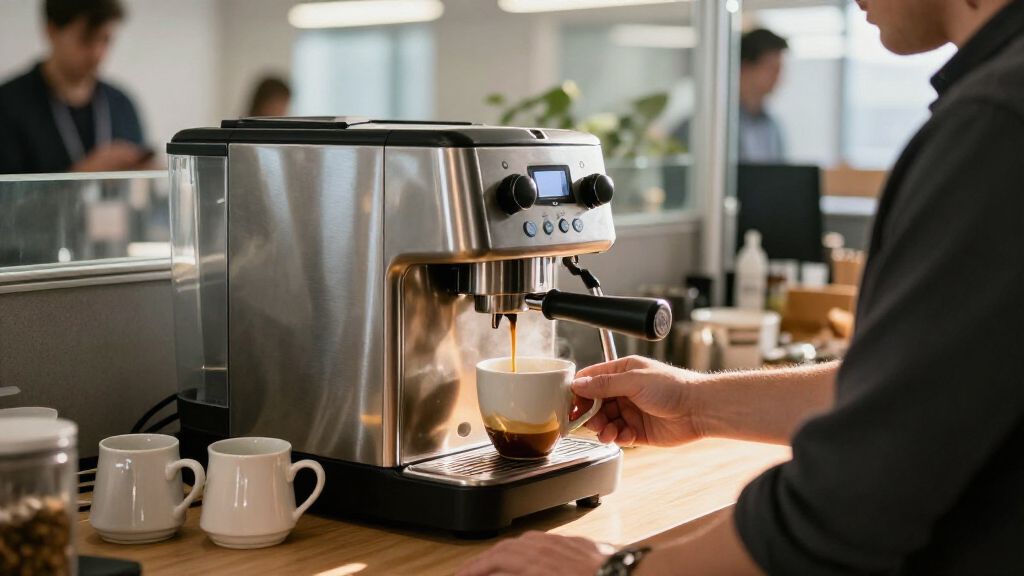
I ranked these commercial coffee makers for offices by how well their brewing and serving setup fits a shared workplace. I compared batch versus single-cup formats, stated cup or carafe capacity, the number of warmers or serving vessels, water-line or pour-over operation, and whether the design keeps coffee available between brewing cycles. I also weighed everyday usability, likely counter and serving-space demands, and the maintenance tradeoffs implied by each format.
The order reflects office usefulness across common needs, not a claim that one format suits every team. The BUNN VPR leads for straightforward batch service, while the Keurig K-1500 and NUPANT airpot brewer stand out for different serving patterns. Models with multiple carafes or warmers rank well when ready-to-serve volume matters; simpler brewers and pod machines make more sense when space, variety, or reduced leftover coffee takes priority. I distinguish products by their stated features and avoid treating similar-looking models as interchangeable.
Factors to Consider When Choosing Commercial Coffee Makers For Offices
Choosing an office brewer starts with the way people actually take breaks: in short waves, across a long shift, or together at meetings. I’d settle the workflow questions before comparing individual models, because capacity and plumbing can matter more than a long feature list.
Match Brewing Style to Daily Demand
Estimate how many people will want coffee during the busiest 30-minute period, not just the total headcount. A shared drip pot works well when employees arrive in clusters, while single-serve brewing suits staggered breaks and different cup preferences. The common mistake is buying for average demand and leaving the brewer unable to keep up with a morning rush. A larger batch brewer can help, but coffee sitting too long may go unused. If demand varies sharply, consider whether a smaller batch or individual cups would reduce waste better than simply increasing capacity.
Think Beyond the Brewer’s Cup Count
A stated cup capacity does not tell the whole serving story: the number of carafes and warmers affects how much coffee can be ready at once. Multiple vessels help when one batch is being served while another is brewed, but they also occupy counter space and create more parts to wash. Check whether the capacity refers to a brewer’s output or a vessel’s size, and compare that with the cups your team pours. Offices that serve meetings may value several ready carafes more than a single larger batch. Leave room for mugs, filters, supplies, and safe access around hot equipment.
Choose a Water-Fill Setup That Fits the Site
Pour-over brewers are easier to place because they do not depend on a fixed water connection, but someone must refill them throughout the day. Auto-fill models can reduce that recurring task and suit a steady, high-use station. The tradeoff is installation: confirm that the proposed location has suitable plumbing access and that facilities staff can handle the connection. A water line is not helpful if the brewer must sit far from a sink or if the office cannot approve plumbing work. Decide who will refill, clean, and monitor the machine before treating automation as a labor-saving benefit.
Account for Coffee Freshness and Holding Time
Glass carafes on warming plates keep coffee available, but a pot can sit longer than intended during quieter periods. Thermal airpots avoid continuous hot-plate holding and can be easier to place near a meeting table or shared counter. Neither format fixes a mismatch between batch size and demand: brewing smaller amounts more often may preserve freshness better than keeping a full pot ready. Ask how quickly coffee is usually consumed and whether people serve themselves away from the brewer. For offices with uneven demand, serving time and batch planning deserve as much attention as maximum capacity.
Settle Pod Convenience Against Ongoing Operations
Single-serve brewers let each person choose a cup without leaving a half-full shared pot, but the office must stock pods and manage the waste they create. Pod availability, storage space, and the range of drinks employees expect all affect day-to-day suitability. A drip brewer generally uses a shared batch workflow and may be a better fit when many people want the same coffee. Avoid choosing a pod machine solely because it seems simpler; frequent use can make restocking and spent-pod disposal part of the office routine. Match the format to actual employee preferences, not just the easiest first impression.
Plan for Cleaning, Counter Space, and Ownership
Commercial equipment still needs a clear owner for daily cleaning, carafe washing, and periodic descaling. More carafes can support faster service but add washing and storage tasks; airpots also need regular attention to serving components. Measure the counter and overhead clearance, then account for the space needed to pour, refill, and place cups safely. Decide who handles upkeep before installation so the brewer does not become an unmanaged shared appliance. A model that fits the coffee volume but blocks a work area or has no maintenance owner may create more friction than a smaller, simpler setup.
Frequently Asked Questions
Should I choose a batch brewer or a single-serve machine for a small office?
Choose based on how employees use the coffee station, not headcount alone. If several people take coffee at the same time and tend to drink the same style, a batch brewer can serve them quickly. If breaks are spread out or people want different cups, a single-serve machine can reduce leftover brewed coffee. Compare that convenience with the need to keep pods stocked and dispose of them. For a small team with mixed habits, estimating peak use over a short period is more useful than counting total employees.
Is an auto-fill coffee maker worth arranging a water-line connection for?
It can be worthwhile when the brewer sees regular use and manual refilling repeatedly interrupts staff. Before choosing one, confirm that the installation site has appropriate water access and that your facilities team can approve and maintain the connection. If the coffee station moves often or plumbing access is limited, a pour-over model is easier to place and operate. Consider who currently refills the brewer and how often; an occasional task may not justify installation work. Auto-fill solves water replenishment, not cleaning, filter changes, or coffee restocking.
Are warming plates or a thermal airpot better for office coffee?
Warming plates suit a fixed station where people serve themselves from glass carafes and the coffee is consumed soon after brewing. A thermal airpot is more useful when coffee needs to be carried to a meeting or kept available away from the brewer without continuous hot-plate heating. The right choice depends on serving location and how quickly a batch is used. Neither option removes the need to brew an appropriate amount or clean the serving vessel. If coffee often sits through quiet periods, consider smaller batches rather than relying on a holding method alone.
How much brewing capacity should I plan for during a busy morning?
Start by estimating the number of cups people typically take during the busiest part of the day and how quickly they expect them to be ready. Then check whether the machine’s stated capacity refers to a brewing cycle, a carafe, or total available serving vessels. Multiple carafes or warmers can keep a second batch available while the first is being served, but they need additional counter and washing space. Do not size the machine only for the entire office headcount; that can encourage oversized batches and leftover coffee. A brief observation of actual morning use can make the estimate more dependable.
What should I check before installing a commercial coffee maker in a shared office kitchen?
Measure the available counter area and leave space for pouring, mug placement, refilling, and safe access around hot surfaces. Check whether the model needs a nearby outlet or a water-line connection, and ask facilities staff about installation requirements before ordering. Decide where filters, coffee, pods, and clean carafes will be stored so supplies do not crowd the station. Assign responsibility for daily cleaning and routine upkeep rather than assuming someone will take it on. These practical details often determine whether a brewer works smoothly in a shared kitchen.
Conclusion
For most shared kitchens, my best overall pick is the BUNN VPR for its straightforward batch setup and upper and lower warmers. The best value direction is a simpler pour-over drip brewer such as the SYBO SF-CB-2GA or VEVOR two-carafe model, especially when manual filling is acceptable. For a best premium-style workflow, choose the NUPANT auto-filling airpot brewer if your office can support a water connection and wants thermal serving. The best choice for beginners is a basic pour-over drip model with familiar carafes and no plumbing decisions. For individual cups, look to the Keurig K-1500, K155 Office Pro, or K-2500; for meetings or coffee served away from the machine, pick a NUPANT airpot model. Your deciding factor should be whether your office needs shared batches, individual choice, or coffee held for flexible serving.