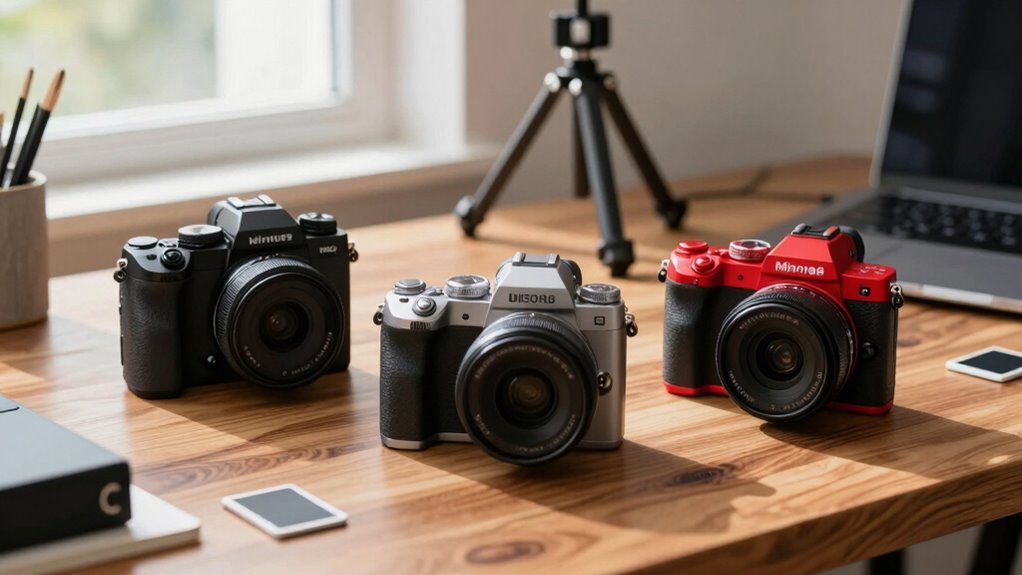

Choosing a beginner mirrorless camera for a small business comes down to what you need to make: product photos, quick social videos, staff portraits, or a mix of all three. I rank the Canon EOS R50 first for its approachable controls and stronger video tools, the Sony a6400 for fast autofocus and more action-friendly shooting, and the Canon EOS R100 as the straightforward entry point when basic product and everyday business photos matter most. All five options here include a standard zoom lens, but the R100 bundle listings differ mainly in included accessories, not in the camera’s core capabilities.

Get business pricing on office and shipping supplies
- Business-only prices and quantity discounts
- Tax-exempt purchasing
- Multiple users, one account, clear invoices
The main tradeoff is ease versus room to grow. The R50 offers more creator-focused features, while the a6400 brings an established autofocus system but asks more of a new user. The R100 keeps the setup simple, though its modest kit lens is less suited to dim rooms and tight close-ups. I’ve ranked these picks by how well they balance learnability, dependable image-making, useful video features, and a practical starter kit for a small business.
Key Takeaways
- The Canon EOS R50 is my first pick for businesses that need both product photos and polished short-form video, thanks to oversampled 4K, vertical-video tools, and Dual Pixel AF II.
- The Sony a6400 is the better fit for moving subjects and frequent staff or event coverage, but its menu complexity makes it less inviting than the Canon R50 for a first camera.
- The three Canon R100 listings share the same basic camera and 18–45mm kit lens; compare the bundle contents rather than expecting a meaningful difference in image quality.
- The standard zoom lenses are useful for general work, but their slow maximum apertures can be limiting for indoor photography, dim storefronts, and blurred-background portraits.
- None of these picks replaces a lighting setup or suitable business lens; I’d budget attention for those upgrades before expecting the camera body alone to solve every content need.
| Canon EOS R50 Mirrorless Camera with 18-45mm Lens Bundle |  | Best Overall for Mixed Business Content | Sensor: 24.2MP APS-C CMOS | Included lens: 18–45mm | Autofocus: Dual Pixel AF II with face and eye detection | VIEW ON AMAZON | See Our Full Breakdown |
| Sony Alpha a6400 Mirrorless Camera with 16-50mm Lens |  | Best for Fast Autofocus and Active Subjects | Sensor: 20.1MP APS-C | Included lens: 16–50mm | Autofocus: Real-Time Eye AF | VIEW ON AMAZON | See Our Full Breakdown |
| Canon EOS R100 Mirrorless Camera RF-S 18-45mm F4.5-6.3 IS STM Lens Kit |  | Best Simple Starter for Business Photography | Sensor: 24.1MP APS-C CMOS | Included lens: RF-S 18–45mm F4.5–6.3 IS STM | Video: 4K at 24 fps; Full HD at 60 fps; HD at 120 fps | VIEW ON AMAZON | See Our Full Breakdown |
| Canon EOS R100 Mirrorless Camera with 18-45mm F4.5-6.3 IS STM Lens Bundle |  | Best R100 Bundle for a Ready-to-Go Kit | Sensor: 24.1MP APS-C CMOS | Included lens: RF-S 18–45mm F4.5–6.3 IS STM | Video: 4K and Full HD | VIEW ON AMAZON | See Our Full Breakdown |
| Canon EOS R100 Mirrorless Camera with RF-S 18-45mm Lens Bundle |  | Best Straightforward R100 Kit for Guided Learning | Sensor: 24.1MP APS-C CMOS | Processor: DIGIC 8 | Included lens: RF-S 18–45mm f/4.5–6.3 IS STM | VIEW ON AMAZON | See Our Full Breakdown |
| beginner mirrorless cameras for small business | Sensor | Included lens | Autofocus | Video |
|---|---|---|---|---|
| Canon EOS R50 Mirrorless Camer | 24.2MP APS-C CMOS | 18–45mm | Dual Pixel AF II with face and eye detection | 4K; listed frame-rate options include 24, 30, and 60 fps |
| Sony Alpha a6400 Mirrorless Ca | 20.1MP APS-C | 16–50mm | Real-Time Eye AF | 4K |
| Canon EOS R100 Mirrorless Came | 24.1MP APS-C CMOS | RF-S 18–45mm F4.5–6.3 IS STM | Dual Pixel CMOS AF with face, eye, animal, and vehicle detection | 4K at 24 fps; Full HD at 60 fps; HD at 120 fps |
| Canon EOS R100 Mirrorless Came | 24.1MP APS-C CMOS | RF-S 18–45mm F4.5–6.3 IS STM | Dual Pixel autofocus | 4K and Full HD |
| Canon EOS R100 Mirrorless Came | 24.1MP APS-C CMOS | RF-S 18–45mm f/4.5–6.3 IS STM | Dual Pixel CMOS AF with 143 zones | 4K 24p with crop; Full HD 60p |
More Details on Our Top Picks
Canon EOS R50 Mirrorless Camera with 18-45mm Lens Bundle
The Canon EOS R50 is my strongest all-round recommendation for an owner who expects to make product photos, talking-head clips, and vertical social posts with one camera. Its Dual Pixel AF II face and eye detection can reduce the distraction of checking focus during a solo recording, while 4K oversampling gives video a detailed look. Vertical-video support and in-camera guides also point toward the way many small businesses actually publish content.
Compared with the R100, the R50 is the more capable creator tool, especially when video is a regular part of the job. It is still paired with the same general-purpose 18–45mm lens class, so a faster lens or added lighting may be needed for dim interiors and soft-background portraits. The listing’s specifications report a two-pound item weight, which is worth checking against your portability needs. It is not water resistant, and first-time users may need time to learn the menus. I’d choose it over the a6400 when guided, approachable content creation matters more than a faster burst rate.
Pros:- Dual Pixel AF II with face and eye detection supports solo video recording.
- Oversampled 4K and vertical-video features suit online business content.
- 24.2MP APS-C sensor offers flexible detail for product and portrait images.
- In-camera guides and familiar automatic modes lower the initial learning barrier.
Cons:- The 18–45mm lens has a slow aperture for low-light work.
- The camera is not water resistant, so outdoor work needs protection.
- The supplied listing gives a two-pound item weight, which may feel less compact than expected.
Best for: Small-business owners who need one approachable camera for product images, portrait-style posts, and vertical video.
Not ideal for: People who work in wet or dusty outdoor conditions, want a particularly light carry kit, or need a bright lens for dim rooms right away.
- Sensor:24.2MP APS-C CMOS
- Included lens:18–45mm
- Autofocus:Dual Pixel AF II with face and eye detection
- Video:4K; listed frame-rate options include 24, 30, and 60 fps
- Stabilization:Optical stabilization in the included lens
- Viewfinder:Electronic
- Storage:64GB memory listed
- Weather protection:Not water resistant
Our verdict“I’d choose the R50 as the most versatile first camera here when business content includes both stills and regular video.”
Sony Alpha a6400 Mirrorless Camera with 16-50mm Lens
The Sony a6400 is the lineup’s strongest choice when a small business frequently photographs people in motion: staff at work, event activity, demonstrations, or candid customer scenes. Its Real-Time Eye AF and 11 fps burst rate give it a responsiveness advantage over the R100, whose listed continuous shooting is 6.5 fps. That speed is less relevant for carefully arranged product shots, but it can help when a moment cannot be repeated.
The tilting screen and 4K recording make the a6400 useful for video as well, though it is not as explicitly creator-oriented as the R50’s vertical-video and in-camera guide features. Its key cost is learnability: the menu system can feel involved to a first-time camera owner, so it may take more setup before routine business shoots feel quick. The included 16–50mm lens covers everyday framing, but the kit lens remains a limitation for low-light interiors. I’d put it ahead of the R100 for action and tracking, but behind the R50 for a user who wants guided, mixed-format content creation.
Pros:- Real-Time Eye AF helps maintain focus on people.
- 11 fps burst shooting is useful for action and event coverage.
- 4K video and a tilting LCD support both stills and video work.
- The 16–50mm lens covers a practical everyday range.
Cons:- The menu system can be difficult for new camera users.
- The included lens is not especially suited to dim rooms.
- Battery life may constrain long, uninterrupted shooting sessions.
Best for: Businesses that regularly photograph staff, demonstrations, events, or other moving subjects and can spend time learning camera controls.
Not ideal for: First-time owners who want the simplest menu experience, or businesses whose main need is guided vertical-video creation.
- Sensor:20.1MP APS-C
- Included lens:16–50mm
- Autofocus:Real-Time Eye AF
- Video:4K
- Screen:Tiltable LCD
- Burst rate:11 fps
- Lens mount:Sony E-mount
Our verdict“I recommend the a6400 when fast subject tracking matters more than the most welcoming beginner interface.”
Canon EOS R100 Mirrorless Camera RF-S 18-45mm F4.5-6.3 IS STM Lens Kit
The Canon EOS R100 kit is a sensible entry point for a business that needs better-controlled product pictures, basic portraits, and occasional video without paying for a long list of creator features it may not use. Its 24.1MP APS-C sensor gives room to crop and adjust images, while face and eye detection can help keep portraits sharp. The included 18–45mm lens has optical stabilization, a practical aid when framing still subjects by hand.
Against the R50, the R100 is the more restrained choice: it offers 4K at 24 fps and Full HD at 60 fps, but lacks the R50’s more developed creator-focused feature set. Its 6.5 fps continuous shooting also trails the a6400, making it less suited to action-heavy coverage. The kit lens’s F4.5–6.3 aperture can demand brighter lighting indoors, and the product details list no built-in flash. For a small shop photographing products near a window or with simple added lights, those limits are manageable; for dim restaurants or frequent video, I’d move up to the R50.
Pros:- 24.1MP APS-C sensor captures detailed images for common business uses.
- Face and eye detection support approachable portrait shooting.
- Compact body and stabilized 18–45mm lens make a simple starter kit.
- 4K and Full HD recording cover basic video needs.
Cons:- The 18–45mm lens has a slow aperture, limiting dim-room flexibility.
- 4K recording is listed at 24 fps, with fewer frame-rate choices than the R50 listing.
- No built-in flash is listed, so indoor lighting may require an accessory.
Best for: A first-time camera owner focused mainly on product photos, straightforward portraits, and occasional online video.
Not ideal for: Businesses that need strong low-light performance, frequent fast-action coverage, or an especially flexible video setup.
- Sensor:24.1MP APS-C CMOS
- Included lens:RF-S 18–45mm F4.5–6.3 IS STM
- Video:4K at 24 fps; Full HD at 60 fps; HD at 120 fps
- Autofocus:Dual Pixel CMOS AF with face, eye, animal, and vehicle detection
- Continuous shooting:6.5 fps
- Lens stabilization:Optical image stabilization in the lens
Our verdict“I’d pick this R100 kit for a stills-first business that values a simple starting setup over expanded video tools.”
Canon EOS R100 Mirrorless Camera with 18-45mm F4.5-6.3 IS STM Lens Bundle
This listing uses the same core Canon EOS R100 and 18–45mm lens as the other R100 options, so I wouldn’t expect a different image-making experience from the camera itself. Its appeal is the included kit: the details name a 64GB card, deluxe case, tripod grip, and cleaning kit. For a new business owner starting from scratch, that can make the first setup more convenient than buying the camera and basic carrying or storage items separately.
That accessory advantage does not address the R100’s main limits. The lens still has an F4.5–6.3 maximum aperture, so the R50 remains a better match for businesses that prioritize video, and the a6400 remains stronger for fast-moving subjects. The listing also cites limited battery life and no built-in flash. I’d select this bundle over the bare R100 listing only when its named accessories match what you need; I would not choose it on the assumption that the bundle improves autofocus or low-light performance. Accessories vary in usefulness, so check the exact package contents before deciding.
Pros:- Includes a 64GB card, travel case, tripod grip, and cleaning kit as listed.
- The 24.1MP APS-C sensor suits product photos and everyday business images.
- Wi-Fi and Bluetooth support convenient image sharing.
- The electronic viewfinder provides a clear way to compose in bright conditions.
Cons:- Bundle accessories do not improve the R100’s core video or autofocus performance.
- The kit lens remains limited in low light.
- Battery life may be restrictive during longer sessions, and no built-in flash is listed.
Best for: A beginner who wants the R100 camera with basic carrying, storage, and handling accessories in one listing.
Not ideal for: Buyers who already own a memory card and case, or who need a camera upgrade beyond the standard R100 feature set.
- Sensor:24.1MP APS-C CMOS
- Included lens:RF-S 18–45mm F4.5–6.3 IS STM
- Video:4K and Full HD
- Autofocus:Dual Pixel autofocus
- Viewfinder:Electronic
- Display:3-inch LCD, 1.04 million dots
- Connectivity:Wi-Fi and Bluetooth
- Listed accessories:64GB card, deluxe case, tripod grip, cleaning kit
Our verdict“I’d choose this version of the R100 when its accessory bundle is useful, not because it is a more capable camera than the other R100 kits.”
Canon EOS R100 Mirrorless Camera with RF-S 18-45mm Lens Bundle
This third R100 listing is another entry-level Canon kit, with the same 24.1MP sensor class and stabilized 18–45mm zoom as the other R100 options. The supplied details call out an OLED electronic viewfinder, a 3-inch 1.04-million-dot screen, Wi-Fi, and Bluetooth. For a beginner learning composition, the viewfinder offers an alternative to composing only on the rear screen, while wireless connectivity can simplify moving finished images to a phone for business posts.
Its role is narrower than the R50’s: the listed 4K 24p video includes a crop, and the kit lens still calls for good light when photographing indoors. No in-body stabilization is listed, so stabilization support comes from the lens rather than the camera sensor. Compared with the accessory-heavy R100 bundle, this listing’s supplied details focus more on camera functions than extras; compared with the a6400, it offers a gentler entry point but less burst speed. I’d choose it when a familiar, stills-focused learning setup is the priority, not when video flexibility is central to the business.
Pros:- 24.1MP APS-C sensor supports detailed product and everyday photographs.
- Dual Pixel AF is suited to straightforward focus on people.
- Electronic viewfinder and clear LCD offer two composition options.
- Wi-Fi and Bluetooth make phone sharing more convenient.
Cons:- The listed 4K video has a crop, which can make tight spaces harder to frame.
- No in-body image stabilization is listed.
- The slow kit-lens aperture can limit indoor and low-light use.
Best for: A new camera owner who wants an uncomplicated Canon setup for everyday photos and occasional video, with an electronic viewfinder.
Not ideal for: Owners who need uncropped 4K framing, in-body stabilization, or a clear accessory bundle to complete a starter kit.
- Sensor:24.1MP APS-C CMOS
- Processor:DIGIC 8
- Included lens:RF-S 18–45mm f/4.5–6.3 IS STM
- Video:4K 24p with crop; Full HD 60p
- Autofocus:Dual Pixel CMOS AF with 143 zones
- Continuous shooting:6.5 fps
- Viewfinder:2.36-million-dot OLED EVF
- Screen:3-inch, 1.04-million-dot LCD
Our verdict“I’d consider this R100 listing for photo-led work and basic video, while choosing the R50 for a more video-centered business.”

How We Picked
I ranked these cameras for the realities of small-business content, not for a spec-sheet contest. A first camera should let its owner produce clear product images, portraits, and social video without turning every shoot into a technical project. I gave weight to beginner-friendly controls, autofocus that can keep faces in focus, a useful included lens, and video options that suit common online formats.
I also separated the cameras by meaningful differences. The R50 earns the lead because its creator tools and newer autofocus make mixed photo-and-video work less cumbersome. The a6400 ranks next for tracking and burst speed, balanced against a steeper learning curve. The R100 versions follow as practical stills-first starters; where a listing includes extras, those accessories may help a new owner get set up, but they don’t change the core camera. Across the lineup, I treated lens limitations, low-light performance, stabilization, and usability as real tradeoffs rather than minor footnotes. These are recommendations based on the supplied specifications and product details, not claims of hands-on testing.
| beginner mirrorless cameras for small business | Autofocus |
|---|---|
| Canon EOS R50 Mirrorless Camer | Dual Pixel AF II with face and eye detection |
| Sony Alpha a6400 Mirrorless Ca | Real-Time Eye AF |
| Canon EOS R100 Mirrorless Came | Dual Pixel CMOS AF with face, eye, animal, and vehicle detection |
| Canon EOS R100 Mirrorless Came | Dual Pixel autofocus |
| Canon EOS R100 Mirrorless Came | Dual Pixel CMOS AF with 143 zones |
Factors to Consider When Choosing Beginner Mirrorless Cameras For Small Business
I’d start by listing the work the camera must handle each week. A shop that mainly photographs objects on a tabletop has different needs from a consultant filming frequent short videos or a café documenting events. The body matters, but the included lens, light, storage, and workflow can shape the final results just as much.
Match the camera to your main content
For a mix of product photography and social video, the Canon R50 is the most balanced pick here because its listed video features and creator aids support varied output. If still photographs lead the workload, an R100 can be a simpler starting point. For events or active staff demonstrations, the Sony a6400’s 11 fps burst rate and Real-Time Eye AF make it more responsive than the R100. Choose based on the work you repeat, not on the feature you might use once.
Understand what the kit lens can and cannot do
The R100 and R50 kits include an 18–45mm lens, while the a6400 kit includes a 16–50mm lens. These ranges handle broad views and everyday framing, but the listed apertures are modest. In practice, that means a shop photographing products by a window or under added lights can get useful results, while a dim interior may call for brighter lighting or a faster lens. A lens kit is a starting point, not a guarantee of strong performance in every room or style.
Plan for lighting and stabilization
The R100 kit lenses include optical stabilization, which can help with hand-held framing of still subjects, but the R100 listing with the crop in 4K states there is no in-body stabilization. Stabilization does not freeze a moving person or product, and it does not replace light. For repeatable product images, I’d prioritize a simple light source and stable support. Before a shoot, also check whether the listing includes a flash or other lighting aid; the standalone R100 details say no built-in flash.
Think about setup and daily workflow
A beginner camera should fit the time you can spend learning. Canon’s R100 is the restrained option among these picks, and the R50 adds guides and vertical-video features that can suit a solo creator. The a6400 offers stronger burst speed but has a more complex menu system. For any model, check how images will move to your phone or computer, what memory card is included, and whether the bundle accessories are actually useful. Bundle contents vary by listing, even when the camera body is the same.
Leave room for business growth
These kits can support early work, but a growing business may eventually need a specialty lens: a macro option for small products, a brighter lens for portraits, or a wider view for cramped interiors. Canon’s R100 and R50 use the RF mount, while the a6400 uses Sony E-mount; those systems shape the lens choices available as your needs change. I’d choose the body that meets today’s workload, then plan lens upgrades around a specific recurring problem rather than buying extra gear without a purpose.
Frequently Asked Questions
Which camera is easiest for a small-business beginner?
I’d start with the Canon R50 if the owner needs both photos and video and values guided features such as in-camera guides and vertical-video support. The R100 is a more restrained alternative for someone focused mostly on still photos and basic recording. The Sony a6400 can be a strong tool, but its more involved menu system may take longer to learn.
Are the three Canon EOS R100 listings different cameras?
Based on the supplied descriptions, all three are built around the same R100 camera and RF-S 18–45mm lens, so their basic image quality and core camera capabilities should be similar. The most useful distinction is the listed bundle: one names a case, memory card, tripod grip, and cleaning kit. I’d compare exact package contents rather than treating the listings as separate camera models.
Is the included lens enough for product photography?
The included standard zoom can work for many basic product images, especially when the subject is not extremely small and the business can use bright, controlled lighting. Its aperture range is relatively slow, so it is less convenient in dim rooms or when a soft background is desired. For close detail work or a repeatable catalog look, a suitable dedicated lens and a consistent lighting setup may be useful later.
Which of these cameras is better for short-form business video?
I’d choose the Canon R50 for frequent short-form video because its supplied details list oversampled 4K, vertical-video support, face and eye detection, and in-camera guides. The a6400 also records 4K and has a tilting screen, while the R100 covers basic video needs but has fewer creator-specific tools in the supplied descriptions. Whichever model you pick, plan for clear audio and good lighting as well as camera features.
Do I need to buy extra equipment right away?
Not necessarily. The included zoom lens, a compatible memory card, and a dependable light source can be enough to begin making useful business content. Check whether the exact camera listing includes a card and case, since bundle contents differ. I’d add equipment only when a recurring limitation appears, such as dim indoor images, shaky video, or a need for closer product detail.
Conclusion
For one camera to cover product photos, staff portraits, and regular online video, I recommend the Canon EOS R50. Choose the Sony a6400 if fast autofocus and burst shooting matter most and you are comfortable learning a more involved menu. For a stills-first beginner, the Canon EOS R100 is the simpler route; pick the accessory bundle only if its case, card, grip, and cleaning kit fit your setup needs. Across all five options, I’d put lighting and lens needs near the top of the plan: the camera can make business content easier, but the standard kit lens still has clear limits in dim spaces.
Halloween Picks
halloween
As an affiliate, we earn on qualifying purchases.