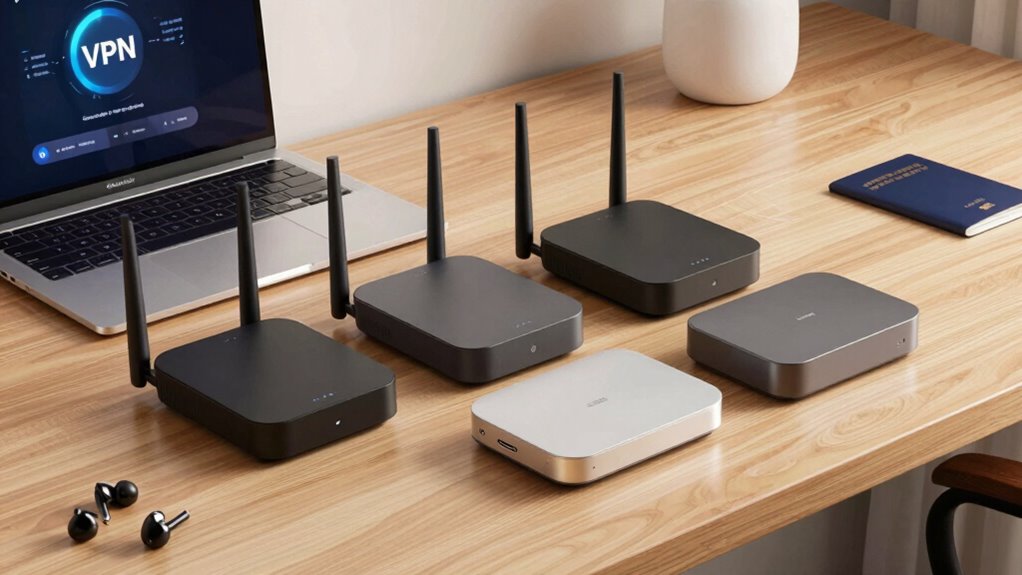

Hotel Wi-Fi, airport hotspots, and café networks all share one problem: you have no idea who else is on them. A travel router with built-in VPN support solves this by encrypting every device you connect through a single tunnel, which means your laptop, phone, and tablet all get protected without juggling individual VPN apps. After comparing the current GL.iNet lineup side by side, two picks rise to the top for different reasons: the GL-MT3000 Beryl AX hits the sweet spot of portability, Wi-Fi 6 speed, and a 2.5G WAN port, while the GL-MT3600BE Beryl 7 is the outright VPN speed champion thanks to its 1100 Mbps WireGuard capability.

Get business pricing on office and shipping supplies
- Business-only prices and quantity discounts
- Tax-exempt purchasing
- Multiple users, one account, clear invoices
The main tradeoffs in this category come down to three things: VPN throughput (which varies wildly between models), Wi-Fi generation, and physical size. Budget models like the Opal keep things light and cheap but slow your encrypted traffic considerably, while Wi-Fi 7 units like the Slate 7 and Beryl 7 push serious bandwidth at the cost of a higher price and slightly heftier builds. Below, I break down which router belongs in which bag.
Key Takeaways
- VPN throughput is the single biggest differentiator here, ranging from roughly 100 Mbps on the Slate 7’s OpenVPN tunnel up to 1100 Mbps WireGuard on the Beryl 7
- The Beryl AX (GL-MT3000) is the best all-around pick because it balances Wi-Fi 6 speed, a 2.5G WAN port, and true pocket portability
- The Opal (GL-SFT1200) is the value choice: it has full OpenVPN and WireGuard support but slower Wi-Fi 5 radios and no USB port
- The Slate 7’s touchscreen makes it the easiest to set up at a hotel desk, but its OpenVPN speed caps around 100 Mbps
- Every model here supports VPN cascading, OpenWrt customization, and 30+ VPN providers, so your choice hinges on speed, size, and budget
| GL.iNet GL-SFT1200 Opal Travel Router, AC1200 Dual-Band Wi-Fi |  | Best Value | Wi-Fi Generation: Wi-Fi 5 (AC1200 dual-band) | Wireless Speed: 300 Mbps (2.4GHz) + 867 Mbps (5GHz) | Ethernet: 2x Gigabit LAN, 1x Gigabit WAN | VIEW ON AMAZON | See Our Full Breakdown |
| GL.iNet GL-AXT1800 Slate AX Pocket-Sized Wi-Fi 6 Travel Router with VPN |  | Best for File Sharing and Multi-Device Travel | Wi-Fi Generation: Wi-Fi 6 (AX1800 dual-band) | Wireless Speed: 600 Mbps (2.4GHz) + 1200 Mbps (5GHz) | Ethernet: Gigabit ports (WAN + LAN) | VIEW ON AMAZON | See Our Full Breakdown |
| GL.iNet GL-MT3000 Beryl AX Wi-Fi 6 Travel Router, 2.5G WAN, VPN, OpenWrt |  | Best Overall | Wi-Fi Generation: Wi-Fi 6 (AX3000 dual-band) | Wireless Speed: 574 Mbps (2.4GHz) + 2402 Mbps (5GHz) | Ethernet: 1x 2.5G WAN, 1x Gigabit LAN | VIEW ON AMAZON | See Our Full Breakdown |
| GL.iNet GL-BE3600 Slate 7 Wi-Fi 7 Travel Router with Touchscreen and 2.5G Ports |  | Best for Easy Setup | Wi-Fi Generation: Wi-Fi 7 (802.11.be) | Wireless Speed: 688 Mbps (2.4GHz) + 2882 Mbps (5GHz) | Ethernet: 2x 2.5G (1 WAN, 1 LAN) | VIEW ON AMAZON | See Our Full Breakdown |
| GL.iNet GL-MT3600BE Beryl 7 Dual-Band Wi-Fi 7 Travel Router |  | Best Premium / Fastest VPN Throughput | Wi-Fi Generation: Wi-Fi 7 dual-band | Wireless Speed: 688 Mbps (2.4GHz) + 2882 Mbps (5GHz) | Ethernet: 2x 2.5G (1 WAN, 1 LAN) | VIEW ON AMAZON | See Our Full Breakdown |
| travel routers with vpn support | Wi-Fi Generation | Wireless Speed | Ethernet | VPN |
|---|---|---|---|---|
| GL.iNet GL-SFT1200 Opal Travel | Wi-Fi 5 (AC1200 dual-band) | 300 Mbps (2.4GHz) + 867 Mbps (5GHz) | 2x Gigabit LAN, 1x Gigabit WAN | OpenVPN and WireGuard pre-installed, 30+ providers |
| GL.iNet GL-AXT1800 Slate AX Po | Wi-Fi 6 (AX1800 dual-band) | 600 Mbps (2.4GHz) + 1200 Mbps (5GHz) | Gigabit ports (WAN + LAN) | OpenVPN up to 500 Mbps; WireGuard up to 550 Mbps |
| GL.iNet GL-MT3000 Beryl AX Wi- | Wi-Fi 6 (AX3000 dual-band) | 574 Mbps (2.4GHz) + 2402 Mbps (5GHz) | 1x 2.5G WAN, 1x Gigabit LAN | OpenVPN up to 150 Mbps; WireGuard up to 300 Mbps; client + server simultaneously |
| GL.iNet GL-BE3600 Slate 7 Wi-F | Wi-Fi 7 (802.11.be) | 688 Mbps (2.4GHz) + 2882 Mbps (5GHz) | 2x 2.5G (1 WAN, 1 LAN) | OpenVPN up to 100 Mbps; WireGuard up to 540 Mbps |
| GL.iNet GL-MT3600BE Beryl 7 Du | Wi-Fi 7 dual-band | 688 Mbps (2.4GHz) + 2882 Mbps (5GHz) | 2x 2.5G (1 WAN, 1 LAN) | WireGuard up to 1100 Mbps; OpenVPN-DCO up to 1000 Mbps; client + server cascading |
More Details on Our Top Picks
GL.iNet GL-SFT1200 Opal Travel Router, AC1200 Dual-Band Wi-Fi
The GL.iNet Opal is the entry point of this lineup, and it earns its place by refusing to cut the feature that matters most: OpenVPN and WireGuard are pre-installed and compatible with 30+ VPN providers, exactly what you get on models costing considerably more. For travelers whose needs stop at email, browsing, and light streaming through an encrypted tunnel, this router covers the basics without asking much in return. Its 145g weight and retractable antennas make it genuinely pocket-friendly, and the physical toggle switch lets you flip the VPN on and off without digging through menus.
Where the Opal falls behind is raw speed. It is a Wi-Fi 5 (AC1200) router, so compared with the Beryl AX, you give up Wi-Fi 6 efficiency, USB connectivity, and any multi-gigabit port. The three gigabit Ethernet jacks are respectable for the class, but VPN throughput will bottleneck noticeably on fast connections, and there is no USB port for file sharing or tethering. This model makes the most sense for buyers who want a set-and-forget security appliance rather than a performance hub; anyone streaming 4K or running a busy multi-device workload should step up to the Beryl AX instead.
Pros:- Full OpenVPN and WireGuard support with 30+ compatible providers despite the low price
- Featherlight 145g design with retractable antennas that fits any bag
- Physical toggle switch to enable or disable the VPN instantly
- Three gigabit Ethernet ports for wired devices
Cons:- Wi-Fi 5 radios lag well behind the Wi-Fi 6 and Wi-Fi 7 models in this lineup
- No USB port, so no tethering or NAS-style file sharing
- VPN speeds are noticeably slower than the B-series models
Best for: Budget-conscious travelers who want full VPN protection for basic browsing and email on hotel networks
Not ideal for: Users who stream 4K, tether over USB, or need fast VPN throughput on gigabit connections
- Wi-Fi Generation:Wi-Fi 5 (AC1200 dual-band)
- Wireless Speed:300 Mbps (2.4GHz) + 867 Mbps (5GHz)
- Ethernet:2x Gigabit LAN, 1x Gigabit WAN
- VPN:OpenVPN and WireGuard pre-installed, 30+ providers
- Weight:145 g
- Security:IPv6, Cloudflare encryption support
- Special Features:VPN toggle switch, public Wi-Fi repeater mode
Our verdict“The Opal is the smart money pick if you want VPN-protected travel Wi-Fi without paying for speed you will not use.”
GL.iNet GL-AXT1800 Slate AX Pocket-Sized Wi-Fi 6 Travel Router with VPN
The Slate AX occupies a middle rung between the budget Opal and the port-heavy Beryl AX, and its identity is built around two things: fast encrypted throughput and on-the-go file access. Rated at up to 500 Mbps over OpenVPN and 550 Mbps over WireGuard, it comfortably outruns the Beryl AX’s rated VPN speeds, which matters if you regularly push large files through a tunnel on fast hotel or coworking networks. The USB port with SAMBA and WebDAV support means a portable hard drive becomes a travel NAS, a capability the Opal simply cannot offer.
Its Wi-Fi 6 radios with MU-MIMO and OFDMA handle up to 120 simultaneous devices, and the OpenWrt 21.02 foundation gives tinkerers thousands of installable packages. Compared with the Beryl AX, though, you trade away the 2.5G multi-gigabit WAN port, so the Slate AX is better suited to wireless-first travelers than to people plugging into fast wired networks. The fixed antennas and slightly boxier frame also make it a touch less pocketable. It handles captive portals for hotel login pages, which keeps the day-one experience painless.
Pros:- Strong rated VPN throughput: up to 500 Mbps OpenVPN, 550 Mbps WireGuard
- USB NAS feature with SAMBA and WebDAV for travel file sharing
- Wi-Fi 6 with MU-MIMO and OFDMA supporting up to 120 devices
- OpenWrt 21.02 with extensive package customization
Cons:- No 2.5G port, so wired speeds cap at gigabit unlike the Beryl AX
- Fixed antennas and a chunkier shape reduce pocketability
- Wi-Fi 6 speeds trail the Wi-Fi 7 models considerably
Best for: Remote workers and digital nomads who want VPN speed plus USB file sharing across many devices
Not ideal for: Travelers who mainly connect over wired hotel Ethernet at multi-gigabit speeds, or those wanting the smallest possible device
- Wi-Fi Generation:Wi-Fi 6 (AX1800 dual-band)
- Wireless Speed:600 Mbps (2.4GHz) + 1200 Mbps (5GHz)
- Ethernet:Gigabit ports (WAN + LAN)
- VPN:OpenVPN up to 500 Mbps; WireGuard up to 550 Mbps
- USB:USB port for NAS (SAMBA/WebDAV)
- Firmware:OpenWrt 21.02
- Device Capacity:Up to 120 simultaneous devices
- Security:WPA3, IPv6, Cloudflare encryption
Our verdict“The Slate AX is the pick for travelers whose priority is pushing encrypted traffic and shared files fast rather than maximizing raw Wi-Fi specs.”
GL.iNet GL-MT3000 Beryl AX Wi-Fi 6 Travel Router, 2.5G WAN, VPN, OpenWrt
If I had to point one traveler toward a single router on this list, it would be the Beryl AX. It hits the intersection most people actually need: Wi-Fi 6 speeds up to 3000 Mbps combined, a 2.5G multi-gigabit WAN port that the Slate AX lacks, USB 3.0 for tethering, and true palm-sized portability. Its rated VPN throughput of 150 Mbps OpenVPN and 300 Mbps WireGuard is lower than the Slate AX on paper, but in real-world travel scenarios, where the upstream hotel connection is the bottleneck anyway, most users will never notice the difference.
The feature that elevates the Beryl AX above simpler travel routers is VPN cascading: it can run a VPN server and VPN client simultaneously, so you can tunnel your traffic outbound while still reaching devices on your home or office network remotely. That is a genuine rarity in this size class. With WPA3, encrypted DNS, and access to 5,000+ OpenWrt plug-ins through a no-code admin panel, it rewards both casual users and tinkerers. The honest drawback is positioning: its Wi-Fi 6 radios are outclassed by the Wi-Fi 7 Beryl 7 and Slate 7, and if your laptop and phone already support Wi-Fi 7, you are leaving performance on the table. For everyone else, this is the most balanced package in the lineup.
Pros:- 2.5G multi-gigabit WAN port plus gigabit LAN for fast wired connections
- VPN cascading: runs VPN client and server simultaneously
- Compact palm-sized design with USB 3.0 tethering support
- WPA3, encrypted DNS, and 5,000+ OpenWrt plug-ins via no-code interface
Cons:- Rated VPN speeds trail the Slate AX and Beryl 7
- Wi-Fi 6 rather than Wi-Fi 7, so less future-proof
- Only one LAN port for wired devices
Best for: Most travelers: a balance of speed, portability, wired flexibility, and full VPN features
Not ideal for: Wi-Fi 7 early adopters or users who need near-gigabit VPN throughput
- Wi-Fi Generation:Wi-Fi 6 (AX3000 dual-band)
- Wireless Speed:574 Mbps (2.4GHz) + 2402 Mbps (5GHz)
- Ethernet:1x 2.5G WAN, 1x Gigabit LAN
- USB:USB 3.0
- VPN:OpenVPN up to 150 Mbps; WireGuard up to 300 Mbps; client + server simultaneously
- Firmware:OpenWrt 21.02 with 5,000+ plug-ins
- Security:WPA3, DNS over HTTPS/TLS, IPv6
- Device Capacity:Up to 120 devices
Our verdict“The Beryl AX is the best all-around travel router here because it gets portability, wired speed, and VPN flexibility right without a flagship price.”
GL.iNet GL-BE3600 Slate 7 Wi-Fi 7 Travel Router with Touchscreen and 2.5G Ports
What separates the Slate 7 from every other router in this comparison is its 2.8-inch touchscreen. Instead of fighting with a laptop and admin panel in a hotel room, you can scan a QR code to join networks, watch real-time speed monitoring, and toggle your VPN on and off directly on the device. For travelers who dread router setup, this is the friendliest interface in the lineup, and it makes the Slate 7 the model I would hand to a less technical partner or colleague.
Under the screen, the hardware is serious: Wi-Fi 7 radios delivering up to 2882 Mbps on 5GHz, dual 2.5G Ethernet ports, 2GB of RAM, and OpenWrt 23.05, the newest firmware base here. But there is a catch that matters for this specific roundup: its rated OpenVPN speed tops out around 100 Mbps, the slowest encrypted throughput of the five. WireGuard reaches 540 Mbps, which is respectable, but OpenVPN-heavy users will feel that ceiling. Compared with the Beryl 7, which doubles the VPN speed for similar wireless specs, the Slate 7 trades raw tunnel performance for convenience and its touchscreen workflow. The 12V power requirement also means it is less forgiving about powering from random USB sources than the 5V models.
Best for: Travelers who prioritize effortless touchscreen setup, QR-code onboarding, and Wi-Fi 7 wireless performance
Not ideal for: OpenVPN users who need fast tunnel throughput, or minimalists who want USB power and the smallest possible device
- Wi-Fi Generation:Wi-Fi 7 (802.11.be)
- Wireless Speed:688 Mbps (2.4GHz) + 2882 Mbps (5GHz)
- Ethernet:2x 2.5G (1 WAN, 1 LAN)
- VPN:OpenVPN up to 100 Mbps; WireGuard up to 540 Mbps
- RAM / Storage:2 GB RAM / 512 MB storage
- Firmware:OpenWrt 23.05
- Security:WPA3, DNS over HTTPS/TLS, IPv6, AdGuard Home
- Control:Touchscreen and app
Our verdict“The Slate 7 is the easiest travel router to live with day to day, provided your VPN protocol of choice is WireGuard rather than OpenVPN.”
GL.iNet GL-MT3600BE Beryl 7 Dual-Band Wi-Fi 7 Travel Router
The Beryl 7 is the performance ceiling of this lineup, and its headline number is remarkable for a pocket router: up to 1100 Mbps over WireGuard and 1000 Mbps over OpenVPN-DCO. That is roughly ten times the OpenVPN throughput of the Slate 7 and seven times the WireGuard speed of the Beryl AX, which means this is the one travel router that can saturate a genuinely fast connection while keeping every byte encrypted. If you work with large files, join video calls all day, or simply refuse to let a VPN become your bottleneck, this is the model that justifies the premium.
The rest of the package keeps pace: Wi-Fi 7 radios matching the Slate 7’s 2882 Mbps, dual 2.5G Ethernet ports, USB 3.0, and VPN cascading so you can be a client and server at once. It ships with US, UK, EU, and AU plug options, a thoughtful touch for long-haul travelers that the Slate 7 does not advertise. The tradeoffs are straightforward: it costs the most in the family, its OpenWrt 21.02 base is one generation behind the Slate 7’s 23.05 firmware, and there is no touchscreen, so setup requires the web admin panel like the older models. For a certain buyer, though, none of that matters next to a tunnel that never slows you down.
Best for: Power users and remote professionals who need near-gigabit encrypted speeds on fast connections
Not ideal for: Casual travelers on a budget, or anyone who wants touchscreen convenience over maximum throughput
- Wi-Fi Generation:Wi-Fi 7 dual-band
- Wireless Speed:688 Mbps (2.4GHz) + 2882 Mbps (5GHz)
- Ethernet:2x 2.5G (1 WAN, 1 LAN)
- VPN:WireGuard up to 1100 Mbps; OpenVPN-DCO up to 1000 Mbps; client + server cascading
- USB:USB 3.0
- Firmware:OpenWrt 21.02 (Kernel 5.4.281), 512 MB storage
- Security:WPA3, DNS over HTTPS/TLS, IPv6
- Device Capacity:Up to 120 devices
- Plugs:US, UK, EU, AU
Our verdict“The Beryl 7 is the no-compromise choice for travelers who refuse to trade encryption for speed.”

How We Picked
Since all five of these routers come from the same manufacturer family, I focused on the differences that actually change the travel experience rather than parroting spec sheets. My first filter was VPN capability: every pick needed pre-installed OpenVPN and WireGuard clients, but I weighted models by their rated encrypted throughput, because a VPN router that throttles your connection to a crawl defeats its own purpose on a fast hotel network.
From there, I judged each model on portability versus performance. A travel router lives in a carry-on, so weight and footprint matter, but not at the expense of dropping connections when three devices stream at once. I also factored in setup friction, favoring models with physical VPN toggle switches, captive portal support for hotel login pages, and interfaces a non-networking person can navigate. Finally, I considered future-proofing: Wi-Fi 6 and Wi-Fi 7 models earn their premium only if you own devices that can use them, so I flagged which buyers genuinely benefit and which are paying for headroom they will never touch.
| travel routers with vpn support | Wi-Fi Generation | VPN | Security | USB |
|---|---|---|---|---|
| GL.iNet GL-SFT1200 Opal Travel | Wi-Fi 5 (AC1200 dual-band) | OpenVPN and WireGuard pre-installed, 30+ providers | IPv6, Cloudflare encryption support | — |
| GL.iNet GL-AXT1800 Slate AX Po | Wi-Fi 6 (AX1800 dual-band) | OpenVPN up to 500 Mbps; WireGuard up to 550 Mbps | WPA3, IPv6, Cloudflare encryption | USB port for NAS (SAMBA/WebDAV) |
| GL.iNet GL-MT3000 Beryl AX Wi- | Wi-Fi 6 (AX3000 dual-band) | OpenVPN up to 150 Mbps; WireGuard up to 300 Mbps; client + server simultaneously | WPA3, DNS over HTTPS/TLS, IPv6 | USB 3.0 |
| GL.iNet GL-BE3600 Slate 7 Wi-F | Wi-Fi 7 (802.11.be) | OpenVPN up to 100 Mbps; WireGuard up to 540 Mbps | WPA3, DNS over HTTPS/TLS, IPv6, AdGuard Home | — |
| GL.iNet GL-MT3600BE Beryl 7 Du | Wi-Fi 7 dual-band | WireGuard up to 1100 Mbps; OpenVPN-DCO up to 1000 Mbps; client + server cascading | WPA3, DNS over HTTPS/TLS, IPv6 | USB 3.0 |
Factors to Consider When Choosing Travel Routers With Vpn Support
Choosing between these five routers comes down to a handful of decisions about speed, size, and how you actually travel. These are the questions I would ask before clicking buy.How fast does your VPN actually need to be?
This is the single question that most efficiently sorts this lineup. If your travel internet is hotel Wi-Fi averaging 30 to 80 Mbps, any model here will keep up, and the Opal’s slower tunnel is irrelevant. But if you stay places with fast wired internet or gigabit fiber, the gap between the Slate 7’s 100 Mbps OpenVPN ceiling and the Beryl 7’s 1100 Mbps WireGuard rating is the difference between a tunnel that disappears and one that throttles everything you do. Match the router’s rated throughput to the fastest connection you realistically encounter.
Wi-Fi 6 versus Wi-Fi 7: does it matter for you?
Wi-Fi 7 only benefits devices that support it, and as of 2026 that still means recent flagships and newer laptops. If your hardware is Wi-Fi 6 or older, the Beryl AX or Slate AX deliver nearly identical real-world results to the Wi-Fi 7 models for less money. Buy Wi-Fi 7 if you plan to keep the router for several years, if you stream high-bandwidth content across many devices, or if you want the dual 2.5G ports that tend to come with the newer generation.
Wired ports and USB flexibility
Travelers who carry an Ethernet cable appreciate a 2.5G WAN port, available on the Beryl AX, Slate 7, and Beryl 7, because hotel and conference wired networks are often faster and more stable than the wireless one. USB matters in two ways: tethering to a phone’s cellular connection when no Wi-Fi exists, and plugging in a drive for travel file storage. The Opal has no USB at all, which is its biggest practical limitation beyond speed.
Power and portability
Weight differences here are modest, but power input varies: most models run on 5V USB power, which pairs nicely with a power bank, while the Slate 7 requires 12V, meaning you carry its adapter. If your travel style is a slim bag with a single USB-C charger, check power requirements before committing.
Ease of use and setup
All five share GL.iNet’s admin panel, OpenWrt foundation, captive portal support for hotel login pages, and a hardware button you can configure as a VPN toggle. The Slate 7’s touchscreen removes the laptop from the equation entirely, which is a real advantage when you are configuring a router from a phone in an airport. Everyone else should plan on a one-time setup at home before the first trip.