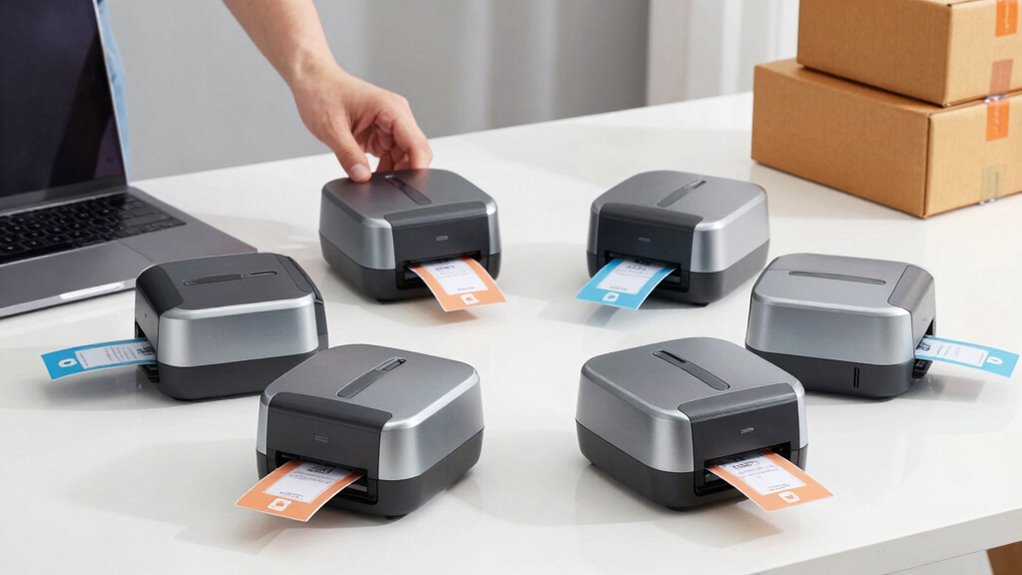

If you run a small business that ships more than a handful of packages a week, a wireless thermal label printer pays for itself in saved time and skipped trips to the print shop. All five models here print ink-free 4×6 shipping labels over Bluetooth, but they are not interchangeable: the real differences come down to print speed, how each one handles label calibration, and how much the companion app gets in your way. My top pick is the NULLTONEX, which pairs fast output with a genuinely useful app and a solid desktop build. If desk space is tight or you print from a phone most of the day, the KNAON is the compact runner-up with the fastest speed rating of the group. And for sellers who want the lowest-friction setup with automatic label detection, the Rongta RP425 is the easiest path from box to first printed label.

Get business pricing on office and shipping supplies
- Business-only prices and quantity discounts
- Tax-exempt purchasing
- Multiple users, one account, clear invoices
Key Takeaways
- The NULLTONEX leads the lineup because it balances 150 mm/s speed, a 1,800-template app, and offline template storage — the strongest all-around package for daily shipping volume.
- The KNAON is the fastest printer here at 180 mm/s and the most compact, but it forces every device through its FlashLabel Pro app, which adds a step to platform printing.
- Rongta‘s RP425 offers the widest label support (0.98″ to 4.37″) and automatic label feeding, making it the best pick for mixed label sizes beyond standard 4×6 shipping.
- The JADENS is the budget-friendly choice, but its manual calibration requirement and narrower 4.1″ max width make it feel less polished than the HKHKPI.
- Bluetooth convenience always trades off against reliability: for bulk batches, USB on any of these printers is steadier than wireless printing from a phone.
| NULLTONEX Thermal Shipping Label Printer 4×6 Bluetooth Label Maker |  | Best Overall | Print technology: Direct thermal, inkless | Resolution: 203 DPI | Print speed: Up to 150 mm/s (~72 labels/min) | VIEW ON AMAZON | See Our Full Breakdown |
| HKHKPI Bluetooth Thermal Label Printer, 4×6 Shipping Label Printer |  | Best for Label Handling | Print technology: Direct thermal, inkless | Resolution: 203 DPI | Print speed: ~55 labels/min | VIEW ON AMAZON | See Our Full Breakdown |
| JADENS Bluetooth Thermal Shipping Label Printer |  | Best Budget Pick | Print technology: Direct thermal, inkless | Resolution: 203 DPI | Connectivity: Bluetooth (Windows/Mac), USB | VIEW ON AMAZON | See Our Full Breakdown |
| Rongta RP425 Bluetooth Shipping Label Printer |  | Easiest Setup | Print technology: Direct thermal, inkless | Resolution: 203 DPI | Print speed: Up to 150 mm/s | VIEW ON AMAZON | See Our Full Breakdown |
| KNAON Bluetooth Thermal Shipping Label Printer, Portable 4×6 |  | Best Compact and Fastest | Print technology: Direct thermal, inkless | Resolution: 203 DPI | Print speed: Up to 180 mm/s | VIEW ON AMAZON | See Our Full Breakdown |
| wireless thermal label printers for small business | Print technology | Resolution | Connectivity | Print speed |
|---|---|---|---|---|
| NULLTONEX Thermal Shipping Lab | Direct thermal, inkless | 203 DPI | Bluetooth, USB | Up to 150 mm/s (~72 labels/min) |
| HKHKPI Bluetooth Thermal Label | Direct thermal, inkless | 203 DPI | Bluetooth, USB (Type-C) | ~55 labels/min |
| JADENS Bluetooth Thermal Shipp | Direct thermal, inkless | 203 DPI | Bluetooth (Windows/Mac), USB | — |
| Rongta RP425 Bluetooth Shippin | Direct thermal, inkless | 203 DPI | Bluetooth, USB Type-C | Up to 150 mm/s |
| KNAON Bluetooth Thermal Shippi | Direct thermal, inkless | 203 DPI | Bluetooth, USB | Up to 180 mm/s |
More Details on Our Top Picks
NULLTONEX Thermal Shipping Label Printer 4×6 Bluetooth Label Maker
This option stands out for the way it balances speed, software, and durability without leaning too hard on any one of them. At 150 mm/s (roughly 72 labels per minute), it keeps pace with the Rongta and sits close behind the KNAON, which matters if you print in batches during a packing session. Where it pulls ahead is the FlashLabel Pro app with 1,800+ templates and offline storage — you can save your label designs locally and print immediately instead of waiting on cloud downloads, something none of the other four models match as cleanly.
The dual Bluetooth and USB approach is also more flexible than the KNAON’s app-mandatory workflow. With NULLTONEX, USB gives you a steady, interference-free connection to a laptop for bulk runs, while Bluetooth handles quick phone prints. Compared with the JADENS, the matte reinforced finish and built-in printhead overheat protection make it feel better suited to long daily runs. The tradeoff: it only supports labels from 1.57″ to 4.3″ wide, which is narrower than the Rongta’s range, and there is no automatic calibration mentioned, so you may spend a moment feeding the first label of a new roll correctly.
Pros:- Fast 150 mm/s output keeps up with high-volume packing sessions
- Offline template storage in the FlashLabel Pro app avoids cloud delays
- Bluetooth and USB dual connectivity covers both mobile and desktop workflows
- Overheat protection supports stable long-run printing
Cons:- No automatic label calibration, unlike the Rongta or HKHKPI
- Minimum label width of 1.57″ excludes some small barcode and QR label sizes
- Black-and-white printing only, as with every thermal printer here
Best for: Small business sellers who print shipping labels daily and want one printer that handles both phone-based and laptop-based workflows well
Not ideal for: Sellers who mostly print tiny labels (under 1.57″ wide) or want fully automatic label detection
- Print technology:Direct thermal, inkless
- Resolution:203 DPI
- Print speed:Up to 150 mm/s (~72 labels/min)
- Connectivity:Bluetooth, USB
- Max label width:4.3 inches
- Min label width:1.57 inches
- App:FlashLabel Pro (1,800+ templates)
- Included labels:25 sheets of 4×6 thermal labels
Our verdict“The most well-rounded pick of the five, combining speed, flexible connectivity, and genuinely useful app features for everyday small business shipping.”
HKHKPI Bluetooth Thermal Label Printer, 4×6 Shipping Label Printer
Where the NULLTONEX wins on software polish, the HKHKPI wins on the mechanical side of label handling. Its automatic calibration positioning, intelligent paper ejection, and self-diagnostics mean fewer wasted labels and fewer jams — the kind of frustration that adds up when you are switching between roll sizes during a busy day. The JADENS, by contrast, asks you to press and hold the feed button to calibrate every time you change labels, which is exactly the chore this model eliminates.
The standout durability claim is the print head rated for roughly 1.25 million labels (50 km), which is the most concrete longevity figure in this lineup and appealing if you print hundreds of labels weekly. Its NADA Print app is capable — with OCR text recognition and PDF import — though the workflow leans more toward DIY labels than raw shipping throughput. At 55 labels per minute it is the slowest printer here, behind the NULLTONEX’s 72 and the KNAON’s higher rating, and at 722g it is heavier than the KNAON despite similar dimensions. This model is better suited to sellers who juggle many label types and hate fiddling with paper than to anyone chasing maximum speed.
Pros:- Automatic calibration and intelligent paper ejection reduce wasted labels
- Print head rated for approximately 1.25 million labels
- Handles both fanfold and roll paper from 25mm to 110mm wide
- Broad platform compatibility including ShipStation, Shippo, and Pirate Ship
Cons:- Slowest print speed of the group at 55 labels per minute
- Heavier than similarly compact rivals like the KNAON
- App-focused design adds a step for direct platform printing
Best for: Sellers who frequently switch label sizes and want automatic calibration and jam prevention to handle it for them
Not ideal for: High-volume shippers who need the fastest possible batch output
- Print technology:Direct thermal, inkless
- Resolution:203 DPI
- Print speed:~55 labels/min
- Connectivity:Bluetooth, USB (Type-C)
- Label width range:25mm–110mm
- Print head life:~1.25 million labels (50 km)
- Dimensions:18.5 x 9.35 x 9.23 cm
- Weight:722.5 g
Our verdict“The most forgiving printer in the lineup for people who change labels often, trading top-end speed for smarter paper handling and a long-lived print head.”
JADENS Bluetooth Thermal Shipping Label Printer
The JADENS earns its place by covering the fundamentals at a lower level of complexity than the rest of the field. It prints clean 203 DPI labels from both fanfold and roll stock, works across Windows and Mac over USB, and supports the major shipping platforms sellers actually use — ShipStation, Shippo, Endicia, eBay, Amazon, and Shopify. Setup is refreshingly direct, with drivers and tutorial videos supplied on a USB drive, and the one-year warranty with phone and remote-support options is stronger support than most budget thermal printers offer.
The compromises are real, though. Wireless printing is uneven across devices: Windows and Mac can print over Bluetooth, but Android and iOS users must go through the JADENS app rather than printing natively, which is clunkier than the Rongta’s cleaner phone workflow. You also have to manually calibrate label size every time you change labels by holding the feed button — a small annoyance the HKHKPI automates entirely. The 4.1″ maximum width is the narrowest in this lineup, so it is fine for standard 4×6 shipping labels but tighter for anything unusual. For a first thermal printer at low volume, those tradeoffs are acceptable; for a growing operation, the NULLTONEX is the better long-term tool.
Pros:- Works with both fanfold and roll labels
- USB drive includes drivers and troubleshooting videos for quick setup
- One-year warranty with phone, email, and remote support
- Compatible with all major shipping and e-commerce platforms
Cons:- Manual calibration required every time you change labels
- Mobile printing only works through the JADENS app, not natively over Bluetooth
- Narrowest label support of the group at 4.1″ maximum width
Best for: First-time thermal printer buyers and low-volume sellers who want a dependable, no-frills machine with real customer support
Not ideal for: Frequent label-size switchers or sellers who print primarily from a phone
- Print technology:Direct thermal, inkless
- Resolution:203 DPI
- Connectivity:Bluetooth (Windows/Mac), USB
- Label width range:1.57″–4.1″
- Media types:Fanfold and roll labels
- System support:Windows 7+, Mac OS 10.9+
- Warranty:One year
Our verdict“A sensible entry point that does the basics reliably, provided you can live with manual calibration and app-dependent mobile printing.”
Rongta RP425 Bluetooth Shipping Label Printer
If the JADENS asks too much of you, the Rongta RP425 is the opposite experience: load labels, and the printer automatically detects, grabs, and feeds them with no manual calibration step. That single feature removes the most common frustration in this category, and combined with a clean Bluetooth pairing flow through the Rongta app on iOS and Android, it is the shortest path from unboxing to your first printed shipping label among the five models here.
Its 0.98″ to 4.37″ label width range is the widest in this lineup, comfortably covering 2×2 circular labels, 1×1 QR codes, and standard 4×6 shipping labels — broader than both the NULLTONEX and the KNAON. Print speed matches the NULLTONEX at 150 mm/s, and driver support extends to Windows, Mac, and even Chrome OS. The drawbacks are quieter but worth knowing: the driver download from Rongta’s website is a more old-school process than the JADENS’ included USB drive, and the compact build means it lacks the HKHKPI’s self-diagnostics or stated print-head lifespan, so long-term heavy users get fewer reassurances. Compared with the KNAON, you give up some speed and app template richness in exchange for simpler, more reliable label handling.
Pros:- Automatic label detection and feeding eliminates manual calibration
- Widest label support of the group: 0.98″ to 4.37″ wide
- 150 mm/s print speed matches the fastest mainstream picks
- Native iOS and Android app support with quick Bluetooth pairing
Cons:- Drivers must be downloaded from the manufacturer website rather than bundled
- No self-diagnostics or stated print-head lifespan like the HKHKPI
- Fewer app templates and design tools than the NULLTONEX or KNAON
Best for: Sellers who want plug-and-play simplicity, automatic label detection, and flexibility across many label sizes
Not ideal for: Buyers who want extensive in-app design templates or detailed hardware diagnostics
- Print technology:Direct thermal, inkless
- Resolution:203 DPI
- Print speed:Up to 150 mm/s
- Connectivity:Bluetooth, USB Type-C
- Label width range:0.98″–4.37″
- System support:Windows 7+, Mac OS 10.11+, Chrome OS
- Dimensions:10.2 x 7.4 x 5.3 inches
- Weight:0.65 kg
Our verdict“The easiest printer here to live with day to day thanks to automatic label handling and the widest media support in the lineup.”
KNAON Bluetooth Thermal Shipping Label Printer, Portable 4×6
The KNAON competes directly with the Rongta for mobile-first sellers, and it wins on two counts: it is the smallest printer in this lineup at 7.17 x 3.9 x 3.43 inches, and at 180 mm/s it carries the fastest speed rating of the five. If your shipping station is a kitchen counter or you occasionally take the printer to a market or pop-up, that footprint matters more than any other spec. The app ecosystem is also the richest here, with 3,000+ templates, 5,000+ icons, and 100+ fonts for sellers who print branded thank-you labels and price tags alongside shipping labels.
The catch is a meaningful one: every device must print through the FlashLabel Pro app — no direct Bluetooth printing from any platform, and shipping labels from Etsy or Shopify need to be saved as PDFs and imported manually. That makes platform-heavy workflows slower than the NULLTONEX’s or JADENS’ direct USB printing from a laptop. The 1.5″ to 4.2″ label range is decent but narrower than the Rongta’s, and the box includes only 10 test sheets versus 25–100 elsewhere. This pick makes the most sense for sellers whose center of gravity is a phone or tablet and who value portability and creative labeling over raw platform integration.
Pros:- Fastest print speed of the group at 180 mm/s
- Most compact footprint, easy to store or travel with
- Largest template and icon library for branded and DIY labels
- Broad USB support including ChromeOS and Linux, with drivers on a built-in USB drive
Cons:- All printing must go through the FlashLabel Pro app, including desktop
- Shipping labels from platforms require manual PDF import
- Only 10 test sheets included, fewer than competing bundles
Best for: Mobile-first sellers and small workspaces that prioritize portability, speed, and creative label design
Not ideal for: Sellers who print large batches of platform-generated shipping labels via laptop
- Print technology:Direct thermal, inkless
- Resolution:203 DPI
- Print speed:Up to 180 mm/s
- Connectivity:Bluetooth, USB
- Label width range:1.5″–4.2″
- Dimensions:7.17 x 3.9 x 3.43 inches
- App:FlashLabel Pro (3,000+ templates, 5,000+ icons)
- System support:Windows 7+, macOS, ChromeOS, Linux
Our verdict“The fastest and most portable option here, best for phone-centric sellers willing to route everything through an app.”

How We Picked
When I compare wireless thermal label printers for small business use, I focus on the factors that actually affect a seller’s daily workflow rather than spec-sheet bragging rights. Print speed matters once you move past ten labels a day, so I weighed each model’s mm/s rating against its real-world throughput claims. Connectivity flexibility was next: a printer that only works well through a proprietary app is a different product from one that prints cleanly over USB from a laptop running ShipStation or Pirate Ship. I also looked at label-size range, because a printer locked to 4×6 stock is less useful than one that handles barcodes, price tags, and circular labels. Finally, I considered setup friction and reliability features — automatic calibration, jam prevention, and printhead protection — since a printer that wastes labels during a shipping rush costs more than it saves. Every model here prints at 203 DPI, which is the standard resolution carriers require for scannable barcodes, so resolution was not a differentiator.
| wireless thermal label printers for small business | Print speed | Connectivity | System support |
|---|---|---|---|
| NULLTONEX Thermal Shipping Lab | Up to 150 mm/s (~72 labels/min) | Bluetooth, USB | — |
| HKHKPI Bluetooth Thermal Label | ~55 labels/min | Bluetooth, USB (Type-C) | — |
| JADENS Bluetooth Thermal Shipp | — | Bluetooth (Windows/Mac), USB | Windows 7+, Mac OS 10.9+ |
| Rongta RP425 Bluetooth Shippin | Up to 150 mm/s | Bluetooth, USB Type-C | Windows 7+, Mac OS 10.11+, Chrome OS |
| KNAON Bluetooth Thermal Shippi | Up to 180 mm/s | Bluetooth, USB | Windows 7+, macOS, ChromeOS, Linux |
Factors to Consider When Choosing Wireless Thermal Label Printers For Small Business
Before choosing between these five printers, it helps to understand the few specs that genuinely separate them — and the ones that do not, since every model here prints at the carrier-standard 203 DPI.Connectivity: How Wireless Do You Actually Need?
“Wireless” means different things across this lineup. The Rongta and NULLTONEX offer the most flexible Bluetooth implementations, with straightforward phone printing plus USB for desktops. The JADENS restricts mobile printing to its own app, and the KNAON requires every device — phone or computer — to print through FlashLabel Pro. If you print platform labels from a laptop all day, USB reliability beats Bluetooth convenience, and a printer with a smooth USB path like the NULLTONEX or JADENS will serve you better than a more app-dependent model.
Label Size Range and Media Type
Every printer here handles standard 4×6 shipping labels, so the differentiator is what else they support. The Rongta’s 0.98″–4.37″ range is the widest, covering tiny QR and barcode labels the others cannot. The HKHKPI uniquely supports both fanfold and roll paper up to 110mm, which matters if you prefer fanfold stacks that skip the roll holder. Check your actual label inventory before buying — a narrower range is only a limitation if you use labels outside it.
Speed and Duty Cycle
Ratings run from the HKHKPI’s 55 labels per minute to the KNAON’s 180 mm/s. For under twenty packages a day, any of these speeds is fine. For batch printing fifty or more labels at once, the faster models reduce waiting time and heat buildup. Durability claims also vary: the HKHKPI’s million-label print head rating is the clearest indicator of long-term heavy-duty suitability, while the NULLTONEX’s overheat protection serves the same goal differently.
App Quality and Platform Workflow
Companion apps range from a convenience to a requirement. The NULLTONEX’s offline template storage and the KNAON’s huge design library reward sellers who print custom labels. But if your labels come straight from ShipStation, Pirate Ship, or Etsy, an app that demands PDF imports adds friction with every single label. Match the app’s role to how you actually generate labels — that choice will affect your daily routine more than a few mm/s of print speed ever will.
Frequently Asked Questions
Do wireless thermal label printers need ink or toner?
No. All five printers in this roundup use direct thermal technology, which means the print head heats specially coated thermal paper to create the image. There are no ink cartridges, toner, or ribbons to buy or replace — your only ongoing consumable is the thermal label paper itself. That keeps operating costs low and eliminates the most common failure mode of inkjet printers: dried or clogged cartridges after a period of disuse. The tradeoff is that thermal labels can fade over years or with prolonged heat exposure, so they are ideal for shipping labels but not for archival documents.
Can I print shipping labels from my phone with these printers?
Yes, but the experience varies by model. The Rongta pairs quickly with iOS and Android through its own app, and the NULLTONEX offers a similar Bluetooth workflow with offline template storage. The JADENS also supports phone printing but only through its app rather than native Bluetooth, and the KNAON requires every device to route through FlashLabel Pro, meaning you typically save a shipping label as a PDF and import it. If phone-first printing is central to your workflow, the Rongta or NULLTONEX will feel noticeably smoother than the app-dependent alternatives.
Do these printers work with Shopify, Etsy, Amazon, and shipping software like Pirate Ship?
All five models list compatibility with the major e-commerce and shipping platforms, including Amazon, eBay, Etsy, Shopify, USPS, UPS, FedEx, and DHL, and most also support shipping software such as ShipStation, Shippo, and Pirate Ship. In practice, the smoothest path is usually downloading the label as a PDF from your platform and printing it over USB from a computer, which works identically on every printer here. The differences show up in wireless workflows, where some apps import PDFs more gracefully than others. None of these printers print in color, but carriers only require black-and-white scannable barcodes.
Is 203 DPI resolution good enough for shipping labels?
Yes — 203 DPI is the industry standard for shipping labels, and every carrier’s barcode scanners read it without issue. All five printers in this comparison print at 203 DPI, so resolution is not a reason to choose one over another. Higher resolutions of 300 DPI exist on pricier printers, but the difference only becomes visible on very small text or dense graphics like tiny QR codes. For addresses, barcodes, and standard shipping labels, 203 DPI produces sharp, scannable output, and paying more for higher resolution rarely benefits a typical small business shipper.
What size thermal labels do these printers support?
All five handle the standard 4×6 inch shipping label, which covers most small business needs. Beyond that, they diverge: the Rongta supports the widest range at 0.98″ to 4.37″, including small QR and circular labels; the NULLTONEX covers 1.57″ to 4.3″; the KNAON spans 1.5″ to 4.2″; and the JADENS tops out at 4.1″. The HKHKPI handles 25mm to 110mm and uniquely accepts fanfold as well as roll paper. If you only print 4×6 shipping labels, any of them works; if you also print barcodes, price tags, or name badges, the wider ranges are worth having.
Conclusion
The right pick depends less on specs and more on how your shipping operation actually runs. High-volume daily shippers should go with the NULLTONEX — its speed, dual connectivity, and offline template storage make it the most complete tool in the lineup. Sellers who switch between label types constantly will get more from the HKHKPI’s automatic calibration and long-lived print head, while anyone who values a frustration-free setup above all else should choose the Rongta RP425 for its automatic label feeding and the widest media support here. Phone-first sellers and cramped workspaces are the natural audience for the compact, fast KNAON, provided the app-based workflow fits their habits. And if you are just getting started and want a dependable machine with real customer support behind it, the JADENS covers the basics without demanding much in return.