
📊 Full opportunity report: The Workflow Audit: A Useful Tool For SMB Automation Consulting on IdeaNavigator AI — validation score, market gap, and execution plan.

Get business pricing on office and shipping supplies
- Business-only prices and quantity discounts
- Tax-exempt purchasing
- Multiple users, one account, clear invoices
TL;DR
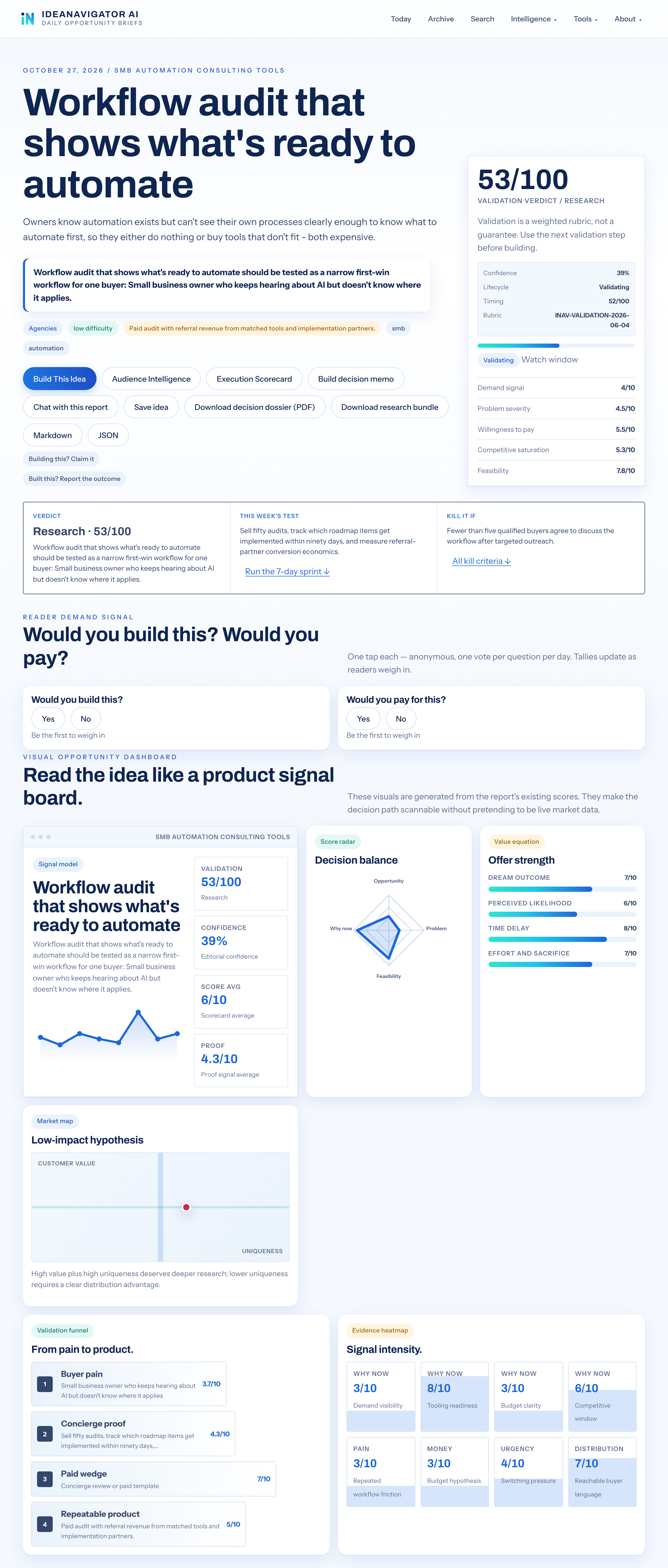
A proposal for small-business automation consulting centers on a guided workflow audit that scores processes and recommends tools and a 90-day implementation plan. Its demand and business model are unproven; the suggested test is to sell 50 audits and track implementation and referrals.
IdeaNavigator AI has proposed a workflow-audit service that would help small-business owners identify which operations may be ready for automation, then provide a sequenced 90-day roadmap with matched tools. The concept is aimed at owners unsure where artificial intelligence and automation fit their work, but no product launch, customer results or completed market test are reported.
According to IdeaNavigator AI’s proposal, the audit would use a guided interview to map a business’s operations. It would then score individual processes on automation readiness, potential return on investment and difficulty, giving owners a way to compare possible projects rather than choosing software first.
The proposal says each audit would produce a prioritized plan covering the next 90 days, with suggested tools for each step. It also identifies a possible revenue model: charging for the audit and earning referral revenue when customers select recommended software or implementation partners. These are proposed features and revenue sources, not evidence of an operating service or established income.
IdeaNavigator AI describes the suggested validation test as an effort to sell 50 audits, then track which roadmap recommendations customers implement within 90 days and measure conversion economics from referral partners. The proposal provides no sales, implementation rates, conversion figures, pricing or customer feedback, so the test remains a proposed next step.
A Filter Before Buying Automation Tools
The concept addresses a practical gap between interest in automation and choosing what to change. Owners may know that software can handle some tasks but lack a clear map of their own workflows. Without that map, they can delay action or purchase tools that do not fit their processes, the problem described in IdeaNavigator AI’s proposal.
A structured audit could make consulting more concrete by connecting a process review to ranked recommendations and a limited-term plan. For small businesses with little time to evaluate an expanding range of AI tools, that format may make decisions easier to compare. However, a readiness score or projected return is only useful if its assumptions are transparent and its recommendations match the business’s actual needs.
The commercial model also creates a potential conflict to manage: a provider earning referral fees may have an incentive to recommend particular tools. Clear disclosure of paid relationships and recommendations based on fit would matter to customers. IdeaNavigator AI’s proposal does not describe how such referrals would be selected or disclosed.
Products Worth Considering

Apple iPad Air (4th Generation, 10.9-inch, Wi-Fi, 256GB) – Space Gray

Apple iPad Air 13-inch (M4), 128GB, Wi-Fi 7, Space Gray

Dell XPS 13 9350 AI Professional Laptop 13.4 120Hz FHD+ Display
As an affiliate, we earn on qualifying purchases.
From AI Interest to Process Mapping
IdeaNavigator AI frames the opportunity around decision paralysis among small-business owners amid a proliferation of AI tools. Its argument is that owners often cannot tell which of their own processes merit automation, even when they are aware that automation is available. This is the problem the proposed audit is intended to address, rather than a report that businesses have already adopted a specific solution.
The proposal also points to guided process interviews as a possible use for large language models (LLMs), which can help structure questions and organize responses. That observation describes a potential product approach; it does not establish that an LLM can reliably capture every workflow, calculate returns or recommend the best tool without human review.
The idea sits within the broader SMB automation consulting market. Its distinguishing proposal is a packaged audit with scoring and a short implementation roadmap. IdeaNavigator AI provides no market-size estimate, competitor comparison or evidence of demand, so the scale of the opportunity cannot be judged from the concept alone.
Demand and Results Remain Untested
No operating results are available in IdeaNavigator AI’s proposal. It does not identify a launched service, customers, audit price, delivery costs, implementation rates or referral income. The suggested target of 50 paid audits is a validation plan, not a record of 50 completed sales.
It is also unclear how the audit would distinguish processes that are technically automatable from those that are worth automating, or how it would account for data quality, privacy, security, staff capacity and existing software. The proposal does not specify whether a human consultant would review the process map, how scoring would be calculated or how recommendations would be updated as tools change.
Without follow-up data, there is no basis to say whether customers would implement the roadmap within 90 days, achieve savings or generate enough partner referrals to support the model. Those questions would need to be answered through the proposed test and transparent reporting of its results.
The Proposed 50-Audit Test
IdeaNavigator AI identifies the next stated milestone as an effort to sell 50 audits and follow each customer’s roadmap for 90 days. The test would measure which recommended actions are implemented and whether referrals to software vendors or implementation partners convert into revenue.
Those figures could help assess whether owners will pay for the audit and whether its recommendations lead to action. The proposal gives no timeline for running the test or reporting results. Until those details are available, the service should be treated as an unvalidated business concept rather than a proven way to improve small-business operations.
Source: IdeaNavigator AI
Key Questions
What is the proposed workflow audit?
It is a proposed guided review of a small business’s operations. The intended output is a process map, scores for automation readiness, potential return and difficulty, plus a 90-day roadmap and tool suggestions.
Is the audit service already available?
The available information describes a concept and a validation plan. It does not confirm a launch, availability, pricing or completed customer work.
How would the business make money?
The proposal suggests charging customers for audits and receiving referral revenue from recommended tools or implementation partners. Actual earnings and conversion rates have not been reported.
How would the idea be tested?
The proposed test is to sell 50 audits, track which roadmap items customers implement within 90 days and measure referral-partner conversions.
What is not yet known about the recommendations?
The proposal does not explain how scores would be calculated, how recommendations would be checked for accuracy, or how potential referral fees would be disclosed. It also provides no evidence yet about implementation outcomes.
Source: IdeaNavigator AI