
📊 Full opportunity report: Understanding Data Center Equipment Lifecycles For Better Planning on IdeaNavigator AI — validation score, market gap, and execution plan.

Get business pricing on office and shipping supplies
- Business-only prices and quantity discounts
- Tax-exempt purchasing
- Multiple users, one account, clear invoices
TL;DR
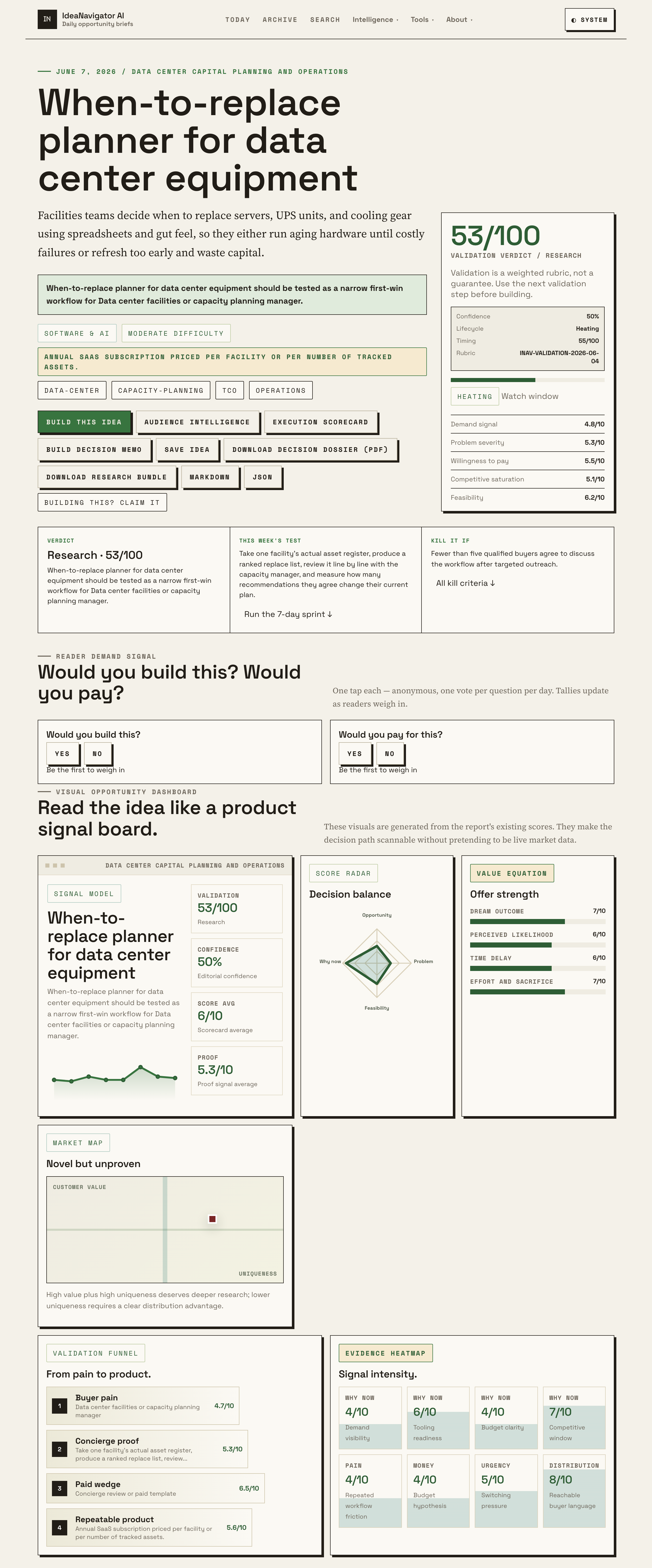
A new SaaS-based planner for data center facilities helps determine optimal timing for hardware replacements. It uses asset data to improve decision-making, reducing costs and failures. The tool is currently being validated with real facilities.
A new software tool designed to assist data center facilities managers in determining when to replace hardware is entering a validation phase. The tool, developed by IdeaNavigator AI, ingests asset data such as age, power consumption, and maintenance costs to generate prioritized replacement recommendations. This development addresses a longstanding challenge in data center management — deciding when to refresh equipment to balance costs, efficiency, and reliability.
The tool, called the When-to-Replacement Planner, aims to replace traditional methods based on spreadsheets and intuition. It analyzes a facility’s asset list, considering factors like hardware age, energy usage, failure risk, and replacement costs. Based on this data, it produces a ranked list of equipment that should be replaced immediately versus those that can be kept longer. The goal is to optimize capital expenditure and minimize unexpected failures.
According to IdeaNavigator AI, the approach is to test the planner by applying it to one facility’s existing asset register, then reviewing its recommendations with the capacity manager. The success of the validation depends on how many suggested replacements align with current plans and whether the recommended changes lead to cost savings and improved reliability. The SaaS product is priced per facility or per number of assets tracked, targeting data center operations and capital planning teams.
Energy costs and hardware efficiency are driving the need for better planning tools. As hardware becomes more efficient but also more complex, intuitive decision-making is increasingly unreliable, making data-driven tools essential for future-proofing infrastructure.
Implications for Data Center Cost and Reliability Management
This development could significantly improve how data centers manage hardware lifecycle decisions, leading to reduced operational costs and increased reliability. By providing objective, data-driven recommendations, facilities managers can avoid premature hardware replacement or costly failures caused by aging equipment. As energy costs continue to rise, optimizing replacement timing becomes even more critical, potentially saving millions annually across large-scale facilities.
Furthermore, this tool exemplifies a broader shift toward automation and analytics in data center operations, aligning with industry trends toward smarter, more efficient infrastructure management. If validated successfully, it may set a new standard for capital planning processes in the sector.
data center hardware replacement tools
As an affiliate, we earn on qualifying purchases.
As an affiliate, we earn on qualifying purchases.
Growing Pressure on Data Center Hardware Lifecycle Planning
Data centers face increasing pressure to optimize hardware replacement due to rising energy costs, stricter reliability demands, and the rapid pace of hardware innovation. Traditionally, facilities teams relied on spreadsheets and gut instincts, often leading to either premature replacements or unexpected failures. This has resulted in inefficient capital use and operational disruptions.
Recent developments have emphasized the need for more precise, data-driven approaches. Hardware manufacturers are releasing more energy-efficient models, but integrating these into existing infrastructure requires careful planning. The challenge is compounded by the lack of standardized tools for lifecycle management, prompting industry interest in solutions like the When-to-Replacement Planner.
Previous efforts have focused on monitoring hardware health and predictive maintenance, but these often do not directly address the timing of replacements based on overall cost-benefit analysis. The new tool aims to fill this gap by providing actionable insights based on comprehensive asset data.
“Integrating energy consumption and failure risk into replacement decisions is a significant step forward in data center operations.”
— an anonymous researcher
server rack energy monitoring devices
As an affiliate, we earn on qualifying purchases.
As an affiliate, we earn on qualifying purchases.
Validation Results and Adoption Uncertainties
It is not yet clear how well the validation process will confirm the tool’s effectiveness across different types of facilities. The success depends on how closely the recommendations align with existing plans and whether they lead to measurable cost savings or reliability improvements. Details about long-term impact and scalability are still emerging, and industry adoption may face hurdles related to integration and user trust.
data center asset management software
As an affiliate, we earn on qualifying purchases.
As an affiliate, we earn on qualifying purchases.
Next Steps in Validation and Industry Adoption
The next phase involves applying the planner to additional facilities to validate its recommendations and gather user feedback. If results are positive, the company plans to refine the algorithm and expand availability. Industry stakeholders will watch for case studies demonstrating tangible benefits, which could accelerate broader adoption. Further integration with existing facility management systems is also expected.
enterprise hardware lifecycle management
As an affiliate, we earn on qualifying purchases.
As an affiliate, we earn on qualifying purchases.
Key Questions
How does the planner determine which hardware to replace?
The planner analyzes asset data such as age, energy consumption, failure history, and maintenance costs to produce a ranked list of equipment that should be replaced immediately versus those that can be retained.
Is this tool suitable for all types of data centers?
The tool is designed for facilities with detailed asset registers and is currently being validated on a limited number of facilities. Its effectiveness across different data center types remains to be confirmed.
What are the cost implications of using this planner?
The SaaS subscription is priced per facility or per number of assets tracked, aiming to be cost-effective relative to potential savings from optimized replacements.
When will the tool be generally available?
Following successful validation and refinement, the company plans to launch a broader market rollout, but specific timelines have not been announced.
Can this tool replace traditional decision-making methods?
It is intended to supplement existing practices, providing data-driven recommendations that can improve accuracy and confidence in replacement timing decisions.
Source: IdeaNavigator AI
Halloween Picks
halloween
As an affiliate, we earn on qualifying purchases.