

📊 Full opportunity report: The Real Story Behind Qwen3.8-Max’s AI Performance Data on ThorstenMeyerAI.com — validation score, market gap, and execution plan.
TL;DR
Alibaba officially released detailed performance data for Qwen3.8-Max, confirming its 2.4 trillion parameters and benchmark results. The model’s open weights will be available next week, marking a significant milestone in large-scale open AI models.
Alibaba has officially disclosed comprehensive details about Qwen3.8-Max, confirming it as a 2.4 trillion-parameter model with strong benchmark performance and upcoming open weights. This marks a significant step in large-scale AI model deployment, especially in the open-source domain.
For two weeks, Alibaba’s largest-ever model was known only by its slogan, “Second only to Fable 5,” with an unverified 2.4 trillion parameters. On August 3, Alibaba published its full benchmark table and confirmed that open weights will be available next week. The model is built on the Qwen3.5 architecture and features a 95 billion active-parameter count, utilizing sparse mixture-of-experts technology, and supports multimodal inputs including text, images, and videos.
The benchmark results show that Qwen3.8-Max scores 86.6 on Terminal-Bench 2.1, surpassing Claude models but trailing GPT-5.6 Sol, and leads in several multimodal and agentic benchmarks. The model demonstrated the ability to reproduce research paper results and outperform its predecessor in long-horizon agentic capabilities, indicating significant improvements. However, it underperforms on deep software-engineering benchmarks like SWE-bench Pro, with scores considerably below Fable 5, highlighting its limitations in certain specialized areas. The open weights, scheduled for release next week, will be multi-node artifacts, not suitable for individual hosting, but the 27B version is designed for deployment on high-memory single machines.
For fifteen days the claim ran without a benchmark table. Today Alibaba published the table, the active-parameter count, and a weights timeline. The numbers are genuinely strong on the rows Alibaba chose — and twelve to fifteen points behind on the rows it didn’t.
▲ All performance figures: Alibaba’s own harnessThe claim shipped on a Sunday. The evidence shipped two weeks later. In between, the claim did its work.
“Second only to Fable 5” is true on the rows Alibaba chose and false on the rows it didn’t. Both halves below are from the same release.
“Qwen3.8 is going open-weight” describes three things with very different deployment realities.
OpenAI- and DashScope-compatible — a base-URL change to A/B against your current backend.
A multi-node datacenter artifact. At 95B active, no single machine serves it. A flag planted, not a deployment option.
The checkpoint that fits real hardware. Whether the agentic gains survive distillation is the question that decides whether next week matters.
Three Chinese frontier releases in seventeen days, each measured against the same export-controlled model. The contest is real; it is not the same thing as your workload.
- The generation jump is real and consistent across a dozen agentic rows, with a stated mechanism: RL-environment scaling.
- More disclosure than Kimi K3 shipped — full table, active-parameter count, weights timeline.
- If 2.4T lands under a permissive licence, the ceiling of “open weight” moves permanently.
- The 27B sibling could become the best local agent model on hardware people already own.
- Every number is Alibaba’s harness. Independent testing already tempered Kimi K3’s launch claims substantially.
- The paying use case still belongs to Fable 5 — twelve to fifteen points on deep software engineering.
- “Next week” comes from a company that sat on a finished benchmark table for fifteen days.
- Until the licence text exists, “going open-weight” is a press strategy, not a property of the model.
and it says “second only” depends entirely on which row you read.
Implications of Alibaba’s Benchmark and Open Release
This development is notable because it confirms Alibaba's ability to produce a massively large, high-performance open-weight model, potentially reshaping the AI landscape. The detailed benchmark results provide transparency and allow developers to assess the model’s strengths and limitations. The release of open weights for a model of this size could accelerate AI research and deployment, especially for organizations lacking large-scale infrastructure. However, the model's uneven performance across benchmarks underscores ongoing challenges in achieving balanced AI capabilities across diverse tasks.
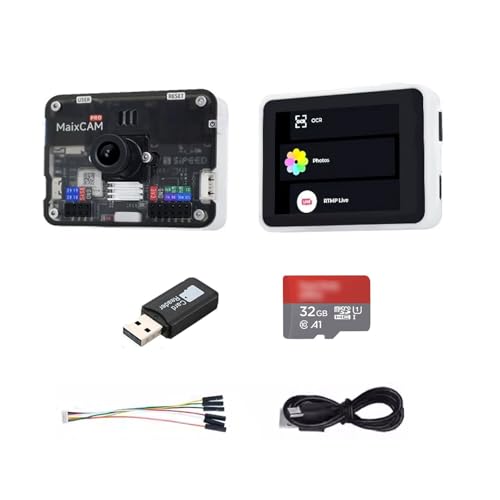
youyeetoo Sipeed MaixCAM Pro AI Development Board, Equipped with a RISC-V 1TOPS NPU and a Vision Camera, enables The Rapid Deployment of AI Vision and Auditory Applications. (SD Card Kit)
- Processor: 1GHz RISC-V C906 or optional ARM A53
- AI Performance: 1TOPS NPU for AI tasks
- Camera: Integrated vision camera
As an affiliate, we earn on qualifying purchases.
As an affiliate, we earn on qualifying purchases.
Background on Alibaba’s AI Model Launch Strategy
Alibaba's AI model development has been marked by strategic stealth and selective disclosure. The initial preview of Qwen3.8-Max appeared anonymously on July 18, followed by a confirmation at the World AI Conference in Shanghai on July 19. The company’s approach involved a staged reveal, culminating in the recent publication of benchmark data and specifications. Prior to this, Alibaba's models had been less transparent, with open models typically shipped under Apache 2.0 licenses, but the current 2.4 trillion-parameter model is a multi-node artifact, indicating a shift in deployment scope. The company’s focus has been on demonstrating agentic capabilities and multimodal performance, with a clear emphasis on scalability and transparency in the latest release.
"We are committed to advancing open AI and providing developers with powerful tools. The upcoming open weights will enable broader experimentation and deployment."
— Alibaba spokesperson
large-scale AI model hosting hardware
As an affiliate, we earn on qualifying purchases.
As an affiliate, we earn on qualifying purchases.
Remaining Questions About Model Capabilities and Licensing
It is still unclear what the exact licensing terms will be for the open weights, as Alibaba has not yet published the license details. The performance on certain benchmarks, especially deep software engineering tasks, indicates limitations that may affect deployment decisions. Additionally, the impact of the model’s agentic capabilities in real-world applications remains to be fully validated beyond benchmark tests. The scalability and integration of the 27B version for local deployment are also still under development, with no detailed benchmark results available yet.

LAFVIN ESP32-S3 1.69" LCD Development Board with Camera, AI Vision Voice Development Kit, Programmable IoT Board with Mic Speaker for STEM Education
- Powerful Microcontroller: ESP32-S3 with 16MB Flash and 8MB PSRAM
- AI Vision & Voice Capabilities: Camera, microphone, and AI interaction support
- Multiple Development Platforms: Supports Arduino IDE and ESP-IDF
As an affiliate, we earn on qualifying purchases.
As an affiliate, we earn on qualifying purchases.
Next Steps for Alibaba’s AI Model Deployment and Community Engagement
Alibaba is expected to release the 2.4 trillion-parameter weights next week, enabling wider testing and deployment. The 27B checkpoint will likely be made available for local use, targeting enterprise and developer markets. Further benchmark results and licensing details are anticipated in the coming weeks, along with potential updates to model capabilities based on early user feedback. Monitoring how the model performs in practical applications and its adoption by the AI community will be key to assessing its long-term impact.

ASRock Intel Arc Pro B70 Creator 32GB Workstation Graphics Card, Xe2-HPG, 32GB GDDR6, PCIe 5.0, 4X DP 2.1, Blower Fan, Vapor Chamber, Honeywell PTM7950
- System Compatibility: Measures 271 x 112 x 39 mm
- Power Requirements: Requires 12V-2x6-pin connector
- Customer Support: Direct Amazon contact for assistance
As an affiliate, we earn on qualifying purchases.
As an affiliate, we earn on qualifying purchases.
Key Questions
What are the main capabilities of Qwen3.8-Max?
Qwen3.8-Max is a multimodal model supporting text, images, and videos, with strong performance in agentic tasks and research paper reproduction, but weaker in specialized software engineering benchmarks.
When will the open weights be available?
The open weights for the 2.4 trillion-parameter model are scheduled for release next week, according to Alibaba’s announcement.
How does Qwen3.8-Max compare to other models like GPT-5.6 or Fable 5?
In benchmark tests, Qwen3.8-Max scores higher than Claude models but trails GPT-5.6 on some measures. It outperforms Fable 5 on agentic and multimodal tasks but underperforms on deep software-engineering benchmarks.
What are the licensing implications for the open weights?
Alibaba has not yet published the license details. Historically, Alibaba’s open models used Apache 2.0, but the upcoming 2.4T model may have different licensing terms, potentially more restrictive.
What does this mean for AI development overall?
This release demonstrates progress toward larger, more capable open models, potentially accelerating AI research and deployment, but also highlights ongoing challenges in balancing broad capability and specialized performance.
Source: ThorstenMeyerAI.com