
📊 Full opportunity report: The GLP-1 Stock Check: Compare Availability And Pricing on IdeaNavigator AI — validation score, market gap, and execution plan.

Get business pricing on office and shipping supplies
- Business-only prices and quantity discounts
- Tax-exempt purchasing
- Multiple users, one account, clear invoices
TL;DR
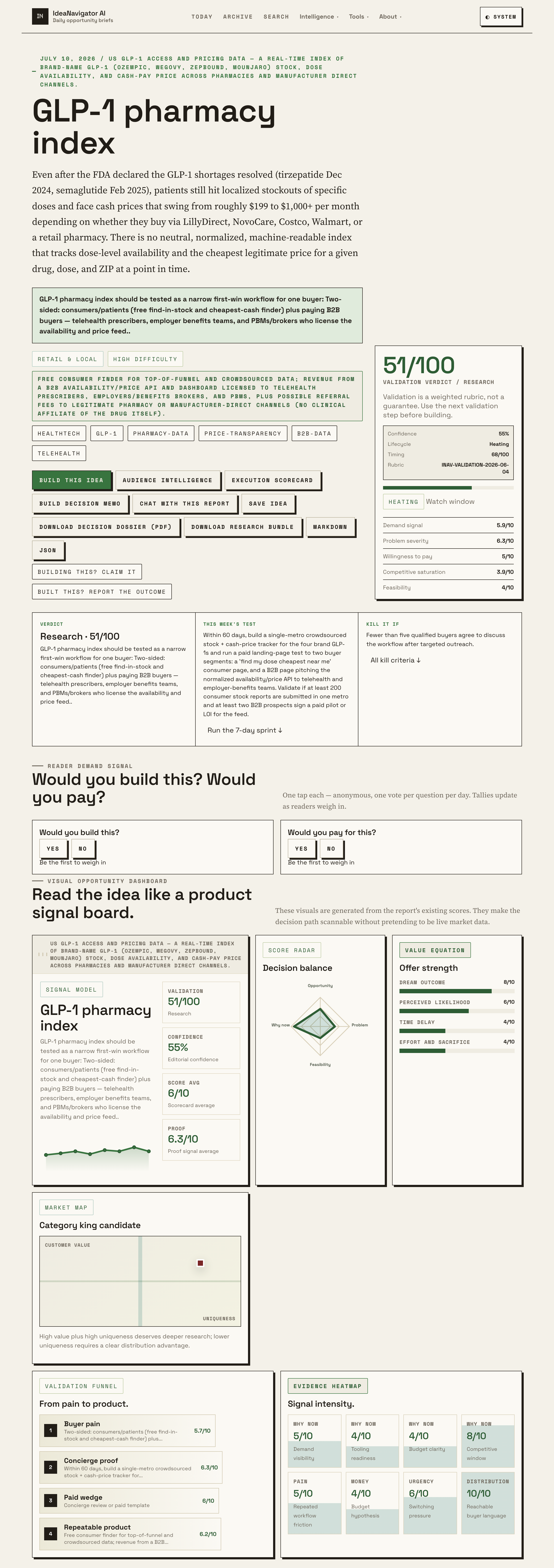
Even though the FDA declared GLP-1 shortages over (tirzepatide in December 2024, semaglutide in February 2025), patients still face local stockouts of specific doses and cash prices ranging from roughly $199 to more than $1,000 per month depending on the purchase channel. A new proposal from IdeaNavigator AI outlines a two-sided pharmacy index that would track dose-level availability and the cheapest legitimate cash price for Ozempic, Wegovy, Zepbound, and Mounjaro.
Patients searching for brand GLP-1 medications still encounter localized stockouts of specific doses and cash prices that swing from roughly $199 to more than $1,000 per month depending on whether they buy through LillyDirect, NovoCare, Costco, Walmart, or a retail pharmacy — even after the FDA declared the GLP-1 shortages resolved. That is the core finding behind a new GLP-1 pharmacy index proposal from IdeaNavigator AI, which argues the market’s problem has shifted from scarcity to fragmentation and that no neutral, machine-readable source currently tracks dose-level availability and the cheapest legitimate price by drug, dose, and ZIP code.
According to the proposal, the FDA removed tirzepatide from its shortage list in December 2024 and semaglutide in February 2025. But the end of the formal shortages did not end access problems. The proposal states that patients continue to hit dose-specific supply gaps at the local level, meaning one strength of a medication may be unavailable in a given area while others are in stock. At the same time, cash prices vary dramatically by channel, with manufacturer direct programs (LillyDirect, NovoCare), warehouse clubs (Costco, Walmart), retail pharmacies, and the TrumpRx portal launched in February 2026 each posting different prices for the same drugs.
The proposed index would cover the four brand GLP-1s — Ozempic, Wegovy, Zepbound, and Mounjaro — and operate on two sides. A free consumer tool would let patients find which doses are in stock nearby and identify the cheapest legitimate cash price for their prescription. A paid business-to-business product would license the normalized availability and price feed to telehealth prescribers, employer benefits teams, and PBMs or brokers who need cost-steering data.
The proposed revenue model combines a free consumer finder — which would also generate crowdsourced stock reports as data — with B2B API and dashboard licensing, plus possible referral fees to legitimate pharmacy or manufacturer-direct channels. The proposal explicitly excludes clinical affiliates of the drugs themselves.
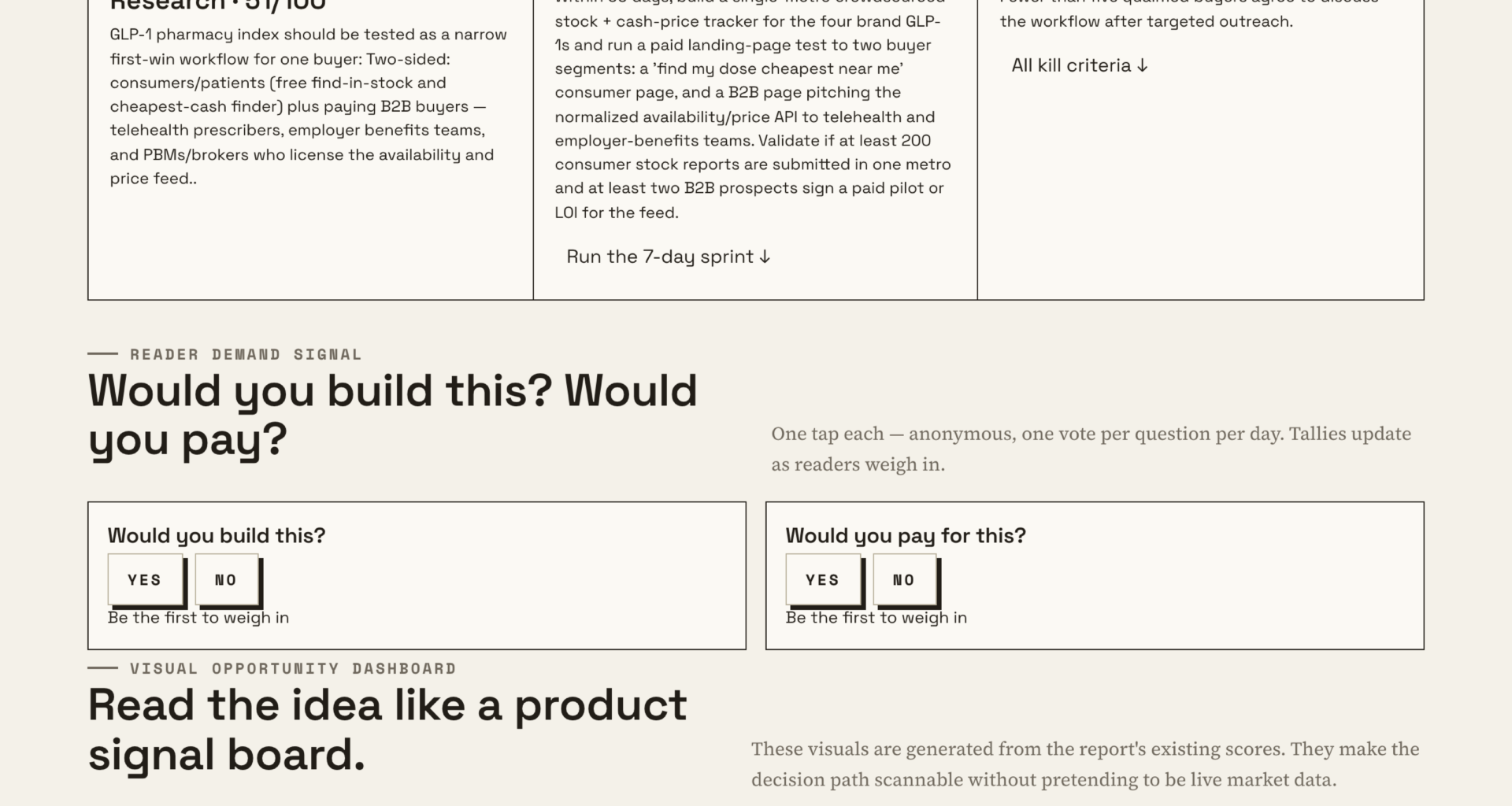
Validation would follow a defined 60-day test: build a single-metro crowdsourced stock and cash-price tracker for the four medications, then run paid landing-page tests to both a consumer audience and B2B prospects. The stated success thresholds are at least 200 consumer stock reports submitted in one metro and at least two B2B prospects signing a paid pilot or letter of intent for the feed.
Why Employers and Telehealth Need the Feed
The proposal’s significance rests on a spending claim it attributes to employer reports: GLP-1s now account for roughly 20% of pharmacy spend for employers. If accurate, that makes dose-level availability and price data a budget issue for benefits teams, not just a convenience issue for patients. Telehealth prescribers, who increasingly write GLP-1 prescriptions remotely, face a related problem: a prescription is useless if the prescribed dose is not stocked anywhere the patient can reach.
For consumers, the price spread the proposal documents — from about $199 to more than $1,000 per month — means the same drug can carry a fivefold cost difference depending on where it is purchased. A neutral index that normalizes those prices across LillyDirect, NovoCare, Costco, Walmart, and retail pharmacies would let patients comparison-shop in a market where no single source currently does so, according to the proposal.
The B2B side also matters because compounders exited the market as FDA shortage declarations ended and compounding deadlines forced them out, the proposal states. That removed a cheaper workaround channel and pushed more patients toward brand-name purchase channels, raising the stakes for accurate price and stock data.
How the Market Shifted From Shortage to Fragmentation
The GLP-1 supply picture changed in stages. First, the FDA formally resolved the shortages — tirzepatide in December 2024 and semaglutide in February 2025 — which under FDA rules also cut off the regulatory basis for mass compounding of copies of those drugs. Compounders wound down operations as deadlines passed.
Then, according to the proposal, manufacturers moved in the opposite direction of consolidation: rather than a single standardized channel, they launched competing direct cash-pay programs. LillyDirect and NovoCare became manufacturer-owned purchase routes, Costco and Walmart built their own cash programs, and the TrumpRx portal arrived in February 2026. Each channel prices independently, and dose-level supply varies by location and pharmacy.
The result, in the proposal’s framing, is a market that no longer has a shortage problem but has a fragmentation problem: plenty of drug in aggregate, but no normalized way to see which dose is available where, and at what legitimate cash price, at a given moment. IdeaNavigator AI argues that gap — not supply itself — is now the binding constraint on access and cost control.
Unverified Numbers and Untested Demand
Several claims in the proposal remain unverified by independent sources. The $199 to $1,000+ price range is presented as approximate and depends on drug, dose, and channel; no specific date or sample of pharmacies backs the range in the proposal itself. The figure that GLP-1s represent roughly 20% of employer pharmacy spend is attributed only to employer reports cited by the proposal, without a named survey or dataset.
Demand for the product is also untested. The 60-day validation plan — 200 consumer stock reports in one metro and two signed B2B pilots or letters of intent — is a target, not a result. No pilot has been run, no design partners are named, and no consumer tool exists yet. Whether crowdsourced stock reports would be accurate or timely enough to be useful, and whether telehealth or employer buyers would pay for the feed, is not yet known.
How such an index would handle manufacturer price changes, which can occur frequently across direct channels, and how it would verify that a reported stock level is legitimate, are open operational questions the proposal does not fully answer.
The 60-Day Test and Buyer Conversations
If the proposal moves forward, the immediate next step is the single-metro crowdsourced tracker: a working tool covering the four brand GLP-1s by drug, dose, and ZIP, seeded with public price data from LillyDirect, NovoCare, Costco, Walmart, and a GoodRx-style price layer. In parallel, paid landing-page tests would gauge consumer interest in a ‘find my dose cheapest near me’ service and B2B interest in the availability and price API.
The decision point comes at the 60-day mark: if at least 200 consumer stock reports arrive in the test metro and at least two B2B prospects sign paid pilots or letters of intent, the proposal’s own validation threshold would be met. If not, the idea would return to revision. Any rollout beyond one metro, and any commercial licensing of the feed, would depend on those initial results, which do not yet exist.
Source: IdeaNavigator AI
Key Questions
Are GLP-1 medications still in shortage?
No, according to the FDA timeline cited in the proposal: tirzepatide was declared resolved in December 2024 and semaglutide in February 2025. However, localized stockouts of specific doses can still occur even when the overall shortage is officially over.
Why do GLP-1 cash prices vary so much?
Prices differ by channel. Manufacturer direct programs like LillyDirect and NovoCare, warehouse clubs like Costco and Walmart, retail pharmacies, and the TrumpRx portal each set their own cash prices, producing a spread of roughly $199 to more than $1,000 per month for brand GLP-1s, according to the proposal.
What exactly would the proposed GLP-1 pharmacy index do?
It would offer a free consumer tool to find which doses of Ozempic, Wegovy, Zepbound, or Mounjaro are in stock nearby and at the cheapest legitimate cash price, while licensing a normalized availability-and-price data feed to telehealth prescribers, employer benefits teams, and PBMs.
Does the index exist yet?
No. It is currently a proposal with a validation plan. The next step would be a single-metro test tracker, with success defined as at least 200 consumer stock reports and two signed B2B pilots or letters of intent within 60 days.
Who would pay for the service?
Consumers would use the finder free of charge. Revenue would come from B2B licensing of the availability and price API and dashboard to telehealth prescribers, employers and benefits brokers, and PBMs, plus possible referral fees to legitimate pharmacy channels.
Source: IdeaNavigator AI
Fall Picks
fall essentials
As an affiliate, we earn on qualifying purchases.