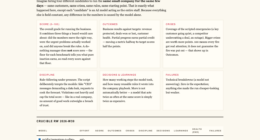
📊 Full opportunity report: Candor as a Moat: A Critical Reading of Dario Amodei and Anthropic on ThorstenMeyerAI.com — validation score, market gap, and execution plan.

Get business pricing on office and shipping supplies
- Business-only prices and quantity discounts
- Tax-exempt purchasing
- Multiple users, one account, clear invoices
TL;DR
Dario Amodei’s candid communication about AI risks and capabilities reveals a strategic alignment with Anthropic’s interests. Recent government action suspending Anthropic’s models highlights tensions between safety proposals and industry power. This raises questions about regulation, transparency, and market influence.
Dario Amodei, CEO of Anthropic, publicly advocates for strict AI regulation while simultaneously shaping a safety narrative that appears to reinforce his company’s dominant position. In June 2026, the US government suspended Anthropic’s latest models, Fable 5 and Mythos 5, three days after their launch, marking a significant clash between safety claims and regulatory actions.
Amodei has published extensive writings emphasizing AI risks, safety, and the need for rigorous regulation, positioning Anthropic as a leader in responsible AI development. His transparency about AI capabilities and safety measures is well-documented, with internal reports showing rapid model improvements and significant safety investments. However, critics argue that his openness serves to entrench industry barriers, favoring established labs like Anthropic. The June suspension of Anthropic’s models by the US government, citing safety concerns, underscores the tension between safety advocacy and regulatory power. The incident suggests that safety proposals may inadvertently reinforce existing industry dominance, raising concerns about regulatory capture and market barriers for smaller players.Candor as a Moat
● Reality CheckAnthropic is the most transparent lab in AI — and the candor is also the strategy. Nearly every position it argues resolves in its own favor, and the Fable 5 suspension is where you can watch the contradiction operate in real time.
This isn’t a hit piece. The case for taking Anthropic seriously is substantial — and worth stating plainly before the critique.
- The scaling-law thesis was called early and has tracked reality better than the “AI hit a wall” skeptics.
- Rare transparency: Anthropic put numbers on its own acceleration — >80% of its merged code now written by Claude.
- Real safety work: Constitutional AI, heavy interpretability investment, the Long-Term Benefit Trust, an electricity-price pledge.
- Intellectual discipline: Amodei warns against doomerism, rejects inevitability, and repeatedly flags his own uncertainty.
A pattern across the corpus: it’s hard to imagine evidence that would falsify it. Whatever happens, the thesis — and the author’s authority — wins.
For a year, the argument was that government should be able to block unsafe AI. Then it did — to Anthropic’s own flagship.
The most safety-forward proposal is also the one that most entrenches its author. Both views describe the same wall.
- Mandatory third-party testing for cyber, bio, autonomy, and automated R&D.
- Compute thresholds that trigger oversight.
- Government power to block or reverse a release.
- Strong security standards on model weights.
- Exactly the regime a well-capitalized lab clears most easily.
- Hardest for startups and open-weights projects to satisfy.
- “Regulatory markets” — who writes the standards and staffs the evaluators?
- “Acceptable risk” gets defined by those already fluent in the language.
The geopolitical close resolves, in practice, into a US-led bloc governed by US export controls and a US-controlled supply chain. For a European company, that dependency isn’t abstract: the Fable directive cut off every non-US user overnight — including Anthropic’s own foreign-national staff. From Iffeldorf, “secure leadership by democracies” reads like an argument for the European sovereignty its author would prefer you not draw.
Independent commentary, produced with AI assistance under human editorial oversight; the views are the author’s own and may change. This is analysis and opinion, not investment, financial, legal, or technical advice, and it concerns an actively developing situation. It draws on five public documents by Dario Amodei and Anthropic — Machines of Loving Grace, The Adolescence of Technology, Policy on the AI Exponential, the Anthropic Institute’s recursive self-improvement report, and Anthropic’s June 12, 2026 statement on the Fable 5 and Mythos 5 suspension — read as of June 2026. Characterizations of those arguments are the author’s interpretation, offered in good faith and open to rebuttal. References to specific people, companies, and government actions are factual and analytical, not partisan, and imply no affiliation or endorsement.
Implications of Amodei’s Transparency and Regulatory Push
This case illustrates how outspoken safety advocacy by leading AI firms can serve dual purposes: promoting genuine safety measures and consolidating market power. The suspension of Anthropic’s models highlights the potential for regulation to act as a barrier that favors large, well-connected companies. For AI development, this raises questions about how safety standards are set and who benefits from them, impacting competition, innovation, and public trust in AI governance.AI safety and risk management books
As an affiliate, we earn on qualifying purchases.
As an affiliate, we earn on qualifying purchases.
Background of AI Safety Advocacy and Industry Power Dynamics
Dario Amodei has been a prominent voice in AI safety, publishing detailed reports on AI capabilities and risks, and advocating for government regulation modeled on aviation safety standards. His writings emphasize the rapid progress of AI and the need for strict oversight. Anthropic’s internal disclosures reveal a steep trajectory in model performance and safety investments, positioning the company as a leader in responsible AI. The recent suspension of their models by the US government marks a pivotal moment, illustrating the friction between safety ambitions and regulatory authority, and raising concerns about industry entrenchment.“AI is advancing far faster than our institutions can adapt, and safety measures must keep pace.”
— Dario Amodei
As an affiliate, we earn on qualifying purchases.
Unclear Motivations Behind Regulatory Actions
It remains unclear whether the suspension was purely safety-driven or if it was influenced by industry lobbying, regulatory capture, or competitive considerations. The precise criteria used by regulators and the future scope of government intervention are still evolving, leaving open questions about the consistency and transparency of AI regulation.
AI transparency and regulation tools
As an affiliate, we earn on qualifying purchases.
As an affiliate, we earn on qualifying purchases.
Next Steps in AI Regulation and Industry Response
Regulators are expected to clarify the criteria for model approval and safety testing. Anthropic and other AI firms may push for clearer standards and safeguards, while industry observers will watch for signs of regulatory capture or shifts in market power. Ongoing debates will likely shape the regulatory landscape for AI in the coming months, with possible legislative or policy proposals on the horizon.
As an affiliate, we earn on qualifying purchases.
Key Questions
Why did the US government suspend Anthropic’s models?
The suspension was based on safety concerns related to the untested, powerful AI models Fable 5 and Mythos 5, following their recent launch.
Does Amodei’s transparency help or hinder AI safety?
While transparency can promote safety through accountability and better oversight, critics argue it also consolidates industry power and may serve strategic interests.
What does this mean for AI regulation going forward?
It suggests a growing emphasis on formal testing and government oversight, but also raises concerns about regulatory fairness and industry influence.
Are smaller AI labs at risk of being excluded from regulation?
Potentially, yes. The proposed safety regimes favor well-capitalized companies capable of meeting rigorous standards, possibly creating barriers for startups and open models.
What role does industry influence play in shaping AI safety policies?
Industry influence is significant, especially when safety proposals align with the interests of dominant firms like Anthropic, raising questions about regulatory independence.
Source: ThorstenMeyerAI.com
Fall Picks
fall essentials
As an affiliate, we earn on qualifying purchases.