📊 Full opportunity report: Mac vs GPU Tower for Local LLMs: The Heat-and-Noise Tradeoff on ThorstenMeyerAI.com — validation score, market gap, and execution plan.

Get business pricing on office and shipping supplies
- Business-only prices and quantity discounts
- Tax-exempt purchasing
- Multiple users, one account, clear invoices
TL;DR
This article compares Mac Silicon and GPU tower setups for running local large language models, focusing on heat, noise, and performance tradeoffs. It highlights how each approach suits different use cases based on model size and operational preferences.
Apple Silicon machines like the Mac Studio offer near-silent operation and low power consumption for local AI inference, contrasting sharply with GPU towers that generate significant heat and noise but deliver higher throughput for models fitting in VRAM.
The core difference lies in architecture: GPU towers prioritize memory bandwidth, enabling faster inference on models that fit within their VRAM, typically 24–32GB per GPU, but at the cost of high power draw and heat production. A typical RTX 5090 consumes around 575W, producing heat that requires active cooling and thermal management. Conversely, Apple Silicon chips like the M3 Ultra leverage a unified memory architecture, offering up to 512GB of shared memory, allowing them to load larger models (70B+ parameters) that cannot fit into GPU VRAM. These Macs operate with minimal heat output and are near-silent during inference, making them ideal for continuous, low-noise environments. The tradeoff is slower inference speeds for models that do not fit in VRAM, which may be acceptable depending on the workload. Experts emphasize that the choice hinges on whether the priority is maximum throughput or operational silence and power efficiency.Mac vs GPU tower
for local LLMs.
What if you sidestep the heat entirely with a different kind of machine? A tower is a high-bandwidth furnace you spend five levers quieting. Apple Silicon is near-silent by design — but asks for different tradeoffs. Match your priority in Part 2.
Put the loud, hot machine where its noise doesn’t matter, and the quiet one where you do. SSH into the tower when you need raw power; let the Mac handle everything else, silently.
Implications for Local AI Deployment
Understanding the heat and noise tradeoffs between Mac Silicon and GPU towers informs users' hardware choices based on their model size, performance needs, and operational environment. For those running large models or seeking quiet, power-efficient setups, Macs offer a compelling alternative to noisy, power-hungry GPU rigs. This decision impacts ongoing operational costs, hardware maintenance, and overall workflow efficiency, especially for continuous or always-on AI applications.Apple Mac Studio M3 Ultra for AI inference
As an affiliate, we earn on qualifying purchases.
As an affiliate, we earn on qualifying purchases.
Key Architectural and Operational Differences
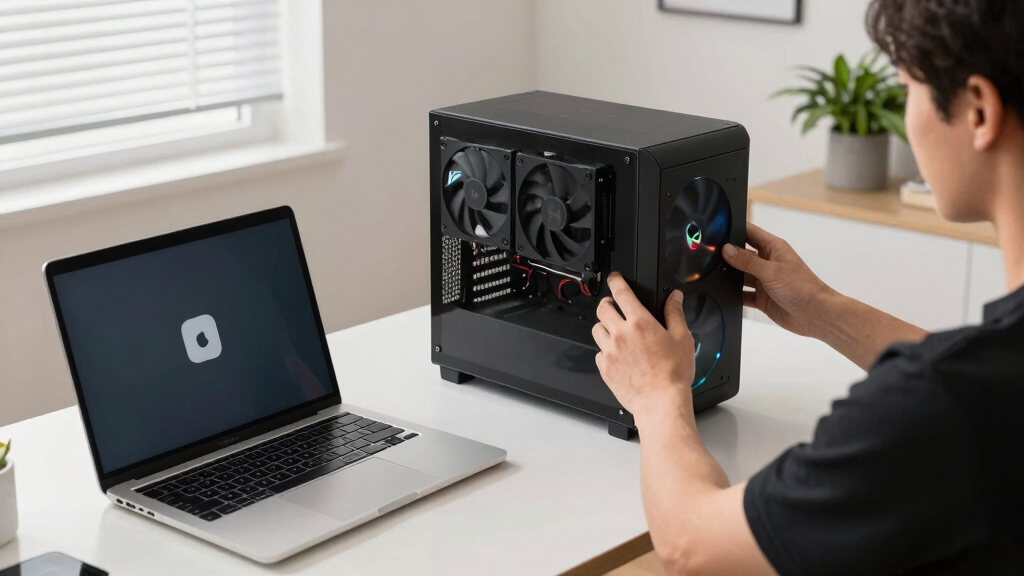
Traditional GPU towers optimize for high memory bandwidth, enabling rapid inference on models that fit within their VRAM limits. For example, an RTX 5090 delivers nearly 1,792 GB/s of bandwidth, enabling 3–4x faster token generation than Mac systems for models within 32GB VRAM. However, they are limited by VRAM capacity and require extensive thermal management due to high power consumption, often exceeding 575W per GPU. Apple Silicon, in contrast, employs a unified memory architecture that allows sharing up to 512GB across CPU, GPU, and Neural Engine. While inference speeds are slower, this setup can run larger models directly on the device, with minimal heat output and noise. The debate centers on whether the workload benefits more from raw speed or operational silence and simplicity."The heat-and-noise dimension that this whole cluster is about happens to be one of the sharpest differences between a GPU tower and a Mac."
— Thorsten Meyer
GPU tower with RTX 5090 for machine learning
As an affiliate, we earn on qualifying purchases.
As an affiliate, we earn on qualifying purchases.
Unresolved Aspects of Performance and Scalability
It remains unclear how future GPU architectures or Apple Silicon updates will shift the balance between performance, heat, and noise. The extent to which multi-GPU scaling can mitigate thermal challenges or whether Apple will enhance shared memory capacity further is still uncertain. Additionally, the evolving software ecosystem, including MLX versus CUDA, influences the practical performance and upgrade options for both platforms.
high-performance local LLM workstation
As an affiliate, we earn on qualifying purchases.
As an affiliate, we earn on qualifying purchases.
Next Steps in Hardware Optimization for Local LLMs
Expect ongoing developments in GPU cooling solutions and Apple Silicon memory architectures. Users should monitor upcoming hardware releases, software improvements, and community insights to determine whether the heat and noise advantages of Macs will expand to larger models or if GPU towers will continue to push throughput limits. Hardware vendors may also introduce hybrid solutions or more efficient cooling technologies that alter current tradeoffs.
As an affiliate, we earn on qualifying purchases.
Key Questions
Can a Mac run the same models as a GPU tower?
Large models exceeding 32GB VRAM, such as 70B+ parameter models, can often run on Macs with up to 512GB of shared memory, which is not possible on most consumer GPU cards.
How much quieter are Macs compared to GPU towers?
Macs like the Mac Studio are near-silent during inference, producing minimal heat and noise, whereas GPU towers generate significant heat, requiring active cooling and fans, which produce noise.
Is the slower inference speed on Macs a major drawback?
It depends on workload requirements. For large models that do not fit in VRAM, Macs offer a practical, quiet solution despite slower speeds. For latency-sensitive applications with models fitting in VRAM, GPU towers provide higher throughput.
Will future hardware updates change this comparison?
Potential improvements in GPU cooling, increased VRAM, and Apple Silicon's shared memory could shift the performance and operational balance, but specifics are still uncertain.
Source: ThorstenMeyerAI.com
Halloween Picks
halloween
As an affiliate, we earn on qualifying purchases.