
📊 Full opportunity report: Acoustic Dampening, Placement, and the “Rig in the Closet” Setup on ThorstenMeyerAI.com — validation score, market gap, and execution plan.
Play games included with Prime
Start a Prime free trial and play with Amazon Luna on your devices.
Start playingAs an affiliate, we earn on qualifying purchases.
TL;DR
Placing AI workstations in separate rooms or closets significantly reduces noise. Proper ventilation is essential for enclosed setups, and acoustic treatment alone is less effective. These methods improve workspace comfort and equipment longevity.
Moving high-power AI workstations into separate rooms or closets is the most effective way to reduce noise, according to recent technical insights. This approach leverages distance and isolation, often eliminating the need for extensive acoustic treatment, and is particularly suited for network-based workflows where the machine and user are not co-located.
Experts emphasize that the most impactful method for noise reduction is relocating the workstation away from the user, such as into another room or closet, and accessing it remotely. This strategy leverages distance and physical separation, which vastly diminishes perceived noise levels.
Placing a rig in a closet or sealed cabinet can be highly effective but requires careful ventilation. Trapped heat can cause thermal throttling, increasing fan noise and defeating the purpose of quiet placement. Proper airflow, either passive or active, is essential to prevent overheating. Purpose-built soundproof cabinets with integrated ventilation are ideal but come at a higher cost.
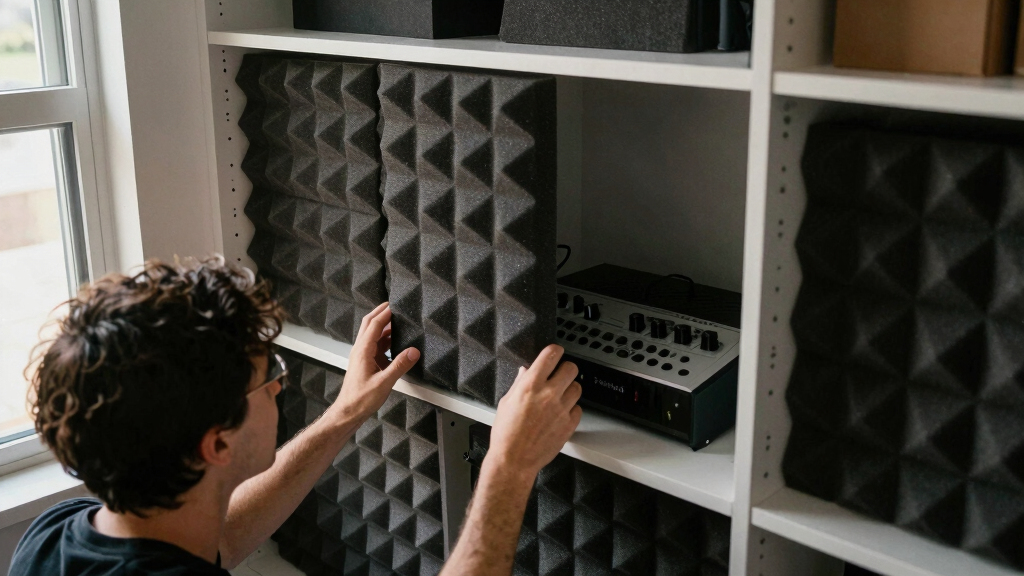
Acoustic dampening materials like foam are less effective for noise mitigation compared to physical separation and soundproof barriers. They primarily absorb reflections within a room but do not block airborne or structure-borne noise, which are the main sources of sound transmission from high-power rigs.
Acoustic dampening
& the rig in the closet.
The most powerful noise fix isn’t a material — it’s a floor plan. A rig you can’t hear because it’s in another room beats any amount of foam. Tap the approaches in Part 1 to see what actually works.
(another room)
(levers 1–4)
(door / barrier)
(acoustic foam)
Contain the noise, not the heat
Why Placement and Ventilation Are Key for Quiet AI Rigs
Effective noise reduction for AI workstations hinges on physical separation and proper airflow management. Moving the rig away from the workspace and ensuring adequate ventilation not only improves comfort but also extends hardware lifespan by preventing overheating. This approach reduces reliance on costly acoustic treatments and aligns with network-based workflows, making it a practical solution for many users.soundproof server cabinet with ventilation
As an affiliate, we earn on qualifying purchases.
As an affiliate, we earn on qualifying purchases.
Current Best Practices for Noise Management in AI Workstations
Traditionally, users have relied on acoustic foam and dampening materials to reduce noise. However, experts highlight that these are last-resort measures compared to the effectiveness of spatial separation. The rise of network-based AI workflows, where the user interacts remotely, further supports placing noisy hardware in separate rooms or enclosures. Proper ventilation remains a critical factor in enclosed setups, as trapped heat can cause performance issues and increased noise from fans."The most effective way to reduce noise is to move the rig into another room or closet. Acoustic foam alone can't solve the problem if heat isn't managed properly."
— Thorsten Meyer, AI workstation expert
As an affiliate, we earn on qualifying purchases.
Uncertainties in Optimal Enclosure Design and Ventilation
It is not yet clear how specific enclosure designs or ventilation configurations compare in effectiveness across different hardware setups. The optimal balance between noise suppression and cooling efficiency remains under study, and individual results may vary based on hardware and room conditions.acoustic dampening foam panels for computers
As an affiliate, we earn on qualifying purchases.
As an affiliate, we earn on qualifying purchases.
Next Steps for Implementing Quiet AI Workstations
Users should evaluate their workspace and consider relocating their rigs to separate rooms or closets, ensuring proper ventilation. Future research and product development are expected to focus on integrated soundproof cabinets with advanced airflow management to optimize both noise reduction and thermal performance.remote-controlled cooling fan for server closet
As an affiliate, we earn on qualifying purchases.
As an affiliate, we earn on qualifying purchases.
Key Questions
Is acoustic foam enough to quiet a high-power AI workstation?
No, acoustic foam primarily absorbs reflections within a room and does not effectively block airborne or structure-borne noise. Physical separation and barriers are far more effective.
Can I put my AI rig in a closet without overheating?
Yes, but only if the closet has proper ventilation, such as passive vents or active exhaust fans, to dissipate heat and prevent thermal throttling.
What are the best ways to ventilate an enclosed workspace?
Using a combination of passive vents and quiet exhaust fans, or purpose-built soundproof cabinets with integrated airflow management, are recommended for effective cooling without noise leakage.
Does moving a rig into another room affect workflow?
For network-based AI workflows, relocating the rig does not hinder productivity, as users interact remotely via SSH or APIs, making physical separation practical and beneficial for noise reduction.
Source: ThorstenMeyerAI.com
NFL season / tailgating Picks
team gear
As an affiliate, we earn on qualifying purchases.