
TL;DR

Get office and shipping supplies delivered free — and shop member deals
- Fast, free delivery on millions of items
- Access to Prime Big Deal Days deals on October 6–7
- Prime Video, Amazon Music and more included
IdeaClyst is a local-first tool that acts as an AI-powered war room for your ideas. It combines structured debate, discovery, and project management to help you turn inspiration into actionable plans—without losing control of your data or ideas.
Ever had a brilliant idea, only to feel the weight of doubt creeping in? Or worse, launched into a project that fizzled because you skipped the tough questions? What if you had a dedicated space — a war room — where your ideas get tested, challenged, and polished before you commit months and thousands of dollars?
That’s what IdeaClyst promises. It’s not just another brainstorming app; it’s a disciplined environment that helps you build conviction, find the best ideas, and turn them into real plans. And it does all this right on your own machine, respecting your privacy and control.
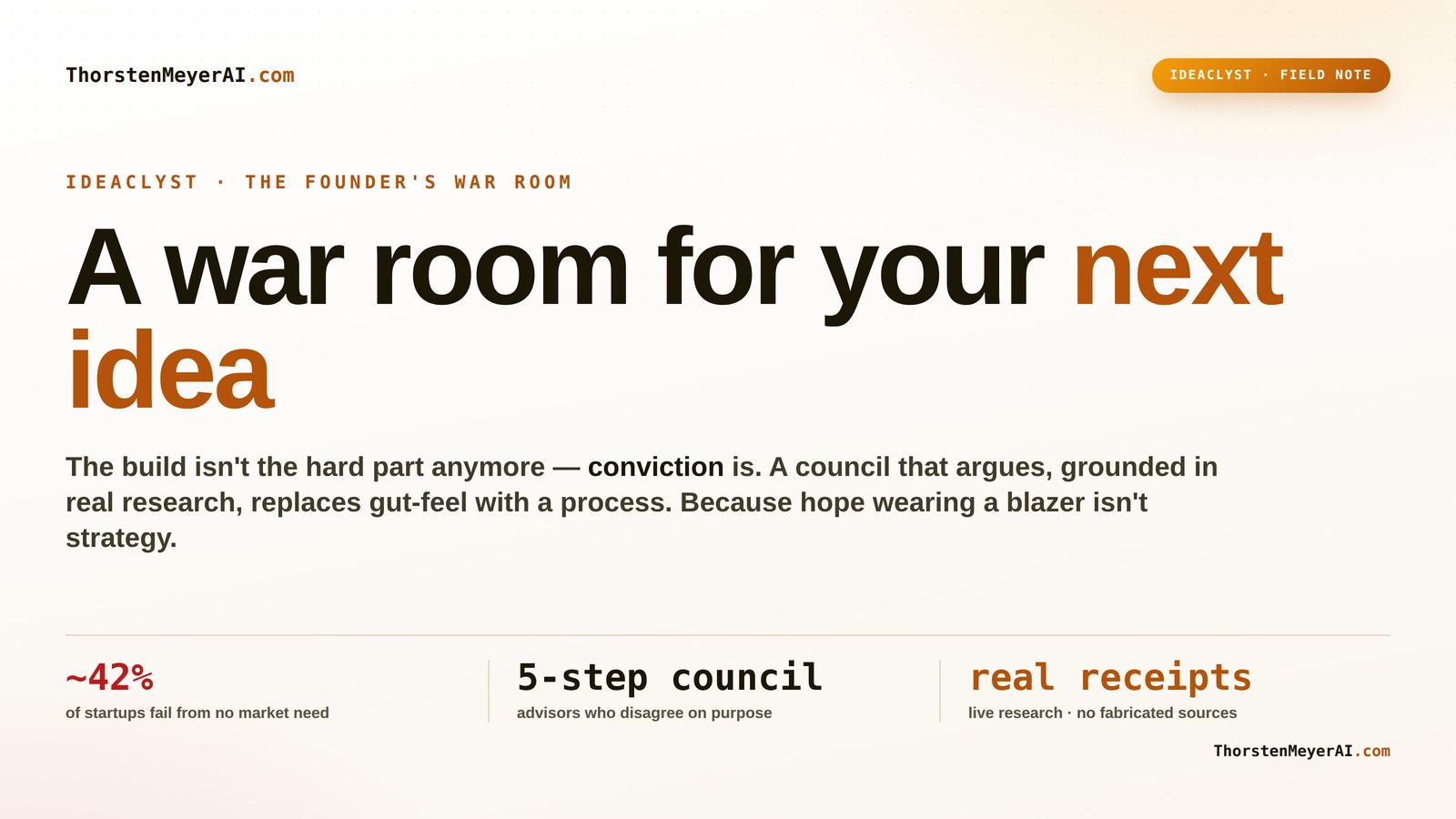
A war room for your next idea
The build isn’t the hard part anymore — conviction is. Knowing which idea deserves the next six months, and being able to defend it. Most founders answer with gut feel and optimistic math. That’s hope wearing a blazer. IdeaClyst replaces it with a process.
The most expensive decision is what to build
The single most valuable thing a tool can do is talk you out of the wrong six months. The numbers make the case better than any pitch.
Three tools in one — on your own machine
Strip away the framing and IdeaClyst is three things at once, all running locally with nothing leaving your laptop.
An AI council
Pressure-tests an idea you bring it — advisors who argue on purpose.
A discovery engine
Finds ideas you didn’t know to look for by hunting real demand signals.
A founder’s workspace
Carries winners from “interesting” all the way to “ready to build.”
Advisors who disagree on purpose
Not one confident, agreeable answer — a structured five-step deliberation where models play different roles and turn on their own work. The disagreement is the feature.
The five-step deliberation
A council that leads with the bad news surfaces the objections you’d otherwise find the expensive way, on month five.
Product strategy
Who’s it for, what’s the wedge, why now, what’s the business model.
Technical architecture
What would it actually take to build — and where’s the risk.
Critique pass
The council turns on its own work. Where’s the hand-waving? What kills this?
Second, independent critique
A different voice, a different angle — so blind spots don’t survive.
Final synthesis
Everything into one coherent founder packet: strategy, architecture, validation, plan.
When IdeaClyst cites a source, it actually fetched it
The hard departure from “ask an AI what it thinks of my startup.” It runs in a strict, real-data-only mode — if it can’t gather genuine evidence, it says so plainly rather than inventing a plausible paragraph.
Confidence with receipts
No fabricated statistics, no imaginary competitors, no made-up citations. The packet survives a skeptical co-founder or a sharp investor because the reasoning has receipts.
Market research first
Scouts the landscape before the council reasons about anything.
Competitor read
Real positioning, pricing signals, feature claims — differentiation vs. reality.
Validation with links
Not “talk to customers” — concrete signals & sources you can click.
From the blank page to build-ready
Evaluation is half the problem; the blank page is the other half. And a plan is worthless if it dies in a tab you never reopen.
Bring a space, not an idea
“AI for accountants,” “tools for indie game studios” — plus your goal and real capacity. It hunts demand signals across HN, Reddit, Product Hunt, GitHub, pricing pages.
- An honest market read — leads with the bad news when a space is hard
- An opportunity map — high pain, thin competition
- Ranked candidates — wedge, who pays, effort, risk, confidence
- each with KILL CRITERIA — when to walk away
A home and a forward path
Every promising idea gets carried forward, with every artifact in plain files on your disk.
- Validation tooling — sprint board, interview list, evidence browser
- Founder profile — a personal-fit lens; same discovery, different advice
- Build workspaces — funnel, personas, landing draft, version history
- “Build this idea” → a PRD + task queue, ready for a coding agent
Key Takeaways
- IdeaClyst acts as a digital war room where ideas are rigorously debated, critiqued, and refined, reducing the risk of costly failure.
- Its structured council stages multiple perspectives, surfacing weak points early in the process, saving time and money.
- Grounding in real-time web research makes validation current, relevant, and trustworthy — a step beyond traditional methods.
- Running locally on your machine means your ideas stay private and under your control, perfect for sensitive projects.
- Following a clear step-by-step process turns fuzzy concepts into solid, actionable plans ready for execution.
As an affiliate, we earn on qualifying purchases.
Why a War Room Makes Your Ideas Smarter
Think of a war room as a battlefield for your ideas. It’s where you gather your best minds, challenge assumptions, and fight off the fog of uncertainty. IdeaClyst creates that space digitally — a place where competing opinions clash, and the best strategies emerge. You can learn more about how digital war rooms are transforming innovation at Cyber Media Creations.
For example, imagine you’re developing a social platform aimed at connecting volunteers with local causes. Instead of relying on gut feeling, you bring your idea into IdeaClyst. The AI council debates its target audience, technical feasibility, and potential impact, revealing blind spots and hidden risks. This process of rigorous scrutiny forces you to confront assumptions early, which can prevent costly mistakes later. It also helps prioritize which ideas are worth pursuing and which need refinement. The discipline of debate and critique ensures that your final plan isn’t just inspired but resilient—built on a thorough understanding of potential pitfalls and opportunities.
As an affiliate, we earn on qualifying purchases.
The Three Pillars of IdeaClyst: AI Council, Discovery, and Your Workspace
IdeaClyst is built around three core components: an AI council, a discovery engine, and your personal workspace. Each plays a vital role in transforming raw inspiration into actionable plans.
The AI council acts as a diverse panel of virtual experts—each with a specific role such as strategist, critic, or synthesizer. They don’t just echo your thoughts; they challenge, dissect, and refine your ideas from multiple angles. This multi-perspective debate is crucial because it uncovers assumptions you might overlook and highlights tradeoffs that are often hidden in initial concepts. It pushes you to consider aspects like feasibility, social impact, and potential unintended consequences, which are essential for robust planning.
The discovery engine finds related ideas, research, and current trends online, grounding your concept in real-world data. This step is critical because it prevents you from working in an echo chamber of assumptions. By integrating up-to-date information, you can identify emerging opportunities or potential threats that might not be apparent from your initial idea alone. It’s about making your plan relevant and competitive in the current landscape. For more insights on leveraging research in innovation, see Artificial Intelligence Max.
Your workspace stores everything as Markdown files on your local machine, ensuring complete ownership and control over your work. This setup allows you to iterate, review, and refine your ideas without dependence on cloud services, which is vital for sensitive projects. The local storage also enables offline work, ensuring productivity even without internet access. Overall, these three components work synergistically—debate refines your ideas, research grounds them in reality, and your workspace preserves your ownership and flexibility.
brainstorming and collaboration app
As an affiliate, we earn on qualifying purchases.
As an affiliate, we earn on qualifying purchases.
How the Council Debates Your Idea — And Why It Matters
Most AI tools echo your thoughts back at you, confirming what you already believe. Not IdeaClyst. Instead, it stages a structured debate among multiple models, each playing a different role. This creates a lively ‘argument’ that surfaces weaknesses you might overlook. To see how AI-driven debate can improve your ideas, visit Geeksalad.
For example, your idea for a community garden app gets challenged on its technical feasibility, market need, and social impact. One side points out logistical hurdles, while another highlights potential funding sources. The process of these layered critiques forces you to confront and address real-world constraints early, rather than after investing significant resources. This debate process is essential because it mimics the natural vetting that happens in a real-world team but with the speed and objectivity of AI. It ensures your idea isn’t just aspirational but also practical and resilient, reducing the risk of failure when you move to implementation.
By systematically dissecting your idea through multiple perspectives, you gain a comprehensive understanding of its strengths and weaknesses. This not only helps in refining the idea but also builds confidence in its viability, making your planning more strategic and less speculative.
privacy-focused idea planning tool
As an affiliate, we earn on qualifying purchases.
As an affiliate, we earn on qualifying purchases.
Grounded in Real Research, Not Just Model Vibes
One of IdeaClyst’s biggest strengths? It’s rooted in live web research. It doesn’t just spit out generic market trends or random stats. Instead, it pulls current data, news, and research directly from the web — making your idea’s foundation solid and up-to-date.
Imagine you’re evaluating a new environmental tech project. Instead of relying on outdated reports or vague assumptions, IdeaClyst scans recent articles, government data, and competitor activity. This approach ensures your strategy is based on the latest developments, giving you a competitive edge and reducing the risk of pursuing ideas that are already obsolete or unviable. The real-time aspect also means you can adapt quickly to new information, which is crucial in fast-changing sectors like tech or social innovation.
Research from All Finance Sites shows that startups that validate with fresh data outperform those that rely on outdated or assumed info. This underscores the importance of grounding your plans in current reality, and IdeaClyst makes this process accessible and straightforward. By integrating live research, it helps you make informed decisions, identify emerging trends, and avoid the trap of relying on stale data that can mislead your planning.
Turning Ideas into Action: From ‘Interesting’ to ‘Ready to Build’
Most brainstorming ends with a list of ‘good ideas,’ but few turn into real projects. IdeaClyst bridges that gap by synthesizing critiques, validation insights, and architectural decisions into a coherent, actionable plan. This step is crucial because it transforms abstract co. Learn more about turning ideas into action at Influenctor.ncepts into concrete steps — the difference between a vague ambition and a tangible project ready for execution.
For example, after a week of debate and research, you might have a detailed plan for a social platform that’s technically feasible, financially sound, and socially impactful. This plan isn’t just a collection of ideas; it’s a structured blueprint you can share with developers or funders. Exported as Markdown or other formats, it serves as a roadmap that guides your next steps, whether that’s coding, pitching, or partnership-building. This final synthesis ensures that your idea is not just promising on paper but also primed for real-world implementation, reducing the risk of scope creep, missed steps, or overlooked dependencies.
This process helps you move from fuzzy inspiration to a well-defined project, with clear milestones and a solid foundation for success.
Why Local-First Matters for Your Privacy and Control
Unlike many AI tools that push your data into the cloud, IdeaClyst runs entirely on your own machine. All your ideas, critiques, and research stay local — safe from leaks, breaches, or data mining.
For example, if you’re working on a sensitive social project or a proprietary tech idea, you don’t have to worry about exposing it online. Everything lives on your hard drive, encrypted and private. This local-first approach not only preserves your confidentiality but also reduces reliance on third-party services, giving you full control over your data. This is especially important for projects that involve sensitive community information, proprietary algorithms, or strategic plans that could be compromised if stored elsewhere. Moreover, working locally means you can operate offline, ensuring continuous productivity even without internet access. This flexibility is essential in environments where connectivity is unreliable or where data sovereignty is a priority.
In essence, the local-first design respects your ownership rights, enhances security, and aligns with best practices for handling sensitive or proprietary information.
How to Use IdeaClyst for Your Next Big Idea — Step by Step
- Bring your raw idea into the system — a sentence, a paragraph, or a broad ambition.
- Let the AI council debate it, surfacing strengths, weaknesses, and risks.
- Use the discovery engine to gather related research, trends, and examples.
- Review critiques from different angles, refining your idea based on real data and expert opinions.
- Synthesize everything into a clear plan, stored as Markdown files on your disk.
- Share or export your plan for team review, pitching, or direct development.
This is the core process that turns fuzzy inspiration into a concrete, defendable project.
Who Should Use IdeaClyst — And Why It Might Be Perfect for You
Are you an entrepreneur, activist, or nonprofit leader with big ideas that need discipline? Or a creative trying to turn a social vision into reality? IdeaClyst suits anyone who values rigorous validation, structured debate, and control over their data.
For example, a social entrepreneur working on a new community project can use it to test assumptions, gather research, and prepare a pitch — all in a private, local environment.
If you’re tired of vague brainstorms and want a tool that helps you make smarter decisions — without the cloud — this could be your new favorite workspace.
Using IdeaClyst to Boost Your Social Impact Projects
For anyone involved in social impact work, structure is everything. IdeaClyst helps you turn lofty ideals into practical steps by grounding your plans in current research and honest critique.
Imagine you’re developing a campaign to improve local literacy rates. The council debates whether the approach is feasible, what partnerships to seek, and how to measure success. The result? A clear, evidence-based plan ready to pitch to funders or volunteers.
This structured approach aligns perfectly with Idealist’s mission of turning good intentions into tangible action, making your impact more measurable and sustainable.
Frequently Asked Questions
Is IdeaClyst a tool or a workshop?
IdeaClyst is a software tool that creates a virtual war room for your ideas. It combines AI-driven debate, research, and your personal workspace to develop and validate ideas systematically.Who should use IdeaClyst?
Entrepreneurs, activists, nonprofit leaders, or any creator who values disciplined validation and control over their data. It’s especially useful for those working on social-impact projects or sensitive innovations.How does IdeaClyst differ from regular brainstorming?
Instead of open-ended ideation, it structures debate among AI models, grounds ideas in current web research, and produces a detailed, defendable plan stored locally. It’s about turning fuzzy ideas into concrete, validated projects.Does it cost anything or require subscriptions?
No, IdeaClyst runs entirely on your own machine, with no cloud account or subscription needed. It’s open source and designed for privacy and control.How does it help with social-impact projects?
It grounds your ideas in current research, surfaces risks early, and helps you develop practical, evidence-based plans that can be shared or implemented directly, aligning with the ideals of community and action.Conclusion
If you’re serious about turning your ideas into real impact, you need a war room — a disciplined space where every angle is examined and every risk challenged. IdeaClyst provides that environment, with the added advantage of total privacy and grounded research. It’s a tool for founders and social innovators ready to move beyond hope and hype into clear, confident action.
Next time you’re torn between options or stuck with a vague concept, remember: a war room can be your secret weapon. Build your conviction, challenge assumptions, and watch your ideas turn into real-world change.
Halloween Picks
halloween
As an affiliate, we earn on qualifying purchases.