📊 Full opportunity report: Modern Industrial Operations Turn To Phone Photos For Gauge Checks on IdeaNavigator AI — validation score, market gap, and execution plan.

Get business pricing on office and shipping supplies
- Business-only prices and quantity discounts
- Tax-exempt purchasing
- Multiple users, one account, clear invoices
TL;DR
Industrial facilities are piloting a new workflow where technicians use phone photos to record gauge readings, replacing traditional clipboard methods. This approach aims to reduce errors and enable trend analysis without expensive sensor retrofits. The pilot is underway at three facilities, with initial results expected soon.
Industrial facilities are beginning to replace traditional clipboard-based gauge readings with a smartphone photo approach, aiming to improve accuracy and data tracking without costly sensor retrofits. This initiative is being tested at three facilities as a potential first step toward modernizing legacy equipment monitoring.
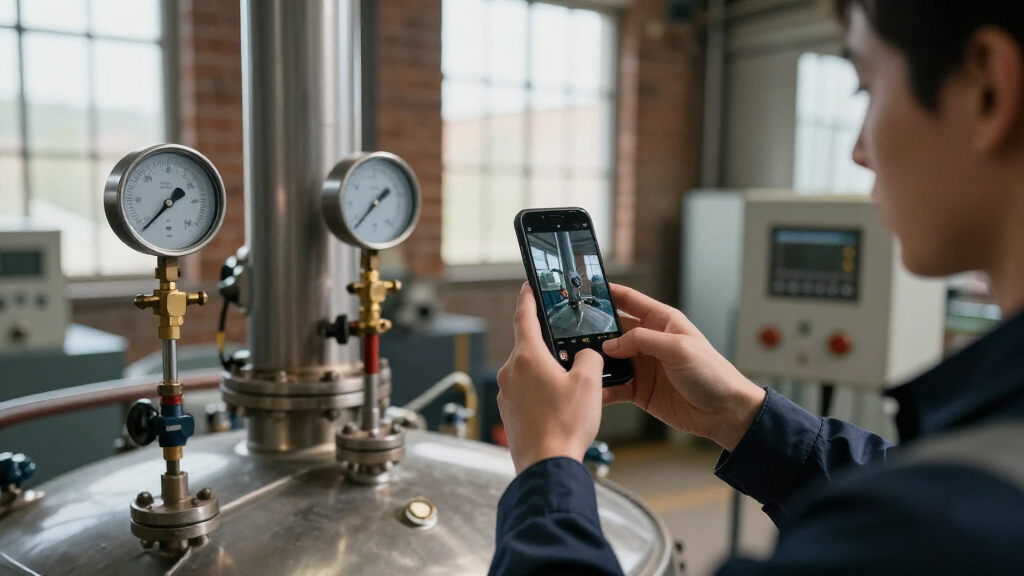
The new workflow involves technicians taking photographs of analog gauges, sight glasses, and counters during their routine rounds. An AI-powered app then automatically reads the gauge values from the photos, checks them against expected ranges, logs the data with timestamps and locations, and flags any anomalies immediately. This process aims to replace manual transcription, which is prone to errors and often results in lost or untrended data.
According to an anonymous researcher involved in the pilot, the approach leverages recent advances in vision models that reliably interpret analog dials from ordinary phone images. The goal is to establish a low-cost, scalable method for capturing accurate gauge data on legacy equipment, which often lacks IoT sensors and cannot be retrofitted easily due to cost or technical constraints.
The pilot program involves running parallel rounds—traditional clipboard recordings versus phone-photo logging—to compare error rates and assess the early detection of anomalies. The initial phase will last about a month, after which data will be analyzed to determine if the new workflow improves accuracy and maintenance responsiveness.
Potential Impact on Industrial Maintenance Efficiency
This development could significantly enhance the accuracy and timeliness of equipment monitoring in industrial operations. By enabling real-time anomaly detection and trend analysis without substantial capital investment, facilities may reduce unplanned outages and maintenance costs. If successful, this approach could become a standard practice for legacy equipment, especially in industries where retrofitting IoT sensors remains prohibitively expensive.
Furthermore, the method offers a scalable, low-cost solution that requires minimal technical change, making it attractive for facilities managing large amounts of legacy infrastructure. The ability to generate accurate, timestamped data from simple phone photos could also improve historical record-keeping and compliance reporting, ultimately supporting more predictive maintenance strategies.
industrial gauge photo reading app
As an affiliate, we earn on qualifying purchases.
As an affiliate, we earn on qualifying purchases.
Legacy Equipment Monitoring Challenges and Recent Tech Advances
Many industrial facilities operate with aging equipment that lacks integrated digital sensors, relying instead on manual gauge readings during routine rounds. These manual methods are susceptible to transcription errors, missed readings, and inconsistent data recording, which can obscure early signs of equipment failure and lead to costly downtime.
Traditional solutions involve retrofitting legacy systems with IoT sensors, but these upgrades often entail high costs and technical complexity. As a result, many plants continue to depend on manual, paper-based methods, which hinder effective data analysis and predictive maintenance.
Recent advances in computer vision and AI have made it possible to interpret analog gauges from standard phone photographs reliably. This technological shift opens the door to low-cost, scalable data collection methods that do not require hardware upgrades, making it an attractive option for facilities seeking to modernize without significant capital expenditure.
smartphone gauge reader for industrial equipment
As an affiliate, we earn on qualifying purchases.
As an affiliate, we earn on qualifying purchases.
Unconfirmed Long-Term Effectiveness and Adoption Pace
It is still unclear how the phone-photo approach will perform over extended periods and across diverse facility types. The pilot will provide initial data, but questions remain about long-term reliability, integration with existing maintenance systems, and user acceptance. Additionally, the scalability of this workflow beyond the pilot sites has yet to be demonstrated, and there may be unforeseen technical or operational challenges.
As an affiliate, we earn on qualifying purchases.
Next Steps for Validation and Broader Implementation
The pilot program will run for approximately one month, after which the data will be analyzed to assess accuracy improvements and anomaly detection effectiveness. If results are positive, facilities may adopt the workflow more broadly, with potential integration into maintenance management systems. Further research and development could focus on refining the app, expanding gauge compatibility, and automating data analysis to support predictive maintenance strategies.
industrial maintenance smartphone tools
As an affiliate, we earn on qualifying purchases.
As an affiliate, we earn on qualifying purchases.
Key Questions
How accurate are phone photos for reading gauges compared to traditional methods?
Initial tests suggest that AI models can interpret analog gauges from phone photos with high accuracy, but comprehensive validation results are not yet available. The pilot aims to compare error rates directly.
Will this method replace all manual gauge readings?
Currently, it is intended as a first-step workflow for legacy equipment. Full replacement depends on pilot success and further validation; some facilities may adopt it gradually.
What are the costs involved in implementing this workflow?
The primary costs are limited to software subscription fees and training for technicians. No hardware upgrades are necessary, making it a low-cost alternative to sensor retrofitting.
Could this system detect all types of gauge failures?
While it can flag anomalies based on deviations from expected ranges, it may not detect all failure modes. Continuous validation and potential system improvements are planned.
When will this approach be available for wider use?
If the pilot demonstrates success, facilities could see broader adoption within the next few months, with commercial offerings possibly available shortly thereafter.
Source: IdeaNavigator AI
Fall Picks
fall essentials
As an affiliate, we earn on qualifying purchases.