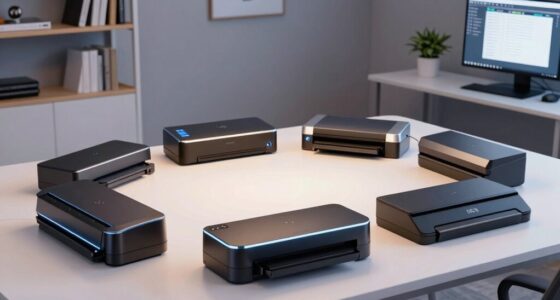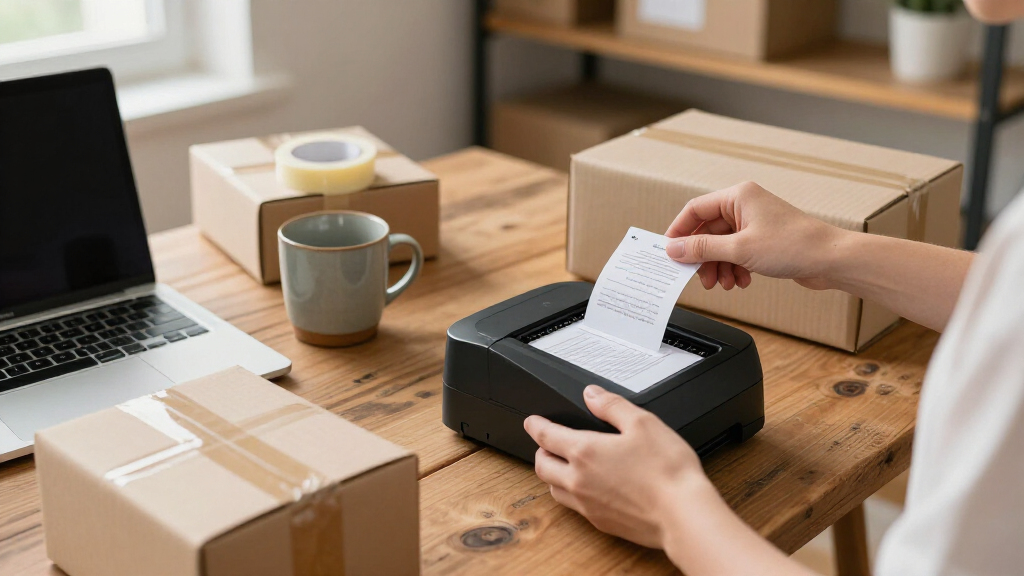

For most ecommerce sellers, I’d start with the Rollo USB Thermal Shipping Label Printer for its straightforward computer connection, then look at the MUNBYN RealWriter 941BP if 300 dpi output or Bluetooth matters more. The Arkscan 2054A is another strong fit for sellers who favor a desktop workflow over phone-based printing. The main tradeoff is between simple, dependable computer printing and the added flexibility of Bluetooth, which can bring more compatibility checks. I also weigh label handling, setup demands, and whether each printer fits a growing shipping routine. Read on for the full comparison and a pick matched to your workflow.

Get business pricing on office and shipping supplies
- Business-only prices and quantity discounts
- Tax-exempt purchasing
- Multiple users, one account, clear invoices
Key Takeaways
- Rollo USB is the clearest computer-first pick in this group; sellers who want phone printing should compare Bluetooth models rather than assume USB and wireless workflows are interchangeable.
- The MUNBYN RealWriter 941BP stands apart with 300 dpi output, a useful distinction for sellers who care about finer print detail, though many standard shipping labels do not need that resolution.
- Bluetooth appears across many entries, but it is not a guarantee of easier setup. Check your device, operating system, and selling platform before choosing a wireless model.
- The D450BT’s built-in label bin gives it a different role from models that rely on separate label storage, making workspace and roll handling part of the choice.
- The roundup favors workflow fit over a feature-count contest: direct USB, wireless flexibility, print resolution, and label storage separate the picks more than the shared 4×6 format.
| Westinghouse 4×6 Thermal Shipping Label Printer |  | Best for Wired, High-Volume Workflows | Printer type: Direct thermal | Resolution: 203 × 203 DPI | Print speed: Up to 6 inches per second | VIEW LATEST PRICE | See Our Full Breakdown |
| Hoorola Bluetooth Thermal Shipping Label Printer, 4 x 6 Inch |  | Best for Multi-Device Compatibility | Printer type: Direct thermal | Resolution: 203 DPI | Maximum stated speed: 72 labels per minute | VIEW LATEST PRICE | See Our Full Breakdown |
| JADENS Bluetooth Thermal Shipping Label Printer, 4×6 |  | Best for Flexible Label Feeding | Resolution: 203 DPI | Label width: 1.57–4.1 inches | Label types: Fanfold and roll labels | VIEW LATEST PRICE | See Our Full Breakdown |
| Arkscan 2054A Direct Thermal Shipping Label Printer |  | Best for USB-Connected Label Design | Printing technology: Direct thermal | Connection: USB | Supported platforms: Windows, Mac, Chromebook, Android | VIEW LATEST PRICE | See Our Full Breakdown |
| Rongta RP425 Bluetooth Thermal Shipping Label Printer |  | Best for Automatic Label Handling | Print method: Direct thermal | Resolution: 203 dpi | Print speed: Up to 150 mm/s | VIEW LATEST PRICE | See Our Full Breakdown |
| Rongta RP420 Bluetooth Thermal Shipping Label Printer |  | Best for Mixed Mobile and Desktop Workflows | Model: RP420 | Connectivity: Bluetooth for mobile devices; USB for computers | Print speed: 150 mm/s | VIEW LATEST PRICE | See Our Full Breakdown |
| NULLTONEX 4×6 Bluetooth Thermal Shipping Label Printer |  | Best Starter Bundle | Printing technology: Direct thermal | Resolution: 203 DPI | Print speed: Up to 150 mm/s | VIEW LATEST PRICE | See Our Full Breakdown |
| MUNBYN RealWriter 941BP Bluetooth Thermal Label Printer, 300 dpi |  | Best for Fine Print and Detailed Labels | Printing technology: Direct thermal | Resolution: 300 DPI | Print speed: Up to 180 mm/s | VIEW LATEST PRICE | See Our Full Breakdown |
| KNAON Bluetooth Thermal Shipping Label Printer, 4 × 6 in, White |  | Best for Broad Computer Compatibility | Connectivity: Bluetooth via FlashLabel Pro; USB | Compatible operating systems: Windows 7 or later, macOS, ChromeOS, Linux | Supported paper width: 1.5–4.2 inches | VIEW LATEST PRICE | See Our Full Breakdown |
| Rollo USB Thermal Shipping Label Printer |  | Best for Straightforward Wired Shipping | Printing technology: Direct thermal | Connectivity: USB | Compatibility: Windows XP and newer; Mac 10.9 and newer | VIEW LATEST PRICE | See Our Full Breakdown |
| Nelko Bluetooth Thermal Shipping Label Printer, 4×6 | 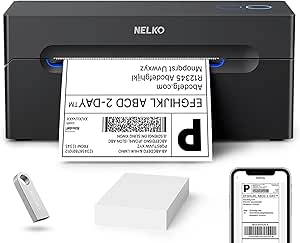 | Best for Mixed-Device Workspaces | Printing technology: Direct thermal | Connectivity: Bluetooth via NELKO app; USB | Compatibility: iOS, Android, Windows 7 or later, Mac OS, Chrome OS | VIEW LATEST PRICE | See Our Full Breakdown |
| D450BT Bluetooth Thermal Shipping Label Printer with Built-In Label Bin |  | Best for Tidy, High-Volume Shipping Setups | Printing technology: Thermal; no ink or toner required | Connectivity: Bluetooth and USB | Compatible operating systems: Android, iOS, Windows, macOS, Linux, ChromeOS | VIEW LATEST PRICE | See Our Full Breakdown |
| TENSPEED RP425A 4×6 Bluetooth Thermal Shipping Label Printer |  | Best Compact Pick | Model: RP425A | Printing technology: Direct thermal | Connectivity: Bluetooth and USB | VIEW LATEST PRICE | See Our Full Breakdown |
| ETIKEZ Bluetooth Thermal Shipping Label Printer, 4 x 6 |  | Best for Marketplace Sellers | Model: PL50E | Printing technology: Thermal | Resolution: 203 dpi | VIEW LATEST PRICE | See Our Full Breakdown |
| thermal label printers for ecommerce | Connectivity | Resolution | Print speed | Printing technology |
|---|---|---|---|---|
| Westinghouse 4×6 Thermal Shipp | USB, Ethernet | 203 × 203 DPI | Up to 6 inches per second | — |
| Hoorola Bluetooth Thermal Ship | Bluetooth, USB | 203 DPI | — | — |
| JADENS Bluetooth Thermal Shipp | Bluetooth, USB | 203 DPI | — | — |
| Arkscan 2054A Direct Thermal S | — | — | — | Direct thermal |
| Rongta RP425 Bluetooth Thermal | Bluetooth, USB-C | 203 dpi | Up to 150 mm/s | — |
| Rongta RP420 Bluetooth Thermal | Bluetooth for mobile devices; USB for computers | 203 DPI | 150 mm/s | Thermal; no ink or toner required |
| NULLTONEX 4×6 Bluetooth Therma | Bluetooth and USB | 203 DPI | Up to 150 mm/s | Direct thermal |
| MUNBYN RealWriter 941BP Blueto | Bluetooth and USB-C | 300 DPI | Up to 180 mm/s | Direct thermal |
| KNAON Bluetooth Thermal Shippi | Bluetooth via FlashLabel Pro; USB | — | Up to 180 mm/s | — |
| Rollo USB Thermal Shipping Lab | USB | 203 × 203 DPI | Up to 150 mm/s | Direct thermal |
| Nelko Bluetooth Thermal Shippi | Bluetooth via NELKO app; USB | — | Up to 72 4×6 labels per minute | Direct thermal |
| D450BT Bluetooth Thermal Shipp | Bluetooth and USB | 203 DPI | Up to 72 labels per minute | Thermal; no ink or toner required |
| TENSPEED RP425A 4×6 Bluetooth | Bluetooth and USB | 203 × 203 dpi | Up to 60 labels per minute (127 mm/s) | Direct thermal |
| ETIKEZ Bluetooth Thermal Shipp | Bluetooth via Labelnize app; USB for computers | 203 dpi | — | Thermal |
More Details on Our Top Picks
Westinghouse 4×6 Thermal Shipping Label Printer
For an ecommerce packing station that stays at a desk, the Westinghouse 4×6 is a practical wired choice: it prints up to 6 inches per second and offers both USB and Ethernet. Ethernet can suit a shared or fixed workstation better than relying on a phone connection, while the included starter labels and setup accessories help get a basic workflow going. Compared with the Hoorola Bluetooth Thermal Shipping Label Printer, it gives up wireless printing but lists Linux support and a wider media range, up to 4.6 inches. Its 203 DPI resolution is suited to ordinary shipping labels, not a reason to choose it for fine graphics. The tradeoff is a tethered setup: Bluetooth is absent, and the Ethernet cable and USB-C cable or adapter are sold separately. I’d rank it for wired throughput, not mobile flexibility.
Pros:- Prints up to 6 inches per second for faster batch runs
- USB and Ethernet give fixed workstations connection options
- Supports Windows, macOS, and Linux
- Includes starter labels, a holder, and setup accessories
Cons:- No Bluetooth connection for phone-based printing
- Ethernet cable and USB-C cable or adapter are sold separately
Best for: Small ecommerce sellers printing batches from a fixed Windows, Mac, or Linux workstation, especially those who want Ethernet as well as USB.
Not ideal for: Sellers who create labels from phones or need a fully wireless packing station; this printer has no Bluetooth.
- Printer type:Direct thermal
- Resolution:203 × 203 DPI
- Print speed:Up to 6 inches per second
- Maximum print width:4.25 inches
- Media width:0.78–4.6 inches
- Connectivity:USB, Ethernet
- Compatible systems:Windows, macOS, Linux
- Dimensions:9.45 × 8.36 × 6.88 inches
Our verdict“Choose the Westinghouse for a wired ecommerce station where speed and Ethernet matter more than wireless convenience.”
Hoorola Bluetooth Thermal Shipping Label Printer, 4 x 6 Inch
The Hoorola Bluetooth Thermal Shipping Label Printer suits sellers who move between a computer and a mobile device: it connects by Bluetooth or USB and lists support for iOS, Android, Windows, macOS, Linux, and Chrome OS. That breadth gives it an advantage over the USB-only Arkscan 2054A for phone-based workflows, while the Arkscan’s included Windows label software may appeal more to sellers designing labels at a computer. Hoorola also supports several common label formats, so it can handle more than standard 4 × 6 shipping labels. Its stated output of up to 72 labels per minute is a headline figure, but real workflows depend on label setup and device connection. The compromise is monochrome output and a required Label Expert app for mobile printing; buyers wanting a direct, app-free phone workflow should look elsewhere.
Pros:- Bluetooth and USB support both mobile and computer workflows
- Lists compatibility across major desktop and mobile operating systems
- Handles several label formats, including 4 × 6 and 4 × 3 inches
- Includes a two-year warranty
Cons:- Mobile printing requires the Label Expert app
- Monochrome printing cannot produce color product or branding labels
Best for: Small online sellers who print from a mix of iOS or Android phones and computers running different operating systems.
Not ideal for: Buyers who want color labels, app-free mobile printing, or a Windows-only label-design package included.
- Printer type:Direct thermal
- Resolution:203 DPI
- Maximum stated speed:72 labels per minute
- Connectivity:Bluetooth, USB
- Compatible systems:iOS, Android, Windows, macOS, Linux, Chrome OS
- Label width:1.54–4.1 inches
- Supported paper sizes:4 × 6, 4 × 3, 4 × 2, 3 × 2 inches
- Warranty:2 years
Our verdict“Pick Hoorola if broad device support and multiple label sizes matter more than app-free phone printing.”
JADENS Bluetooth Thermal Shipping Label Printer, 4×6
The JADENS Bluetooth Thermal Shipping Label Printer earns its place for sellers who alternate between label rolls and fanfold stock. That flexibility can simplify buying and loading supplies, and its USB and Bluetooth connections cover both desktop and wireless setups. Compared with the Westinghouse 4×6, JADENS offers Bluetooth but does not list Ethernet or a print speed; compared with the Hoorola, its stated mobile setup depends on the Jadens Printer app and its warranty is one year rather than two. The printer supports labels from 1.57 to 4.1 inches wide, a useful range for shipping and smaller barcode labels. The key friction is changing formats: label size must be calibrated when switching stock, so frequent changes may slow a busy packing routine. I’d choose it for stock flexibility, not the strongest documented throughput.
Pros:- Accepts both fanfold and roll labels
- Offers Bluetooth and USB connectivity
- Supports labels from 1.57 to 4.1 inches wide
- Includes a one-year warranty and customer support
Cons:- Mobile printing requires the Jadens Printer app
- Label size needs calibration when changing label stock
- One-year warranty is shorter than Hoorola’s listed two-year coverage
Best for: Small ecommerce businesses that use both fanfold and roll labels and want Bluetooth or USB connection options.
Not ideal for: High-volume sellers who frequently change label sizes or need a clearly specified print speed and a longer warranty.
- Resolution:203 DPI
- Label width:1.57–4.1 inches
- Label types:Fanfold and roll labels
- Connectivity:Bluetooth, USB
- Bluetooth compatibility:Windows 8 or later and Mac; mobile devices require the Jadens Printer app
- USB compatibility:Windows 7 or later and Mac OS 10.9 or later
- Warranty:1 year
Our verdict“Choose JADENS for roll-and-fanfold flexibility, provided label changes and app-based mobile printing fit your workflow.”
Arkscan 2054A Direct Thermal Shipping Label Printer
The Arkscan 2054A is the most computer-oriented pick here: it connects by USB, supports Windows, Mac, Chromebook, and Android, and includes BarTender UltraLite for Windows label design. That software gives Windows-based sellers a more defined route to create shipping, product, and barcode labels than the mobile-app approach required by the JADENS and Hoorola. Its 5-inch-per-second speed is a little below the Westinghouse’s stated 6 inches per second, but it still suits routine ecommerce batches. Roll and fanfold support add supply flexibility, while the broad label-length range can serve formats beyond standard parcels. The main tradeoff is its USB-only connection; despite Android support, it does not offer Bluetooth for a wireless phone workflow. The included design software is also Windows-only, limiting its value for Mac users.
Pros:- Includes BarTender UltraLite label-design software for Windows
- Supports roll and fanfold paper
- Prints shipping, product, and barcode labels
- Supports Windows, Mac, Chromebook, and Android
Cons:- USB is the only listed connection
- BarTender UltraLite is available for Windows only
- Its stated 5-inch-per-second speed is below the Westinghouse’s 6 inches per second
Best for: Windows-based sellers who want USB printing, included label-design software, and support for both shipping and barcode labels.
Not ideal for: Phone-first sellers or teams that need Bluetooth, Ethernet, or the included design software on Mac.
- Printing technology:Direct thermal
- Connection:USB
- Supported platforms:Windows, Mac, Chromebook, Android
- Printing speed:Up to 5 inches per second
- Label width:0.75–4.25 inches
- Label length:0.4–90 inches
- Paper types:Roll and fanfold
- Included software:BarTender UltraLite for Windows
Our verdict“Choose the Arkscan if your Windows-based packing station benefits from included label software and does not need wireless printing.”
Rongta RP425 Bluetooth Thermal Shipping Label Printer
The Rongta RP425 is aimed at sellers who want the printer to handle more of the feed setup: it offers automatic label detection and supports media up to 4.37 inches wide. Its listed speed of up to 150 mm/s is comparable to the Westinghouse’s 6 inches per second on paper, while Bluetooth and USB-C give it a more flexible connection mix than the wired-only Arkscan 2054A. Phone printing runs through the Rongta app, and the printer also lists Windows, macOS, and Chrome OS support. There is a data wrinkle buyers should resolve before reserving desk space: the supplied dimensions conflict, with one listing at 10.2 × 7.4 × 5.3 inches and another at 3 × 7 × 2 inches. I’d favor this model for automated feeding and device choice, but not when verified footprint details are a must.
Pros:- Automatic label detection can simplify loading and feeding
- Bluetooth and USB-C support phone and computer connections
- Prints at up to 150 mm/s
- Supports label widths from 0.98 to 4.37 inches
Cons:- Bluetooth printing from phones requires the Rongta app
- Product information gives conflicting dimensions
- 203 dpi monochrome output is limited to black-and-white labels
Best for: Small ecommerce sellers who print from phones or computers and want automatic label detection across common label sizes.
Not ideal for: Buyers who need confirmed physical dimensions before choosing a shelf or packing-station layout, or who want Bluetooth printing without a companion app.
- Print method:Direct thermal
- Resolution:203 dpi
- Print speed:Up to 150 mm/s
- Label width:0.98–4.37 inches
- Maximum media size:4 × 6 inches
- Connectivity:Bluetooth, USB-C
- Compatible systems:Windows 7 or newer, macOS 10.11 or newer, Chrome OS, iOS, Android
- Dimensions:Conflicting listings: 10.2 × 7.4 × 5.3 inches; 3 × 7 × 2 inches
Our verdict“Choose the Rongta RP425 for automatic feed handling and mixed-device printing, but verify its dimensions before planning a tight workspace.”
Rongta RP420 Bluetooth Thermal Shipping Label Printer
The Rongta RP420 suits sellers who switch between preparing orders on a phone and printing from a computer. Bluetooth connects to Android and iOS devices, while USB handles Windows and Mac computers; that split is useful, but laptops cannot print over Bluetooth. Its 150 mm/s speed and 203 DPI resolution match the NULLTONEX for routine 4×6 shipping labels, rather than offering the sharper output of the 300 DPI MUNBYN RealWriter 941BP. The RP420 accepts labels from 1.54 to 4.1 inches wide and uses direct thermal printing, so there is no ink or toner to replace. Setup depends on downloading its app and computer drivers, and there is no Linux or ChromeOS support. I’d rank it for sellers who want phone printing without giving up a conventional wired desktop workflow.
Pros:- Bluetooth printing from Android and iOS devices, plus USB for Windows and Mac computers
- 150 mm/s speed supports brisk batches of shipping labels
- Supports 4×6 labels and widths from 1.54 to 4.1 inches
- Direct thermal printing avoids ink and toner supplies
Cons:- Laptops must connect by USB; Bluetooth is for mobile devices
- No listed support for Linux or ChromeOS
- Requires a dedicated app and computer drivers for setup
Best for: Small ecommerce sellers who create shipping labels on Android or iOS devices but also print from a Windows or Mac computer.
Not ideal for: Sellers who need wireless printing from a laptop, use Linux or ChromeOS, or want a setup that avoids installing an app and drivers.
- Model:RP420
- Connectivity:Bluetooth for mobile devices; USB for computers
- Print speed:150 mm/s
- Resolution:203 DPI
- Label width:1.54–4.1 inches
- Supported systems:Android, iOS, Windows, Mac
- Printing technology:Thermal; no ink or toner required
Our verdict“Choose the RP420 if your shipping workflow moves between a mobile device and a Windows or Mac computer, and wired laptop printing is acceptable.”
NULLTONEX 4×6 Bluetooth Thermal Shipping Label Printer
The NULLTONEX is a practical starting point for a new shipping station because its box includes a USB cable, power cord, and 25 sheets of 4×6 thermal labels. That gives a seller supplies for an initial batch, unlike the KNAON, which includes only 10 test papers. Its 203 DPI resolution and speed of up to 150 mm/s are in line with the Rongta RP420, making it suitable for ordinary monochrome shipping labels rather than especially fine graphics. Bluetooth and USB offer a choice of mobile or computer connections, but wireless printing requires the FlashLabel Pro app. The app’s templates and offline design storage may help with repeat label tasks, though they add an app dependency that the USB-only Rollo avoids. I’d choose this bundle for a modest operation that values a ready-to-start kit over higher resolution.
Pros:- Includes 25 sheets of 4×6 thermal labels, a USB cable, and a power cord
- Bluetooth and USB provide mobile and computer connection options
- Prints at up to 150 mm/s for routine shipping batches
- App templates and offline design storage support repeat label layouts
Cons:- Bluetooth printing requires the FlashLabel Pro app
- 203 DPI monochrome output is less suited to fine detail than the 300 DPI MUNBYN
- Label output is black and white only
Best for: New small-shop sellers who want a few 4×6 labels included and plan to print from a phone app or a USB-connected computer.
Not ideal for: Sellers who need color output, app-free Bluetooth printing, or higher-resolution output for small text and detailed artwork.
- Printing technology:Direct thermal
- Resolution:203 DPI
- Print speed:Up to 150 mm/s
- Connectivity:Bluetooth and USB
- Supported label width:1.57–4.3 inches
- Output:Black and white
- Included labels:25 sheets of 4×6 thermal labels
- Mobile app:FlashLabel Pro
Our verdict“Pick the NULLTONEX as a starter kit if included 4×6 labels and app-based wireless printing matter more than extra resolution.”
MUNBYN RealWriter 941BP Bluetooth Thermal Label Printer, 300 dpi
For sellers who print small text, compact barcodes, or detailed label graphics, the MUNBYN RealWriter 941BP has a clear spec advantage: 300 DPI resolution, compared with the 203 DPI Rongta RP420 and Rollo USB. Its stated 180 mm/s speed is also higher than those models’ 150 mm/s, which can help when shipping batches grow. Bluetooth supports iOS and Android, while USB-C connects to macOS and Windows computers, giving it broader connection flexibility than the wired-only Rollo. The tradeoff is that wireless printing depends on the Munbyn Print app, and the output remains monochrome. At 1.35 kg, it is not the lightest choice here, though its listed footprint is compact. I’d favor it when legibility and finer detail matter more than app-free operation or color.
Pros:- 300 DPI resolution offers finer detail than the 203 DPI Rongta RP420 and Rollo
- Up to 180 mm/s print speed
- Bluetooth for iOS and Android, plus USB-C for macOS and Windows
- Supports label widths from 1.57 to 4.3 inches
Cons:- Bluetooth printing requires the Munbyn Print app
- Monochrome output cannot produce color branding
- At 1.35 kg, it is heavier than a lightweight portable setup may suit
Best for: Online sellers printing small barcodes, compact text, or detailed monochrome labels who want both mobile Bluetooth and computer connectivity.
Not ideal for: Sellers who need color labels, app-independent wireless printing, or a printer dedicated to a simple wired-only workflow.
- Printing technology:Direct thermal
- Resolution:300 DPI
- Print speed:Up to 180 mm/s
- Connectivity:Bluetooth and USB-C
- Label width:1.57–4.3 inches
- Compatible devices:iOS, Android, macOS, Windows
- Output:Monochrome
- Weight:1.35 kg
- Warranty:Lifetime warranty
Our verdict“Choose the MUNBYN if fine monochrome detail and faster listed output are priorities, and you are comfortable printing wirelessly through its app.”
KNAON Bluetooth Thermal Shipping Label Printer, 4 × 6 in, White
The KNAON stands apart for sellers whose computer setup includes more than Windows or Mac: its USB connection supports ChromeOS and Linux as well as Windows and macOS. That makes it a better fit for mixed or less common desktop environments than the Rongta RP420, which lists no support for either system. The printer also offers Bluetooth through FlashLabel Pro and speeds up to 180 mm/s, matching the MUNBYN’s listed speed, though the MUNBYN has the higher 300 DPI resolution. KNAON’s templates, icons, and fonts offer room for custom designs, but shipping labels may need to be saved as PDFs and imported into the app. With just 10 test papers included, it is less ready for a first shipping run than the NULLTONEX bundle.
Pros:- USB compatibility includes Windows, macOS, ChromeOS, and Linux
- Bluetooth printing is available through FlashLabel Pro
- Up to 180 mm/s print speed
- App resources include templates, icons, and fonts for custom designs
Cons:- Bluetooth printing depends on the FlashLabel Pro app
- Shipping labels may need to be saved as PDFs and imported into the app
- Includes 10 test papers rather than a larger supply of 4×6 labels
Best for: Small ecommerce teams using ChromeOS or Linux computers who also want the option to make custom labels through a mobile app.
Not ideal for: Sellers who want to print shipping PDFs directly from a simple workflow, need higher-than-203-DPI detail, or expect a large starter supply of labels.
- Connectivity:Bluetooth via FlashLabel Pro; USB
- Compatible operating systems:Windows 7 or later, macOS, ChromeOS, Linux
- Supported paper width:1.5–4.2 inches
- Print speed:Up to 180 mm/s
- Dimensions:7.17 × 3.9 × 3.43 inches
- Included paper:10 test printing papers
- App resources:3,000+ templates, 5,000+ icons, 100+ fonts
Our verdict“Pick the KNAON if ChromeOS or Linux support is a requirement and you can work with its app-based PDF import process.”
Rollo USB Thermal Shipping Label Printer
The Rollo USB is the simplest match in this group for sellers who print from a Windows or Mac computer and have no need for phone-based wireless printing. Its USB-only connection is less flexible than the Bluetooth-and-USB Rongta RP420 or NULLTONEX, but it also avoids a mobile-app requirement for wireless jobs. At 203 DPI and up to 150 mm/s, its core output specifications are comparable to the RP420; it supports 4×6 shipping labels and media up to 4.1 inches wide. The direct thermal process also handles barcodes and custom stickers without ink or toner. Its main limits are clear: monochrome output, computer-only connectivity, and listed compatibility restricted to Windows and Mac. I’d put it ahead of wireless models only for a fixed, computer-based packing station.
Pros:- USB connection supports a direct computer-based shipping workflow
- Prints 4×6 labels and other labels, barcodes, and custom stickers
- 203 DPI and up to 150 mm/s suit routine ecommerce shipping
- Direct thermal printing requires no ink or toner
Cons:- USB-only connection has less flexibility than Bluetooth-and-USB alternatives
- Monochrome output cannot support color branding
- Listed computer compatibility is limited to Windows and Mac
Best for: Sellers with a dedicated Windows or Mac packing computer who want a straightforward wired printer for shipping labels, barcodes, and stickers.
Not ideal for: Mobile-first sellers, teams that need Bluetooth printing, or users running ChromeOS or Linux.
- Printing technology:Direct thermal
- Connectivity:USB
- Compatibility:Windows XP and newer; Mac 10.9 and newer
- Print speed:Up to 150 mm/s
- Resolution:203 × 203 DPI
- Maximum media width:4.1 inches
- Supported label size:4 × 6 inches
- Weight:2.2 pounds
- Warranty:Limited 1 year
Our verdict“Choose the Rollo USB for a fixed Windows or Mac shipping station if dependable wired printing matters more than mobile connectivity.”
Nelko Bluetooth Thermal Shipping Label Printer, 4×6
The Nelko suits sellers who switch between a phone and a computer: it offers Bluetooth through the NELKO app on iOS and Android, plus USB for Windows, Mac, and Chrome OS. Its 203 DPI direct-thermal printing avoids ink and toner, while support for roll and fanfold labels gives more flexibility in how you load supplies. Compared with the D450BT, Nelko’s listing does not specify a built-in label bin, so it may need more room for labels beside the printer. Its stated rate of up to 72 labels per minute is suited to batch shipping, though actual workflow depends on label setup and device connection. The main compromise is that Mac printing is USB-only, and phone printing depends on the brand’s app.
Pros:- Bluetooth printing from iOS and Android through the NELKO app, with USB computer connections
- Accepts both fanfold and roll thermal labels
- Direct thermal printing needs no ink or toner
- Compact 9 × 5 × 6-inch footprint
Cons:- Bluetooth printing requires the NELKO app
- Mac OS printing is limited to USB according to the listing
Best for: Small ecommerce sellers who print from both iOS or Android phones and a Windows or Chrome OS computer, and want to use roll or fanfold labels.
Not ideal for: Mac-first sellers who want Bluetooth printing from their computer, or anyone who wants a printer with a built-in label compartment.
- Printing technology:Direct thermal
- Connectivity:Bluetooth via NELKO app; USB
- Compatibility:iOS, Android, Windows 7 or later, Mac OS, Chrome OS
- Print resolution:203 × 203 DPI
- Print speed:Up to 72 4×6 labels per minute
- Supported label width:1.54–4.1 inches (40–104 mm)
- Media:Fanfold and roll labels
- Dimensions and weight:9 × 5 × 6 inches; 1.4 kg
Our verdict“Choose the Nelko if you need phone and computer printing plus flexible label loading, but skip it if Mac Bluetooth or a built-in label bin is a priority.”
D450BT Bluetooth Thermal Shipping Label Printer with Built-In Label Bin
The D450BT’s defining advantage is its built-in compartment for up to 250 4×6 labels, which keeps a supply on hand without a separate holder taking up desk space. That makes it a stronger fit for a regular packing station than the Nelko, whose listing supports roll and fanfold media but does not describe internal storage. The D450BT also pairs Bluetooth and USB with broad operating-system support, including Linux, and its automatic alignment is intended to help limit wasted labels. Its 203 DPI resolution and stated speed of up to 72 labels per minute fit ordinary shipping workflows, not color or high-detail output. Buyers should plan around thermal-only media, and the 4.6-inch maximum width may rule out wider specialty labels.
Pros:- Built-in compartment holds up to 250 4×6 labels
- Bluetooth and USB connectivity
- Compatibility includes Android, iOS, Windows, macOS, Linux, and ChromeOS
- Automatic alignment can help reduce misfeeds and label waste
Cons:- Requires thermal labels, which limits media choice
- Maximum supported label width is 4.6 inches
Best for: Online sellers who print shipping labels regularly at a fixed packing station and want a large label supply stored inside the printer.
Not ideal for: Sellers who need non-thermal media, wider-than-4.6-inch labels, or a particularly portable printer for mobile packing.
- Printing technology:Thermal; no ink or toner required
- Connectivity:Bluetooth and USB
- Compatible operating systems:Android, iOS, Windows, macOS, Linux, ChromeOS
- Resolution:203 DPI
- Print speed:Up to 72 labels per minute
- Label capacity:Up to 250 4×6 labels
- Label width:1–4.6 inches
- Dimensions:7.2 × 6.3 × 5.3 inches
Our verdict“Pick the D450BT for a neat, regularly used shipping station with labels stored onboard; choose the Nelko instead if using both roll and fanfold media matters more.”
TENSPEED RP425A 4×6 Bluetooth Thermal Shipping Label Printer
At 1.25 pounds and with a narrow, elongated body, the RP425A is the most portable option in this group by the listed dimensions. It suits sellers who move between work surfaces or have little room to spare, while its 0.98–4.37-inch label-width range covers more than standard 4×6 shipping labels. Automatic label detection and feeding can make loading less fiddly. Compared with the D450BT, however, the RP425A trades a built-in supply compartment for portability, and its stated speed tops out at 60 labels per minute rather than 72. A specific compatibility limit also matters: Intel-based Apple laptops do not support Bluetooth, and multiple paired devices cannot print simultaneously. USB remains an alternative for computer connections.
Pros:- Lightweight 1.25-pound design for easier relocation
- Supports label widths from 0.98 to 4.37 inches
- Bluetooth and USB connections for phones, tablets, and computers
- Automatic label detection and feeding
Cons:- Bluetooth is unsupported on Intel-based Apple laptops
- Connected devices cannot print simultaneously
- Stated maximum speed is lower than the D450BT and Nelko
Best for: Small-shop owners who pack orders in different locations, need a lightweight printer, and may print labels narrower than 4×6 inches.
Not ideal for: Sellers using Intel-based Apple laptops over Bluetooth, or teams that need multiple devices to print at the same time.
- Model:RP425A
- Printing technology:Direct thermal
- Connectivity:Bluetooth and USB
- Compatible devices:iOS and Android phones and tablets; Windows, Mac, and Chrome OS computers
- Label width:0.98–4.37 inches
- Print speed:Up to 60 labels per minute (127 mm/s)
- Resolution:203 × 203 dpi
- Dimensions and weight:3.26 × 2.56 × 7.08 inches; 1.25 lb (500 g)
Our verdict“Choose the RP425A when portability and a broad label-width range beat onboard storage or the faster listed speeds of the D450BT and Nelko.”
ETIKEZ Bluetooth Thermal Shipping Label Printer, 4 x 6
ETIKEZ is a straightforward choice for sellers who want one printer for marketplace shipping and smaller product labels. Its stated compatibility spans Amazon, eBay, Shopify, UPS, FedEx, and USPS, while the 1.57–4.1-inch width range accommodates shipping labels, barcodes, and price tags. Mobile printing uses the Labelnize app on Android and iOS 13 or later; computers connect by USB. That division is less flexible than the Nelko’s broad device support might suggest, since neither model offers computer Bluetooth in the supplied details, but ETIKEZ’s platform list makes its intended ecommerce use clear. The tradeoff is a 203 DPI monochrome thermal workflow and app dependence for phones. The listing provides no print-speed figure, so it is harder to compare for large daily batches.
Pros:- Listed compatibility with Amazon, eBay, Shopify, UPS, FedEx, and USPS
- Supports shipping labels, barcodes, and price tags
- Accepts label widths from 1.57 to 4.1 inches
- Bluetooth mobile printing and USB computer connections
Cons:- Mobile Bluetooth printing requires the Labelnize app
- Computers connect by USB rather than Bluetooth
- The supplied product data does not specify print speed
Best for: Marketplace sellers who ship through major platforms and carriers and also print barcodes or price tags within the stated label-width range.
Not ideal for: Sellers who need computer Bluetooth, want to avoid a dedicated mobile app, or rely on published speed data to plan large print batches.
- Model:PL50E
- Printing technology:Thermal
- Resolution:203 dpi
- Supported label width:1.57–4.1 inches
- Connectivity:Bluetooth via Labelnize app; USB for computers
- Mobile compatibility:Android and iOS 13 or later
- Computer compatibility:Windows, Mac, and Chrome OS
- Compatible platforms:Amazon, eBay, Shopify, UPS, FedEx, and USPS
Our verdict“Choose ETIKEZ if broad marketplace and carrier compatibility matters more than computer Bluetooth or a clearly stated batch-printing speed.”
How We Picked
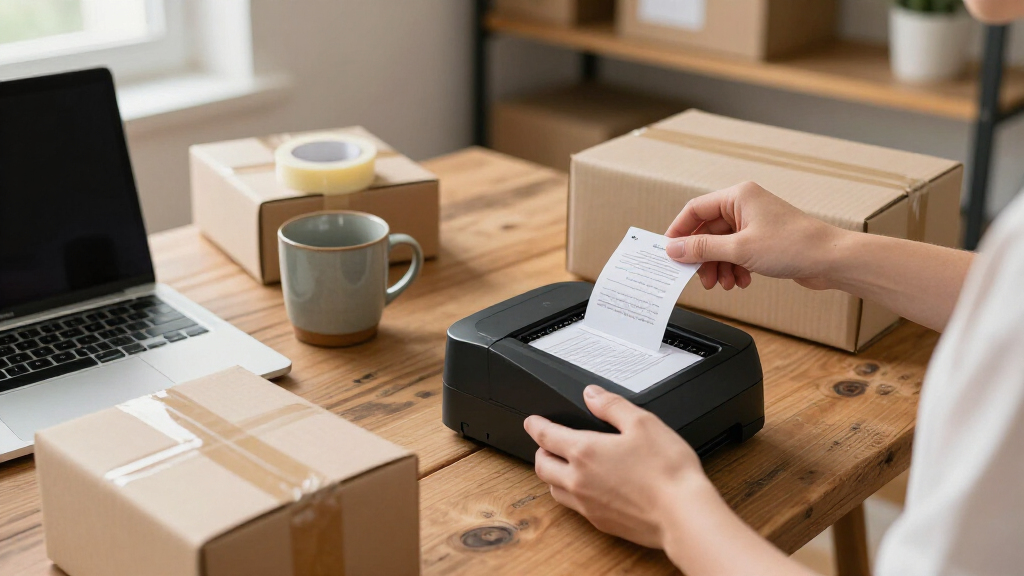
I compared these printers through the needs of ecommerce shipping desks: whether a model supports a practical computer or mobile workflow, how clearly its connection method is presented, what its stated resolution and label handling can offer, and how much setup or workspace the design may require. I also looked for features that could change day-to-day use, such as Bluetooth, USB connectivity, and the D450BT’s built-in label bin. A 4×6 label format is common across this lineup, so I treated that shared capability as a baseline rather than a reason by itself to rank one model above another.
The order gives priority to a clear, useful fit for a broad range of sellers, then recognizes models with a distinct advantage for a narrower workflow. That puts the Rollo USB first for a simple computer-connected shipping setup, while the MUNBYN 941BP earns attention for its 300 dpi specification and wireless capability. Bluetooth-only options remain relevant, but their usefulness depends on device and platform compatibility; I would verify those details before buying. Where the supplied product information does not establish a meaningful advantage, I avoid treating similar feature lists as proof of better performance.
| thermal label printers for ecommerce | Printing technology |
|---|---|
| Westinghouse 4×6 Thermal Shipp | — |
| Hoorola Bluetooth Thermal Ship | — |
| JADENS Bluetooth Thermal Shipp | — |
| Arkscan 2054A Direct Thermal S | Direct thermal |
| Rongta RP425 Bluetooth Thermal | — |
| Rongta RP420 Bluetooth Thermal | Thermal; no ink or toner required |
| NULLTONEX 4×6 Bluetooth Therma | Direct thermal |
| MUNBYN RealWriter 941BP Blueto | Direct thermal |
| KNAON Bluetooth Thermal Shippi | — |
| Rollo USB Thermal Shipping Lab | Direct thermal |
| Nelko Bluetooth Thermal Shippi | Direct thermal |
| D450BT Bluetooth Thermal Shipp | Thermal; no ink or toner required |
| TENSPEED RP425A 4×6 Bluetooth | Direct thermal |
| ETIKEZ Bluetooth Thermal Shipp | Thermal |
Factors to Consider When Choosing Thermal Label Printers For Ecommerce
Choosing a printer is less about the longest feature list and more about fitting it into the way orders are already packed. These decisions can prevent common setup frustrations and help you avoid paying for a capability your labels do not need.
Match the connection to the device that prints orders
Start by identifying whether labels are generated from a desktop computer, a laptop, or a phone or tablet. A USB model can keep a computer-based station simple, while Bluetooth is useful only if the printer, device, operating system, and shipping platform work together. Do not treat the word “Bluetooth” as proof of universal mobile support. Check the manufacturer’s compatibility list and the instructions for your ecommerce platform before ordering. If more than one person prints labels, ask whether each person can connect easily or whether the setup centers on one host device. A little compatibility checking can matter more than an extra feature on the printer.
Choose resolution for the labels you actually print
For everyday carrier labels, prioritize clear, scannable barcodes and dependable output over resolution numbers alone. A 300 dpi model such as the MUNBYN 941BP may suit sellers who also print smaller text or graphics, but it is not automatically the better choice for basic 4×6 shipping labels. Review sample output at the label size you plan to use, especially if your packages rely on small text or dense marks. Print quality also depends on suitable labels and correct printer settings. Avoid paying for finer detail unless your packaging or product-label work gives that detail a job to do.
Check label loading and workspace before choosing a footprint
Look beyond the printer’s outer dimensions and decide where the labels will sit while printing. Some setups may need room for a label roll or an external holder, while the D450BT’s built-in bin changes how label storage can fit into the station. A compact desk can make integrated storage appealing, but it does not automatically make the whole setup smaller if cables or a computer also need space. Check whether your preferred label stock is fanfold or roll-fed and confirm the printer supports that format. Sellers who pack in batches should pay attention to how often labels need reloading, not just how much counter space the printer occupies.
Plan for order volume and packing rhythm
A new seller printing a handful of orders can often favor straightforward setup over features aimed at a busy station. As order volume grows, frequent loading, device switching, and interruptions become more noticeable. Think through who creates labels, who packs parcels, and whether printing happens one order at a time or in batches. A wireless connection may help a flexible workspace, while a dedicated USB station may suit a fixed packing bench. Do not assume a printer’s advertised use alone tells you how it will handle your daily routine; compare its documented workflow and support information with your likely workload.
Verify platform support before committing to wireless
Marketplace and carrier label tools can shape printer choice as much as hardware does. Check whether the printer works with the software you use to buy and print labels, and whether that support applies to your computer or mobile device. Confirm how the software handles label size, orientation, and scaling, since a mismatch can waste stock even when the printer connects. When a seller offers setup documentation or compatible driver details, review those before purchase rather than after a printer arrives. If you rely on several platforms, favor a model with clearly documented support for your full mix of tools.
Balance feature value against maintenance and consumables
Direct thermal printers avoid ink or toner, but labels remain a recurring supply and must match the printer’s supported format. Check how labels are loaded, what cleaning or maintenance the manufacturer recommends, and where replacement supplies are available. A low-complexity setup may be more valuable than extra connectivity if it reduces interruptions at a small shipping desk. On the other hand, integrated storage or finer print output can earn their place when they solve a recurring problem. Compare the ongoing routine—not just the printer’s feature list—before deciding which extras are worth having.
Frequently Asked Questions
Should I choose USB or Bluetooth for an ecommerce shipping label printer?
Choose USB if labels are usually printed from one computer at a fixed packing station and you want a direct connection. Bluetooth is a better match when printing from a compatible phone, tablet, or laptop would make the workflow easier. Before choosing wireless, confirm support for your exact device and label-printing software; Bluetooth availability alone does not confirm that every app can send labels to the printer. If several people share the station, factor in connection and switching steps. The Rollo USB and Bluetooth models in this roundup serve different workflows rather than one being a universal upgrade over the other.
Do I need a 300 dpi printer for standard 4×6 shipping labels?
Most sellers printing ordinary 4×6 carrier labels should focus first on legible text and scannable barcodes, not on chasing a higher resolution specification. The MUNBYN RealWriter 941BP is the standout here for its stated 300 dpi output, which may help when labels include finer detail. That advantage matters more for small text, compact product labels, or graphics than for a basic shipping label. Check whether your actual label templates benefit from that added detail. If they do not, connection fit and label handling may matter more to your day-to-day work.
Can I print marketplace shipping labels from my phone with any Bluetooth model?
No. A Bluetooth connection does not guarantee that a printer supports every phone, operating system, marketplace app, or shipping service. Check the specific printer’s compatibility information alongside the platform’s instructions for printing from mobile. Also confirm the app can output the correct label size without scaling or cropping. If mobile printing is central to your business, prioritize documented phone support rather than choosing from the connection type alone. When support details are unclear, a computer-based workflow may be the safer route.
What should I check before buying labels for a thermal printer?
Confirm that the labels use direct thermal stock and match the printer’s supported dimensions and feed style. A 4×6 label may come on a roll or in fanfold stacks, and the way it feeds can affect whether you need a holder or extra space behind the printer. Check the product’s instructions for supported stock and loading orientation instead of assuming every 4×6 label works the same way. Label adhesive and surface can also affect how well labels stay on your packages. Testing a small supply before stocking up can reduce waste if a particular stock behaves poorly in your workflow.
When is it worth choosing a printer with a built-in label bin?
A built-in bin is useful when you want label storage incorporated into the printer and have a workspace where that arrangement fits. The D450BT is the specific option in this roundup with that feature, so it may suit sellers who prefer an integrated setup. It is not automatically the best choice for every desk: check the unit’s full footprint and the label formats it accepts. If you already use a separate holder or fanfold labels, the bin may not simplify your routine. Decide based on how you store and feed labels now, rather than treating integrated storage as a performance upgrade.
Conclusion
For a broad, computer-based ecommerce workflow, I’d choose the Rollo USB as my best overall pick. The best premium-style feature pick is the MUNBYN RealWriter 941BP for sellers who can use its 300 dpi output and Bluetooth support; those features do not make it necessary for every shipping desk. For a best value approach, compare straightforward 4×6 models such as the Arkscan 2054A and choose based on confirmed platform support and the connection you need, rather than paying for extras you will not use. A beginner should favor the simplest documented setup for their device, with USB usually the easier match for a fixed computer station. If workspace organization is the specific need, consider the D450BT and its built-in label bin; if mobile printing matters most, pick a Bluetooth model only after verifying compatibility with your device and seller tools.
Fall Picks
fall essentials
As an affiliate, we earn on qualifying purchases.