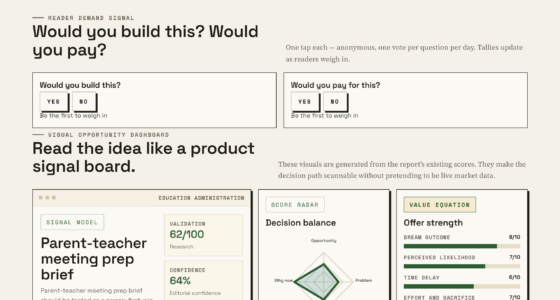
📊 Full opportunity report: Turn Tax Practice Into A Starting Point For Enrolled-Agent Exam Study on IdeaNavigator AI — validation score, market gap, and execution plan.

Get business pricing on office and shipping supplies
- Business-only prices and quantity discounts
- Tax-exempt purchasing
- Multiple users, one account, clear invoices
TL;DR

IdeaNavigator AI has outlined a proposed exam-prep tool that would turn a tax preparer’s real client question into a plain-language answer with a publication reference and a related practice question for the IRS Special Enrollment Examination. The concept remains unvalidated: its suggested next step is a two-week trial with 10 working candidates to test whether the questions feel exam-accurate enough to pay for.
IdeaNavigator AI has proposed a study tool that would turn working tax preparers’ real client questions into both a cited tax explanation and a related practice question for the IRS Special Enrollment Examination (SEE). The concept targets aspiring Enrolled Agents who prepare returns during the day and study outside work, but it has not been reported as a launched or tested product.
The proposed workflow starts when a user enters a tax question encountered in client work. The app would return a plain-language explanation and cite a relevant IRS publication, then generate one multiple-choice question on the same topic in a style intended to resemble the SEE. The practice question could be saved for later study, connecting an immediate work problem with exam preparation.
The idea addresses a specific routine: preparers may research tax questions in one tool and use separate materials for structured exam study. In the proposal, that separation means the research done for real work does not automatically become study material. The proposed product aims to bridge that gap with a single workflow rather than replace the full exam-prep process.
The suggested business model is a monthly subscription for individual candidates, with a discount covering a full study season. No price, product name, launch date, or subscription terms are provided. The concept also does not specify how its answers would be checked, how citations would be displayed, or what safeguards would apply when a question involves a client’s confidential information.
Exam Prep Concept · Enrolled Agent SEE
Turn Tax Practice Into a Starting Point for Exam Study
IdeaNavigator AI has proposed a tool that turns a working preparer’s client question into a plain-language tax explanation with an IRS publication reference—and a related practice question for the Special Enrollment Examination.
Proposal · Not validated01 / Proposed workflow
From client research to recall practice
The idea connects a real work question to exam study in one flow. It aims to supplement the broader preparation process, not replace it.
Start at work
Enter a tax question
A preparer submits an issue encountered while working on a client return.
Explain
Get a plain-language answer
The proposed app responds with an explanation and a relevant IRS publication reference.
Practice
Generate a related question
A multiple-choice item is intended to resemble the SEE and test the same topic.
Save for later
Build a study prompt
The practice item could be saved, linking daily research with later review.
02 / The learning opportunity
Bridge a split study routine
The proposal addresses a specific gap: work research may resolve a tax issue, but it does not automatically become structured exam practice.
Potential value
Relevant by design
Turning a question already encountered on the job into a recall prompt could connect tax work with exam topics.
What matters
Accuracy over convenience
A wrong explanation or weak citation could affect both learning and work decisions. Topic relevance alone does not prove exam quality.
Still unknown
Time and outcomes
No evidence shows that users would save time, improve results, or prefer this approach to existing study resources.
03 / Evidence check
Promising workflow, open questions
The SEE is the IRS examination associated with becoming an Enrolled Agent. The concept does not report exam changes, IRS endorsement, or product validation.
Reported test results
No accuracy findings, candidate feedback, product comparisons, or evidence of improved exam performance are provided.
How would tax explanations and publication references be verified?
Would items match SEE scope, difficulty, and question style?
How would client details be removed, stored, and protected?
Would candidates pay monthly or for a discounted study season?
04 / Suggested validation
Put the questions to a small trial
The proposed next step is a two-week trial with 10 working EA candidates using real client questions. The test would assess whether the generated practice items feel exam-accurate enough to justify a paid subscription. Recruitment and testing are not reported as having begun.
What a useful readout should separate
Quick answers
What is known so far?
The development remains a proposal. Core product, safety, and pricing details are still unspecified.
Has the app launched?
No launch is reported. The concept describes a proposed tool and suggested trial.
How would it work?
A tax question would prompt a cited explanation and a related multiple-choice SEE practice item.
Are the questions exam-accurate?
Unknown. No accuracy results are provided; assessing perceived exam fit is the proposed validation goal.
What would it cost?
No price is stated. The suggested model is a monthly individual subscription, with a full-season discount.
The proposed path from work to study
Turning Work Research Into Study
If it works as intended, the tool could make exam practice more relevant to candidates who already encounter tax issues on the job. A question researched for a return could also create a prompt for later recall, giving candidates a way to connect day-to-day tax work with exam topics without manually rebuilding the issue as a study exercise.
The practical value depends on accuracy, not just convenience. A wrong explanation or misleading citation could affect work decisions as well as learning, while a practice question that does not resemble the exam may offer little preparation value. The proposal therefore centers on whether users judge the generated questions to be exam-accurate enough to pay for, not simply whether the app can produce them.
For working candidates, the suggested subscription would add another cost to an already ongoing preparation process. The idea does not establish that users would save time, improve exam results, or prefer this approach to existing study materials. Those outcomes would need to be measured through testing.
Products Worth Considering
Apple iMac 2024 All-in-One Desktop with M4 Chip, 24‑inch Retina Display, 16GB Unified Memory, 256GB SSD, Silver

HP Sprocket Panorama Portable Color Photo and Label Printer

HP Sprocket Photo Booth Machine Instant Color Photo Printer with 10.1 Touchscreen, LED Ring Light, 250+ Frames, 3×4 ZINK Paper, QR Code Shar
As an affiliate, we earn on qualifying purchases.
The SEE and the Study Gap
The SEE is the IRS examination associated with becoming an Enrolled Agent, and the proposal describes it as a stable, three-part test. It is aimed at people preparing for that credential while also working in tax preparation. No exam changes, new IRS policy, or formal endorsement of the proposed tool are identified.
The pitch frames the opportunity as a gap between client research and structured exam study. In a conventional split workflow, a preparer might resolve a question for a return, then later study from a separate question bank or course. The proposed app would use the original question as the starting point for a related practice item, while retaining a reference to an IRS publication for the explanation.
That approach is an idea for a product, not evidence that artificial intelligence can reliably answer every tax question or reproduce the SEE’s format. The proposal supplies no accuracy results, user feedback, comparisons with existing exam-prep products, or information about whether the IRS has reviewed the generated questions.
Accuracy, Privacy and Demand
No product launch or test results are reported. It is not clear who would develop or operate the tool, when it might become available, or whether the suggested two-week trial has begun. The proposal also gives no evidence that candidates have agreed to pay for it.
Other key details remain open: how the app would verify tax explanations and publication references; how it would handle issues that depend on facts not included in a short prompt; and how candidate or client information would be stored and protected. The concept does not describe whether users would be told to remove identifying client details before entering questions.
It is also not clear how closely the generated questions would match the SEE’s difficulty, scope, or question style. A relevant tax topic alone would not establish that a question is a useful exam simulation. Until a test assesses those points, the proposed learning and business benefits remain unconfirmed.
A Ten-Candidate Trial
The proposed next step is to recruit 10 working Enrolled Agent candidates and have them use the app with real client questions for two weeks. The evaluation would ask whether the resulting practice questions seem accurate enough to support a paid subscription. The proposal does not say that recruitment or testing has taken place.
A useful report of that test would need to distinguish user satisfaction from factual accuracy, and explain how questions and answers were checked. It could also clarify whether candidates would use the tool alongside existing study resources and whether the suggested individual subscription or full-season discount fits their needs.
Until those results or a product announcement are available, the development remains a proposed exam-prep workflow. There is no confirmed release schedule, pricing, or evidence of improved exam performance.
Source: IdeaNavigator AI
Key Questions
Has the Enrolled Agent exam-prep app launched?
No launch is reported. The concept describes a proposed tool and a suggested trial, not an available product.
How would the proposed tool work?
A user would enter a tax question from client work. The app would provide a plain-language explanation with a relevant IRS publication reference and generate a related multiple-choice practice question for later study.
Has the app been shown to produce exam-accurate questions?
No accuracy findings are provided. Testing whether candidates consider the generated questions sufficiently similar to the SEE is the proposed validation goal.
What testing is proposed?
The recommendation is to recruit 10 working EA candidates to use the tool for two weeks and assess whether the practice questions feel accurate enough to justify paying for it. The proposal does not say that this test has happened.
What would it cost?
No price is stated. The suggested model is a monthly subscription for individual exam candidates, with a discount for a full study season.
Source: IdeaNavigator AI